“know something is true because of seeing it” in Teutila Cuicatec (source for this and above: Viola Waterhouse in Notes on Translation August 1966, p. 86ff.)
“ones who will confirm that these-things that you have seen are true” in Kankanaey (source: Kankanaey Back Translation)
“ones who are to testify about these things, because it all happened before your eyes” in Tagbanwa (source: Tagbanwa Back Translation)
Image taken from the Wiedmann Bible. For more information about the images and ways to adopt them, see here . For other images of Willy Wiedmann paintings in TIPs, see here.
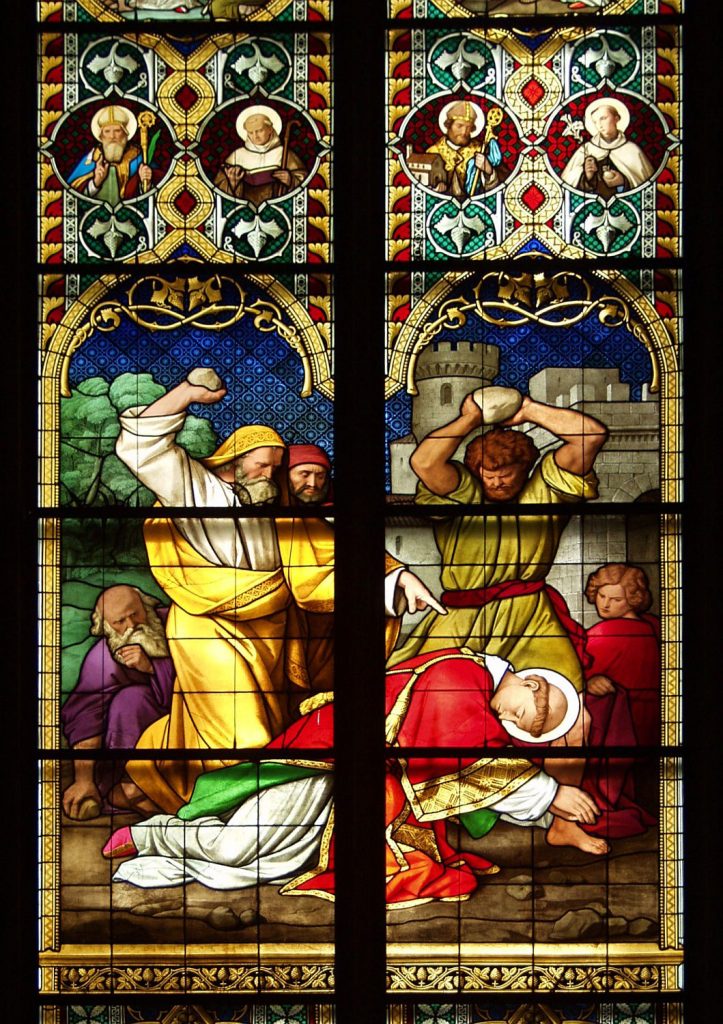
The following is a 19th century stained glass window from the Kölner Dom in Cologne, Germany:
Stained glass is not just highly decorative, it’s a medium which has been used to express important religious messages for centuries. Literacy was not widespread in the medieval and Renaissance periods and the Church used stained glass and other artworks to teach the central beliefs of Christianity. In Gothic churches, the windows were filled with extensive narrative scenes in stained glass — like huge and colorful picture storybooks — in which worshipers could ‘read’ the stories of Christ and the saints and learn what was required for their religious salvation. (Source: Victoria and Albert Museum )
Following are a number of back-translations of Acts 7:58:
Uma: “and they pulled him outside the town in order to kill him throwing stones at him. The lying witnesses who falsely-accused Stefanus took-off their shirts so they could throw well. Their shirts they gave to a man named Saulus so that he could look after them for them.” (Source: Uma Back Translation)
Yakan: “They dragged him outside that city Awrusalam. Then when they were outside there, they began to throw stones at Estepan. The witnesses, meaning the ones throwing stones at him, they took off their shirts and laid them at the feet of a young man named Saul.” (Source: Yakan Back Translation)
Western Bukidnon Manobo: “And they took him outside of the town, and they threw stones at him. And those who had accused him, they laid their shirts there near a person who was named Saul.” (Source: Western Bukidnon Manobo Back Translation)
Kankanaey: “while-simultaneously they dragged-him to take-him to the edge of the town in order to stone-him. The witnesses who had accused him, they placed their outer clothes by a man who was Saulo so that they would be able to join-in-stoning.” (Source: Kankanaey Back Translation)
Tagbanwa: “They dragged him outside the city and then rocks were thrown at him until they had killed him. Those who had testified against Esteban, who were killing him, had removed their outer clothes because they were long-and-impeding. They put them in front of a person called Saulo.” (Source: Tagbanwa Back Translation)
It is difficult to determine whether Luke intends for his readers to understand the stoning of Stephen to be the result of legal action on the part of the Jewish Council or whether it is to be taken as mob violence. The method of stoning is altogether different from the description of execution by stoning as described in the Mishnah, the Jewish source which tells how the Jews carried out this action. For this reason many understand the stoning here to be that of mob action rather than as a carrying out of the legal decision of the court. In cases demanding the capital offense, the Jewish court required the testimony of two witnesses. If a man were convicted, it was the duty of one of these witnesses to push him headfirst off a precipice and then roll a stone over him. If this did not kill him, then the second witness rolled another stone on him which was supposed to crush his chest. In the Mishnah there is nothing said of the witnesses taking off their outer garments, though the Mishnah does state if the criminal is a man then he must be unclothed before he is put to death. From reading Luke’s account one is of the opinion that Stephen was put to death by people throwing stones at him, and that the persons who threw the stone removed their outer garments so they would have better freedom in throwing the stones.
Though the Greek term literally means “threw out,” the action of the mob would suggest more “drive out forcibly.” There seems to be no suggestion that Stephen was literally thrown from a wall or over any cliff.
Stoned him is simply equivalent to “threw stones at him” or “killed him by means of throwing stones at him.” Is this particular verse, however, the rendering may need to be “were killing him” since they continued the process for some time, as noted in verse 59.
Quoted with permission from Newman, Barclay M. and Nida, Eugene A. A Handbook on The Acts of the Apostles. (UBS Handbook Series). New York: UBS, 1972. For this and other handbooks for translators see here .




Leave a Reply
You must be logged in to post a comment.