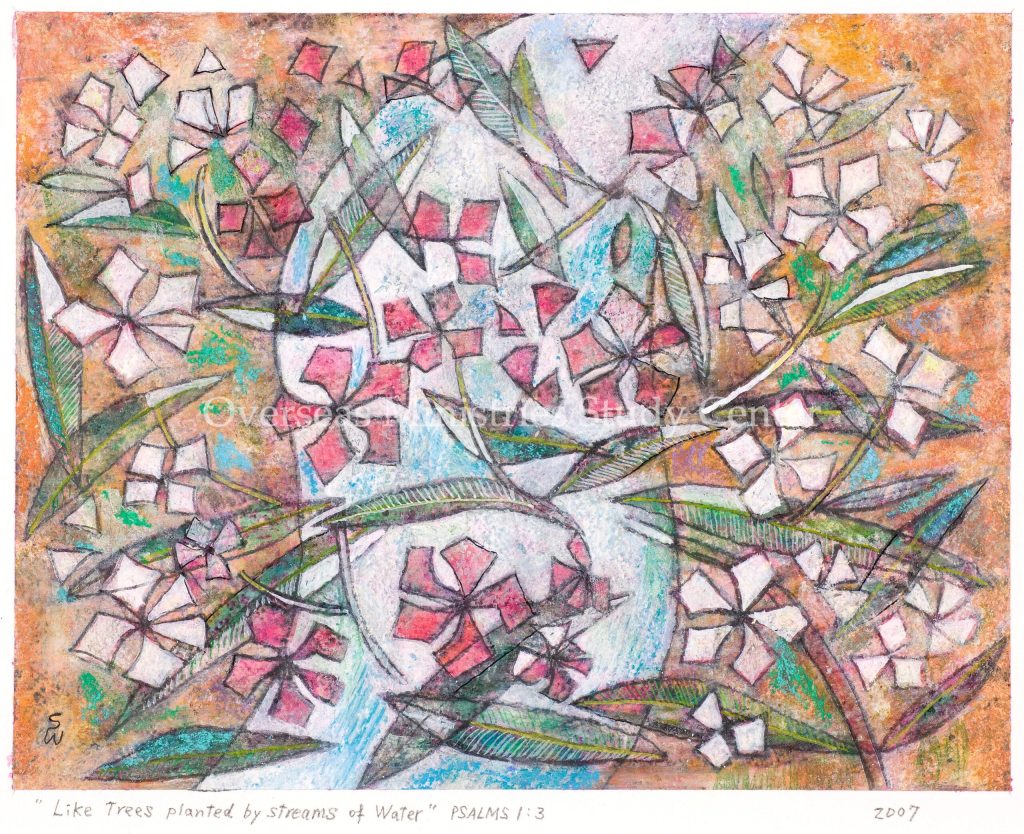
Painting by Soichi Watanabe, used with permission by the Overseas Ministries Study Center (OMSC) at Princeton Theological Seminary. You can purchase this and many other artworks by artists in residence at the OSMC in high resolution and without a watermark via the OSMC website .
“A resident of Koshigaya City, Saitama, Japan, Soichi Watanabe was the 2008-09 OMSC artist in residence. Watanabe graduated in 1982 from the Ochanomizu Art School in Tokyo after having earned, a decade earlier, an economics degree from Tohoku Gakuin University in Sendai. He teaches at a private art school that he started in 1982. Following his 1982 graduation, Soichi founded a private art school where he and his wife work together to help others experience the joy of art.
“Soichi was drawn to God as an undergraduate student during a home Bible study when he encountered Mark 8:35: ‘Whoever wants to save his life will lose it, but whoever loses his life for me and for the gospel will save it.’ Further study of the New Testament led him to realize that he was both ‘stubborn and self-centered.’ He recalls that ‘the richness of the biblical world overwhelmed me and at the same time tortured me.’
“Shortly thereafter he chose to submit his life to God at an evening worship service. ‘I really heard a voice telling me to accept the salvation of Jesus on the cross and to follow him,’ remembers Soichi. From that point on he has been determined to serve God through his abilities. As a follower of Jesus, Soichi points to his faith as the foundation from which he works as an artist. In his art book Jesus Walking With Us (2004), he writes, ‘I realize that [my works] are my own humble responses to God’s calling in my life… . The images are often given to me through the words of God at worship services on Sundays and during my daily devotion. I have the earnest hope that I will go on painting to praise the Lord.'” (Source )
About this image, Watanabe says: “The plant this title refers to is an oleander. According to Plants of the Bible, by H. N. and A. L. Moldenke, ‘the cedar that is planted by streams of water’ (Sirach 39:13) is this plant. I am also remembering Psalm 1 here, because I have often sung that psalm.” (Source: OMSC 2010, p. 34)
Listen to me, O you holy sons: Here ben Sira is talking to his readers, whom he assumes are Jews. “Devout [or, Faithful] readers” might be a good way to express holy sons, so for this line we may say “Listen to what I have to say, my faithful readers.”
And bud like a rose growing by a stream of water …: In this line, and in the next verse, the author uses poetic imagery from the plant world. The idea here is that the praise of God coming from the faithful is compared to the sweet smell of roses and lilies. This is a difficult picture (in English it is downright peculiar), but looking at the structure as follows may help:
bud like a rose growing by — send forth fragrance like frankincense a stream of water put forth blossoms like a lily — Scatter the fragrance sing a hymn of praise — bless the Lord for all his works
It can be seen that the reader is told twice to blossom and after each flower is mentioned the reader is told to send forth the fragrance of that blossom. The point of the comparison does not become clear until the reader is told to sing a hymn and bless the Lord. It may be helpful to rearrange some material. The following is an example of what might be done by combining verses 13b-14:
• Praise the Lord for all that he has made! Let your hymns go up like the smell of incense, like the fragrance of lilies in bloom, like the sweet smell of roses on the stream bank.
For rose see the comments on 24.14. The identification of both the rose and lily is uncertain, and translators may use names of familiar flowers or flowering shrubs. The point here is not the precise identity of the plant, but the imagery of their fragrance perfuming the air. Bless may be rendered “thank” (see 32.13) or “praise” (see the model above).
Quoted with permission from Bullard, Roger A. and Hatton, Howard A. A Handbook on Sirach. (UBS Helps for Translators). New York: UBS, 2008. For this and other handbooks for translators see here.

Leave a Reply
You must be logged in to post a comment.