15Then they came to Jerusalem. And he entered the temple and began to drive out those who were selling and those who were buying in the temple, and he overturned the tables of the money changers and the seats of those who sold doves,
The name that is transliterated as “Jerusalem” in English is signed in French Sign Language with a sign that depicts worshiping at the Western Wall in Jerusalem:
While a similar sign is also used in British Sign Language, another, more neutral sign that combines the sign “J” and the signs for “place” is used as well. (Source: Anna Smith)
“Jerusalem” in British Sign Language (source: Christian BSL, used with permission)
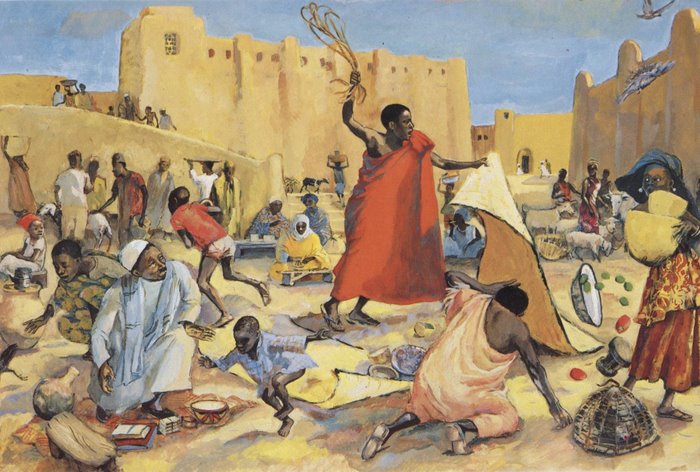
Following is a 1973 painting of the JESUS MAFA project, a response to New Testament readings from the Lectionary by a Christian community in Cameroon, Africa. Each of the readings was selected and adapted to dramatic interpretation by the community members. Photographs of their interpretations were made, and these were then transcribed to paintings:
From Art in the Christian Tradition, a project of the Vanderbilt Divinity Library, Nashville, TN. Image retrieved March 23, 2026. Original source: librairie-emmanuel.fr.
The Hebrew, Latin and Greek that is translated as “dove” or “pigeon” in English is translated in Pijin with the onomatopoeia kurrukurru. (Source: Bob Carter)
In Matumbi is is translated as ngunda, a kind of dove that has the reputation to be monogamous. (Source: Pioneer Bible Translators, project-specific notes in Paratext)
In the fifteenth century the English word “pigeon” meant a young dove, the word “dove” being reserved for the adult birds. In modern English the words are used almost interchangeably. As a general rule, “pigeon” is used for domesticated forms of these birds, and for the larger variety of wild forms, while “dove” is used mainly for wild varieties. However, there are many exceptions to this general rule.
Pigeons and doves are both included in a bird family known scientifically as the Colombidae, consisting of well over two hundred species. In Israel and the Middle East are found the true Colombidae, which are easily distinguished from the genus Stretopelia, that is, the turtle doves.
The most common of the true Colombidae in the Middle East is most certainly the Asiatic Rock Dove Columba livia. This bird was first domesticated around 4500 B.C. in Mesopotamia. By 2500 B.C. it was kept as a domestic bird in Egypt, and by 1200 B.C. there is evidence that its homing abilities were already well known. It is this bird that is the ancestor of the domestic homing pigeons that people keep, some of which have escaped, returned to the wild, and now populate city streets all over the world. The ledges of modern buildings are a good substitute for the rock ledges that were its original nesting sites. It is likely that the Canaanites and the Israelites also kept these birds for both food and sacrifice. It is this bird that is called yonah in the Hebrew Bible and peristera in the Greek New Testament.
There are also three types of turtledove found in the land of Israel, two of which are resident species; the third is a migrant that arrives in spring and spends the summer in Israel. This migrant, the true Turtle Dove Streptopelia turtur, and one of the species now resident, the Collared Dove Streptopelia decaocto, are what the Bible writers called tor in Hebrew and trugōn in Greek. (Both the Hebrew and Greek names are based on the sound the turtledove makes.)
In biblical Hebrew the word gozal generally refers to a nestling of any bird species. In Genesis 15:9 it obviously refers specifically to a young pigeon. Nestling rock pigeons were collected from the rock ledges. Pigeons and doves were kept in cages and dovecotes, and wild ones were trapped in nets. This enabled the Jews to have a handy stock of birds for sacrificial purposes.
The rock pigeon is a blue-gray color with a pinkish sheen to the neck feathers. It has a black tip on its tail. Its call is a repeated moaning oom (the Hebrew name yonah is related to a verb meaning “to moan”) or a rapid cooing coo-ROO-coo-coo, usually repeated two or three times. The call is uttered with the beak closed, into the chest. The male’s sexual display starts with flying wing claps, and then when it lands next to the female, it begins bowing and turning with chest puffed and tail spread.
This type of pigeon lives in large colonies, and when a group is in flight, they maneuver as a single unit, often gliding short distances together with their wings held in a V shape.
The turtledove is a smaller blue-gray bird with a pinkish chest. It arrives in Israel in April, and its rhythmic call yoo-ROO-coo, yoo-ROO-coo, yoo-ROO-coo, repeated for two or three minutes at a time on sunny days, can be heard all over.
Doves are seed eaters, and this fact may be significant in the Flood narrative. The raven, a carrion eater, does not return to the ark, since food is available. The dove returns at first, and when it finally stays away, this is an indication that seeds of some sort are once again available to it, and the earth is again dry.
As seed-eaters, doves and pigeons are ritually clean birds for Jews. Their swift flight means that they are symbolic of speed in some biblical contexts, especially in Psalms. The fact that these birds court, mate, and nest repeatedly throughout the year resulted in their being a symbol of affection, sexuality, and fertility in the ancient Egyptian, Canaanite, and Hebrew cultures. This symbolism is important in the Song of Solomon.
A very ancient belief that the dove has no bile and is therefore devoid of anger led to its becoming a symbol of peace and gentleness. (In actual fact doves and pigeons are aggressive, often attacking other birds, especially at food sources.)
The name yonah for the pigeon and dove is associated with moaning and groaning in pain or sorrow. This is often the symbolism in prophetic poetry.
Pigeons and doves are found worldwide, except in some snow-bound regions and on some remote islands. Almost everywhere they live there is more than one species, and in almost all locations the domestic pigeon is one of these species. As a general rule, the word for the smaller wild dove should be used wherever possible, but in those contexts where both pigeons and doves are mentioned in connection with sacrifices, the word for the domestic pigeon can be used as well as the one for the wild dove.
In 2 Kings 6:25 there is a Hebrew expression that literally means “dove’s dung”. This seems to be a reference to some kind of food that is eaten only in emergencies. Suggestions about what this may refer to have varied from “chickpeas” (which do look somewhat like a dove’s droppings) to “locust-beans”, “wild onions”, and the roots of certain wild flowers. In view of the lack of certainty, it is probably best to translate it literally as “dove’s dung” and include the footnote, “This is probably some kind of wild food eaten only in emergencies.”
One of the distinctions of the gospel of Mark is a breathlessness of telling the story of Jesus. One way that is achieved is by using the Greek kai, normally “and” in English, at the beginning of sections. Different versions and languages have found their own ways of translating it, but the German translation by Walter Jens (publ. 1990, 1998) is unique by consistently using Und ich erzähle or “And I’m telling (you)” for every such occurrence of kai.
Click or tap here to see the rest of this insight.
Like a number of other East Asian languages, Japanese uses a complex system of honorifics, i.e. a system where a number of different levels of politeness are expressed in language via words, word forms or grammatical constructs. These can range from addressing someone or referring to someone with contempt (very informal) to expressing the highest level of reference (as used in addressing or referring to God) or any number of levels in-between.
One way Japanese shows different degree of politeness is through the usage of an honorific construction where the morpheme are (され) is affixed on the verb as shown here in the widely-used Japanese Shinkaiyaku (新改訳) Bible of 2017. This is particularly done with verbs that have God as the agent to show a deep sense of reverence. Here, taos-are-ru (倒される) or “fall/tip” is used.
Living Water is produced for the Bible translation movement in association with Lutheran Bible Translators. Lyrics derived from the ESV® Bible (The Holy Bible, English Standard Version®).
Before agorazontas ‘buying’ Textus Receptus omits tous ‘the ones,’ ‘those,’ which is retained by all modern editions of the Greek text.
Exegesis:
hieron (cf. 11.11) ‘Temple’: here specifically the Court of the Gentiles where all this traffic was carried on.
tous pōlountas (cf. 10.21) ‘those who sold’: the merchants who sold the animals, as well as oil, wine, and salt, for the Temple sacrifices.
tous agorazontas (cf. 6.36) ‘those who bought’: pilgrims who came to offer sacrifice and worship in the Temple.
tas trapezas (cf. 7.28) ‘the tables’ on which the money changers displayed their coins; ‘banks.’
tōn kollubistōn (only here in Mark) ‘of the money changers’: many of the worshipers, Jews of the Dispersion, would not have the half shekel coins required for the payment of the Temple tax (cf. Rawlinson).
tas kathedras (only here in Mark) ‘the chairs,’ ‘seats,’ ‘stools.’
tas peristeras (cf. 1.10) ‘the doves’ used in sacrifices, according to the requirements of the Law (cf. Lev. 12.6, 8; 14.22; 15.14, 29).
katestrepsen (only here in Mark) ‘he upset,’ ‘he overturned.’
Translation:
Came to may require alteration to ‘arrived at.’
Drive out may be rendered in a form parallel to what is used in other Gospels where the action is described as accomplished – at least in part – by the use of a whip. Where languages require a distinction between driving out as a group, or singly (as, for example, in Navajo), the former is probably preferable.
Sold and … bought is in some languages best rendered as ‘exchanged’ (or in some cultures as ‘bartered’).
Pigeons, which are very widespread, – at least in some relatively similar form – may be translated by the closest local parallel, even though the relationship may not be exact.
Quoted with permission from Bratcher, Robert G. and Nida, Eugene A. A Handbook on the Gospel of Mark. (UBS Handbook Series). New York: UBS, 1961. For this and other handbooks for translators see here .
Jesus expelled the buyers and sellers from the temple courtyard
Jesus and his disciples arrived in the city of Jerusalem again. Jesus went back to the temple, where he had looked around at everything the day before. This time he showed his disapproval of the people there who were buying, selling, and exchanging people’s money. He overturned their tables and commanded other people to stop carrying things through the temple area. He quoted Scripture to show that what they were doing was wrong.
The Jewish leaders did not like what Jesus did. They were afraid of the influence he had on the crowds of people. They looked for a way to kill Jesus.
It is good to translate this section before you decide on a heading for it.
Here are some other possible headings for this section:
Jesus Goes to the Temple (Good News Bible) -or-
Jesus Cleanses the Temple (English Standard Version)
There are parallel passages for this section in Matthew 21:10–17 and Luke 19:45–48. See also John 2:13–22.
Paragraph 11:15–17
When Jesus arrived in Jerusalem, it was the time of the year when the Jews celebrated a festival called the Passover. Many people came to Jerusalem at Passover time to offer sacrifices to God.
11:15a
When they arrived in Jerusalem: The Greek clause that the Berean Standard Bible translates as When they arrived in Jerusalem is literally “And they came to Jerusalem” (as in the Revised Standard Version). The previous section tells about what happened as Jesus and his disciples were walking from Bethany to Jerusalem. This section begins with their arrival in Jerusalem.
Here are some other ways to translate these introductory words:
On reaching Jerusalem (New International Version) -or-
When Jesus and his disciples arrived in Jerusalem
Jesus entered the temple courts: The Greek word that the Berean Standard Bible translates as temple courts is literally “temple,” as in most English versions. The temple consisted of the temple building and the walls and courtyards that surrounded it. People did not meet inside the temple building because only the priests could go there.
In this context some English versions have made this clear by translating the Greek word as “temple area” (New International Version) or temple courts (Berean Standard Bible). You may want to do this also if your word or phrase for “temple” would make readers think that Jesus entered the temple building.
The temple area at the time of Jesus
Some ways to translate the term temple courts are:
• Use a descriptive phrase. For example:
courtyard of the house of God -or-
area around the house of sacrifice -or-
courtyard of the holy/sacred house
• If your language has a word for “temple,” consider using it here. But you may need to modify it by saying:
courtyard of the temple of the Lord/Jews -or- big/great temple courtyard
There are more translation examples in the note on “temple” in 11:11a. See how you translated the word there.
See also the word temple, Meaning 1, in the Glossary for more information about the temple and how to translate it.
11:15b–c
and began to drive out: The Greek phrase that the Berean Standard Bible translates as began to drive out means that Jesus began to force some people to leave. For example, the Contemporary English Version says:
began chasing out
those who were buying and selling there: The phrase those who were buying and selling there refers to people who were in the temple courts buying and selling items for sacrifice. Merchants had begun to use the outer temple courtyard as a place to sell the things that people needed in order to make sacrifices.
It is implied that Jesus drove out these people and their customers because they should not have been buying and selling inside the temple courtyard. You may need to make this clear. For example:
he forced certain people to leave because they were buying and selling there
You should make it clear in your translation that those who were buying (the customers) and those who were…selling (the merchants) were different groups of people. In some languages, it may be more natural to mention those who were…selling before those who were buying.
those who were buying: In some languages, it may be more natural to say what the people bought. For example:
those who were buying things -or-
those who were buying things to sacrifice -or-
those who were buying animals to sacrifice/offer to God
those who were…selling: The Greek phrase that the Berean Standard Bible translates as those who were…selling is literally “the ones selling.” This refers to merchants who sold things in the temple area. They sold animals, wine, oil, and salt and other things that people needed for sacrifices.
The courtyard was the only part of the temple that Gentiles (non-Jews) were allowed to enter to worship God. The merchants were making this place like a marketplace so that it was difficult for people to pray and worship there. Many commentators also believe that the merchants charged too much for the things that they sold.
You may prefer to add a footnote with this information. See the General Comment below.
General Comment on 11:15b–c
If your readers would find it confusing that people bought and sold things in the temple, it may be helpful to use a footnote. For example:
If someone needed to buy an animal to offer as a sacrifice to God in the temple, these merchants would sell it to him. They also sold other things that people needed for the sacrifices, such as wine, oil, and salt. Jesus did not want them to buy and sell things in the temple. He wanted the temple courts to be a place where people could pray.
11:15d–e
He overturned the tables…and the seats: The Greek word that the Berean Standard Bible translates as overturned means “turned upside down” or “knocked down.” Jesus turned the tables and benches upside down to show that these things did not belong in the temple courtyard.
the tables of the money changers: The phrase the tables of the money changers refers to small tables where these merchants piled their coins.
Here are some other ways to translate this phrase:
the tables at which people exchanged coins -or-
the tables where people traded coins
the money changers: The money changers were merchants who exchanged Roman and Greek coins for Jewish coins. The Roman and Greek coins had images on them. These images were offensive to Jews. So the Jewish leaders did not permit people to use these coins to pay the temple tax or buy animals for sacrifice. They were required to use Jewish coins. (The people who came to Jerusalem paid a temple tax once a year. The temple tax was due just before Passover. This provided money to maintain the temple and the temple area. Many also needed to buy an animal or something to give the priest to offer as a sacrifice. But some coins had images on them of gods or of people whom other people worshipped as gods. The Jewish religious leaders would not allow people to use those kinds of coins as part of worship in the temple area. So these businessmen would take these coins with the images and exchange them for Judean coins that the Jewish religious leaders would accept. These businessmen made a profit doing this.) It may be helpful to have a footnote in your translation that explains this.
the seats of those selling doves: The phrase the seats of those selling doves refers to the places where the merchants who sold doves sat. They sold doves to people who could not afford to bring a larger animal, such as a sheep or a goat, for a sacrifice.
seats: The Greek word that the Berean Standard Bible translates as seats also means “chairs” (as in the NET Bible) or “benches” (as in the New International Version).
doves: The Greek word that the Berean Standard Bible translates here as doves describes a family of birds that are called either “dove” or “pigeon” in English. (See the note at 1:10c.) These birds were used for sacrifices by people who could not afford more expensive animals such as sheep or cows.
Made available under the terms of a Creative Commons Attribution-ShareAlike 4.0 License (CC BY-SA) creativecommons.org/licenses/by-sa/4.0
All Scripture quotations in this publication, unless otherwise indicated, are from The Holy Bible, Berean Standard Bible.
BSB is produced in cooperation with Bible Hub, Discovery Bible, OpenBible.com, and the Berean Bible Translation Committee.

Leave a Reply
You must be logged in to post a comment.