3But Samson lay only until midnight. Then at midnight he rose up, took hold of the doors of the city gate and the two posts, pulled them up, bar and all, put them on his shoulders, and carried them to the top of the hill that is in front of Hebron.
The name that is transliterated as “Samson” in English means “a little sun,” “splendid sun” (i.e., great joy and felicity), “like the sun,” “distinguished,” “strong,” “a perfect servant.” (Source: Cornwall / Smith 1997 )
It is translated in Spanish Sign Language with the signs for “headband” referring to his long hair and likely use of a headband. (Source: Steve Parkhurst)
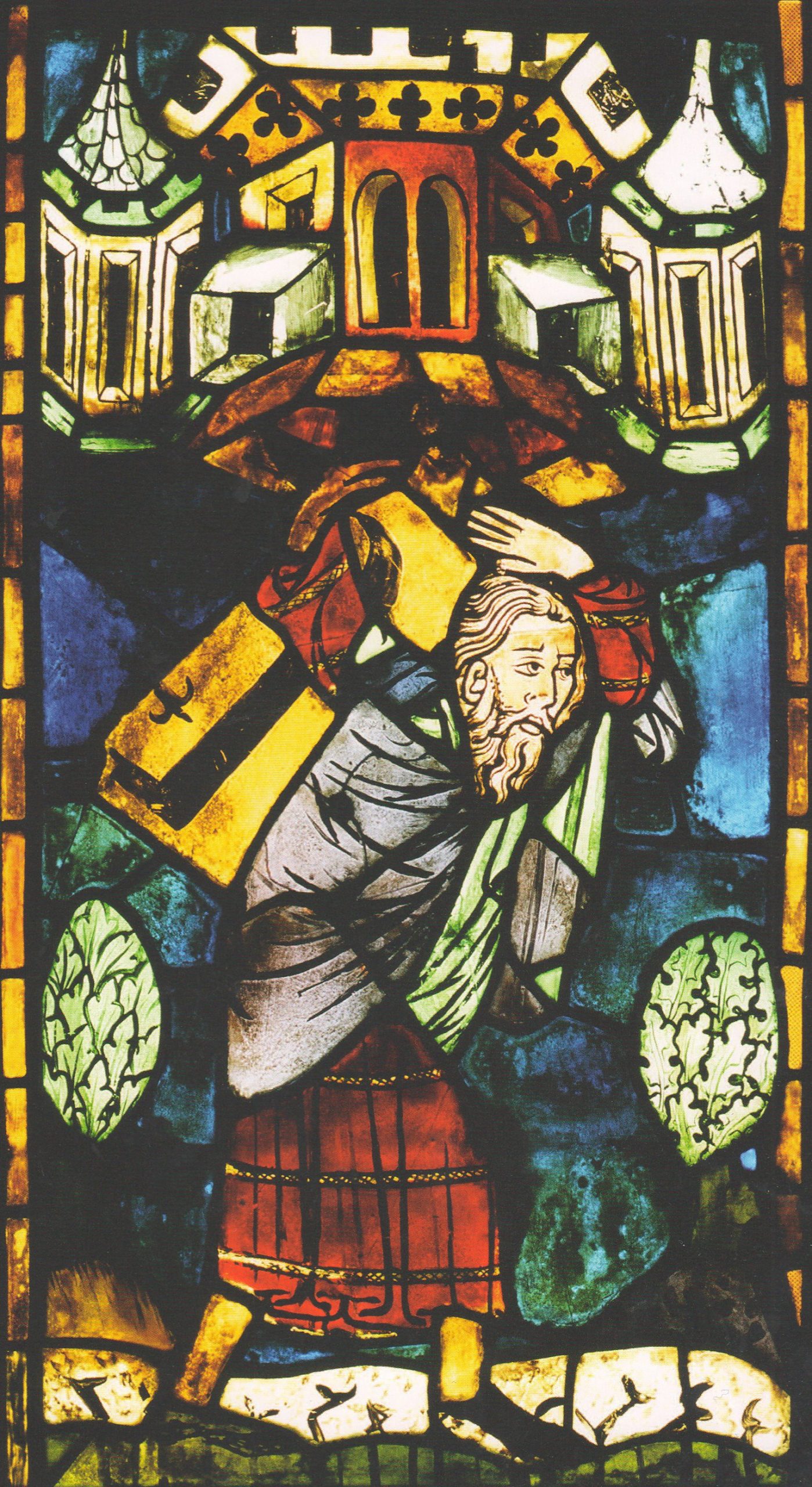
The following is a stained glass window from the Three choir windows in the Marienkirche, Frankfurt (Oder), Germany, of the 14th century, depicting Samson carrying the gates of Gaza:
Source: Der gläserne Schatz: Die Bilderbibel der St. Marienkirche in Frankfurt (Oder), Neuer Berlin Verlag, 2005, copyright for this image: Brandenburgisches Landesamt für Denkmalpflege und Archäologisches Landesmuseum
Stained glass is not just highly decorative, it’s a medium which has been used to express important religious messages for centuries. Literacy was not widespread in the medieval and Renaissance periods and the Church used stained glass and other artworks to teach the central beliefs of Christianity. In Gothic churches, the windows were filled with extensive narrative scenes in stained glass — like huge and colorful picture storybooks — in which worshipers could ‘read’ the stories of Christ and the saints and learn what was required for their religious salvation. (Source: Victoria and Albert Museum )
Following are a number of back-translations as well as a sample translation for translators of Judges 16:3:
Kupsabiny: “But Samson left the house of that woman in the middle of the night and took hold of the door of the gate and both its gateposts and uprooted (them). He carried them on the shoulder and hauled (them) heading to the top of a hill which was near Hebron.” (Source: Kupsabiny Back Translation)
Newari: “But Samson was staying in bed only till midnight. Getting up at midnight he uprooted the city gate, door, pillars, bolt and all. Then he carried the whole thing on his shoulders and took it off to the top of the hill which was located west of Hebron.” (Source: Newari Back Translation)
Hiligaynon: “But Samson lay-down-beside/(had-sexual-relations-with) the woman until midnight only. He then rose-up and went to the gate of the town. He took-hold of the gate/door and pulled-out the pillars/posts and its bars. Then he carried- them -on-(his)-shoulder and brought (them) to the peak of the mountain that faces Hebron.” (Source: Hiligaynon Back Translation)
English: “But Samson did not stay there all night. At midnight, he got up. He went to the city gate, he took hold of its two posts, and he lifted it up out of the ground, with its connecting cross bar still attached. He put it on his shoulders and carried it many miles uphill to Hebron.” (Source: Translation for Translators)
The people of Gaza carefully planned how to capture Samson, but they were no match for him, as he carried out a series of quick, decisive actions. Not only did he escape unnoticed from the prostitute’s house, he also stripped the town of its defenses and walked calmly away from their threat. Exactly how Samson managed to remove the gates and escape without anyone noticing is not explained. The emphasis is on the way Samson tricked the people of Gaza. There are links back to the Ehud story, since yet again, a single Israelite outsmarts many foreigners.
But Samson lay till midnight: But is a good rendering of the Hebrew waw conjunction since it expresses the ironic contrast between the townspeople waiting outside in the night and Samson lying asleep in his bed. Lay means “lay [in bed],” supposedly asleep, but elsewhere in the Old Testament and in this context, the Hebrew verb here also has sexual overtones. We may say “stayed in bed” (Good News Translation, Revised English Bible) or even “stayed with the woman.” Till midnight is literally “until the middle of the night.” This phrase seems to make fun of the Philistines. They had planned to wait “all night” and catch Samson early in the morning. In the meantime Samson is already planning his escape. He only stays at the prostitute’s house until midnight. Languages have many different ways to express midnight and a natural equivalent can be used here. New International Version says “But Samson lay there only until the middle of the night,” highlighting how Samson was always several steps ahead of the Philistines.
And at midnight he arose is literally “and he arose in the middle of the night.” There is no indication that Samson knew about the people’s plan, but he still outwits them. The repetition of the word midnight seems to mock the Philistines. The key Hebrew verb rendered arose (qum) has its regular meaning here: “get out of bed,” but of course, here it is very ironic, since it is the same verb used throughout this book to mark the beginning of each judge’s saving act (see comments on verse 2.16). Here along with its literal meaning, it indicates another occasion when an Israelite hero “arises” to outwit Israel’s enemies.
And took hold of the doors of the gate of the city and the two posts means Samson grabbed these structures with his two hands. The narrator leaves out a step in the narration, and some will want to make explicit that “Samson went to the city gate and took hold….” The doors of the gate may seem an unusual phrase, since in some languages doors and gate may refer to the same thing. The gate of the city refers to a large area, including the entrance, the doors, and an open area or court, where there could also be guard rooms (see verse 9.35). The doors were made of thick wooden planks and were fixed at the outer side of the gate area. They were closed each evening. Often a bar was placed across the two doors to secure them. The locked doors prevented anyone from going in or out of the city. In many languages it may be easier to speak either of the doors or the gate. Good News Translation, for example, says “and took hold of the city gate….” The two posts refers to the posts at either side of the entrance that supported the doors.
And pulled them up, bar and all: This is clearly a superhuman feat, since Samson takes hold of this entire structure, yanking up even the posts that fixed the doors in place. While many languages will express this upward movement with a word such as up, some languages may say, Samson “pulled them out.” Bar and all is a dynamic rendering of the Hebrew, which is literally “with the bar.” The bar refers to a heavy beam of wood that stretched from one doorpost to the other, preventing the doors from being pushed open. When Samson picked up the doors and their posts, the bar came away with them. Good News Translation says “lock,” which is not a good rendering. We might say “he picked up the doors, along with the posts holding them in place and the wood that kept them shut.” Contemporary English Version leaves the word bar untranslated, which is another possible option, but all these details add to the overall impression that this was a truly superhuman feat.
And put them on his shoulders: Samson apparently picks up the doors, the posts, and the bar as though they were a light burden. The Hebrew verb rendered put (sim) is a very common word in this book, which in this context might be translated “lifted” (New International Version) or “hoisted” (Revised English Bible). On his shoulders specifies how he carried these heavy items. This detail is certainly why many illustrators picture Samson as a big man with wide shoulders.
And carried them: After hoisting the doors on his shoulders, Samson carries them off. In some languages this clause may be combined with the previous one, for example, “and carried them away on his shoulders.” However, in Hebrew the use of multiple verbs is a way of heightening the action in the story.
To the top of the hill that is before Hebron: Not only does Samson carry off the heavy doors, but he walks with them about 60 kilometers (40 miles) and carries them up a mountain! This feat adds to Samson’s renown. To the top of the hill is literally “to the head of the mountain.” This mountain was before Hebron (literally “on the face of Hebron”). New International Version is fairly literal with “faces Hebron,” but we could also say “near Hebron” (New Jewish Publication Society’s Tanakh), “across from Hebron” (New Living Translation), or “opposite Hebron” (New American Bible). The Hebrew prepositional phrase rendered before often means “to the east of,” so Revised English Bible says “east of Hebron.” Hebron, an ancient city associated with Abraham and a current city in Palestine, is about 30 kilometers (20 miles) south of Jerusalem. During the period of the judges, it was located in the territory of Judah, on the crest of the mountains that ran north and south (see verse 1.10). The distance from Gaza to Hebron was approximately 60 kilometers (40 miles). This information could be put in a footnote or translators can assert the length of this trek by saying, for example, “all the way to the top of the hill that overlooks Hebron” (Contemporary English Version).
At the end of this verse the Septuagint adds “and placed them there,” but Hebrew Old Testament Text Project gives the Hebrew text here an {A} rating, so it can be followed.
The main concern of the storyteller is to highlight Samson’s incredible feat of strength and endurance, as well as to underline the result of his act: the important sea town of Gaza is now utterly defenseless!
A translation model for this verse is:
• But Samson slept until the middle of the night. Then he got up, went to the city gate, and pulled out its doors, including their posts and the bar that closed them. He hoisted them up on his shoulders and walked all the way to the top of the hill, across from the town of Hebron.
Quoted with permission from Zogbo, Lynell and Ogden, Graham S. A Handbook on Judges. (UBS Helps for Translators). Miami: UBS, 2019. For this and other handbooks for translators see here .
16:3a But Samson lay there only until midnight, when he got up,
But Samson only stayed ⌊with the woman⌋ until the middle of the night. Then he got up.
-or-
But Samson got up in the middle of the night ⌊and went to the town gate⌋ .
16:3b took hold of the doors of the city gate and both gateposts, and pulled them out, bar and all.
He took hold of the doors of the town gate and tore them out of the wall, with the wood at their edges. He tore out the whole thing, including the cross bar.
-or-
He tore the doors of the gate out of the wall, together with the two posts and the beam that locked the gate.
16:3c Then he put them on his shoulders
He lifted the doors onto his shoulders
-or-
He put it all on his shoulders
16:3d and took them to the top of the mountain overlooking Hebron.
and carried them to the top of the hill near the town of Hebron.
-or-
and carried it ⌊sixty (60) kilometers⌋ to the top of the hill that overlooks Hebron Town.


Leave a Reply
You must be logged in to post a comment.