The Hebrew, Greek, and Latin that is translated as “cup” in English is translated in Sar with “calabash” (see here ) (source: Ngarbolnan Riminan in Le Sycomore 2000, p. 20ff. ) and in Bariai with “coconut shell” (source: Bariai Back Translation)
Owls are found worldwide except in the Antarctic and on some islands. They are active at night and are characterized by flat faces and short hooked beaks that they can open very wide. They swallow their prey whole and later regurgitate the undigested parts as small balls. They also have the ability to turn their heads more than 180 degrees.
There are two basic owl families, both of which are found in the land of Israel. One family is the Tytonidae, which are the Barn and Grass Owls. They have heart-shaped whitish faces, usually outlined by a dark line, and small dark eyes. The other family is the Strigidae, the typical owls. This family contains a large variety of species, all of which have large eyes that may vary in color from light brown through orange to yellow. This family includes the eared or horned owls, the fairly rare fishing owls, and owls that vary in size from the midget scops owl (less than 20 centimeters [8 inches]) through to the giant eagle owl (over 70 centimeters [28 inches]).
Eight species of owl are fairly common in the land of Israel. Most are very seldom seen by humans, but they are quite well known by their different and distinct calls. In biblical times the nights would have been much quieter than in most modern places, and the strange night sounds probably would have interested people, causing some speculation about what was making the sound. The different owls would thus probably have had different names even if people had never seen them. In fact it is unlikely that they would have been able to associate most of the calls with the owls that were seen.
As with most of the owls, there is no complete agreement among the versions. It would appear at first that “screech owl” has strong support as the translation of yanshuf. However, this is misleading. The next Hebrew name on the list of unclean birds in Leviticus 11:18 and Deuteronomy 13:16 is tinshemeth, which New International Version renders “white owl” and New American Bible “barn owl”. In fact both white owl and barn owl are simply alternate names for the screech owl, which these two versions have included earlier in the list. They have thus actually listed the same owl twice. Among Jewish scholars the translation of tinshemet as barn owl has a long history, and in modern Hebrew this is the name of the barn owl. Thus it seems best to translate yanshuf in some other way.
There are two likely candidates. For translators who have translated the word tachmas earlier in the list as “eared owl”, yanshuf can be translated as “tawny owl”. For those who decided to follow modern Hebrew usage and translate tachmas as “nightjar”, it would be good to translate yanshuf as “eared owl”, which also follows modern Hebrew usage.
The Tawny Owl Strix aluco is a fairly rare bird in Israel, but where it is present, its call is unmistakable. The male calls with a series of hoots “HOO-hoo-hoo, hoo-HOO-hoo”, and the female replies with a higher pitched single hoot “HOO”. Its eyes are outlined with pale circles, so that it looks as though it is wearing spectacles. As its name indicates, it is a mottled gray-brown color. It prefers wooded areas or orchards and roosts close to the trunk of a tree.
It is listed as an unclean bird.
Owls very similar to the tawny owl, which belongs to the same family as Wood Owls Strigidae, are found in many places in the world. In sub-Saharan Africa the Wood Owl Strix woodfordii is very similar to the tawny owl, while in Australasia the Boobook Owl Ninox novaseelandiae is a good equivalent. Elsewhere the word for a medium-sized wood owl, or a phrase meaning “tawny-colored owl” can be used.
Owls are found worldwide except in the Antarctic and on some islands. They are active at night and are characterized by flat faces and short hooked beaks that they can open very wide. They swallow their prey whole and later regurgitate the undigested parts as small balls. They also have the ability to turn their heads more than 180 degrees.
There are two basic owl families, both of which are found in the land of Israel. One family is the Tytonidae, which are the Barn and Grass Owls. They have heart-shaped whitish faces, usually outlined by a dark line, and small dark eyes. The other family is the Strigidae, the typical owls. This family contains a large variety of species, all of which have large eyes that may vary in color from light brown through orange to yellow. This family includes the eared or horned owls, the fairly rare fishing owls, and owls that vary in size from the midget scops owl (less than 20 centimeters [8 inches]) through to the giant eagle owl (over 70 centimeters [28 inches]).
Eight species of owl are fairly common in the land of Israel. Most are very seldom seen by humans, but they are quite well known by their different and distinct calls. In biblical times the nights would have been much quieter than in most modern places, and the strange night sounds probably would have interested people, causing some speculation about what was making the sound. The different owls would thus probably have had different names even if people had never seen them. In fact it is unlikely that they would have been able to associate most of the calls with the owls that were seen.
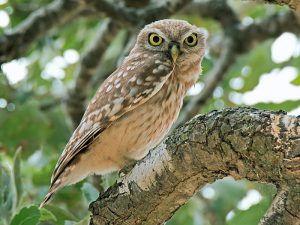
Traditionally kos has been translated as “little owl”, and this is the meaning in modern Hebrew. The case for this translation is probably the strongest, even though not conclusive. If we accept this identification, the lists of unclean birds has a rather neat structure with this the smallest of the owls being paired with nets, the smallest of the birds of prey.
The Little Owl Athene noctua is, as its name suggests, a small owl, which feeds at night mainly on insects and nestlings. It is about 25 centimeters (10 inches) in length and has a short tail. It does not have ear tufts. It nests in holes in banks or termite hills. It is often seen in the daytime, usually being chased by a group of small birds.
It is listed as an unclean bird.
The little owl is found in southeastern Europe, the Middle East, and northeast Africa. Elsewhere one may use the name of a small species of owl or the phrase “little owl”.
Owls are found worldwide except in the Antarctic and on some islands. They are active at night and are characterized by flat faces and short hooked beaks that they can open very wide. They swallow their prey whole and later regurgitate the undigested parts as small balls. They also have the ability to turn their heads more than 180 degrees.
There are two basic owl families, both of which are found in the land of Israel. One family is the Tytonidae, which are the Barn and Grass Owls. They have heart-shaped whitish faces, usually outlined by a dark line, and small dark eyes. The other family is the Strigidae, the typical owls. This family contains a large variety of species, all of which have large eyes that may vary in color from light brown through orange to yellow. This family includes the eared or horned owls, the fairly rare fishing owls, and owls that vary in size from the midget scops owl (less than 20 centimeters [8 inches]) through to the giant eagle owl (over 70 centimeters [28 inches]).
Eight species of owl are fairly common in the land of Israel. Most are very seldom seen by humans, but they are quite well known by their different and distinct calls. In biblical times the nights would have been much quieter than in most modern places, and the strange night sounds probably would have interested people, causing some speculation about what was making the sound. The different owls would thus probably have had different names even if people had never seen them. In fact it is unlikely that they would have been able to associate most of the calls with the owls that were seen.
The terms “barn owl,” “screech owl,” and “white owl” are alternative names for the same owl. There is a long tradition among both Jewish and Christian scholars of translating tinshemeth as “barn owl”. New English Bible and Revised English Bible follow Driver’s suggestion “little owl”, but this does not have as wide support among scholars as “barn owl,” which is also the modern Hebrew meaning of tinshemeth. The New Revised Standard Version, updated edition rendering of “water hen” can be disregarded since it’s too vague a term to be useful.
The word tinshemeth actually occurs three times in the Bible. Twice the word probably refers to the barn owl, but the third occurrence is a reference to a type of lizard or chameleon.
The Barn Owl Tyto alba is one of the most widely distributed owls in the world, being common virtually everywhere but the Arctic and Antarctic regions and remote islands. It is a very pale color, light fawn or gray on the wings and back, and almost white on the chest and under the wings. It has small eyes, a large head for its size, and a very striking heart-shaped white facial disk outlined in brown. This facial disk consists of short bristle-like feathers that help the owl to sense very small sounds. Barn owls often roost in barns, deserted houses, caves, and tombs. They utter a variety of strange sounds, varying from the well-known drawn-out trembling screech, to various hissing, chirruping, and snoring sounds. The females are larger and more vocal than the males. These owls live mainly on rats, mice, and other small nocturnal creatures.
It is listed as an unclean bird and was associated with tombs and death.
This is one owl for which finding a local equivalent should not present any major problem. Failing all else, the phrase “white-faced owl” can be used, although strictly speaking, there is another smaller owl, not closely related to the barn owl, that has this English name.
Following are a number of back-translations as well as a sample translation for translators of Deuteronomy 14:16:
Kupsabiny: “owls of all kinds,” (Source: Kupsabiny Back Translation)
Newari: “the small owl, the big owl and the white owl,” (Source: Newari Back Translation)
Hiligaynon: “But never to eat the eagles, ravens, birds that eat the corpse of man or dead-animal, hawks, owls, birds-of-prey, birds that grab/pounce/swoop-down fishes, a-sort-of-white-herons, storks and bats.” (Source: Hiligaynon Back Translation)
English: “owls, hawks, falcons,” (Source: Translation for Translators)
Eagle: this bird is quite common in the Old Testament.
Vulture: see also Lev 11.18; Psa 102.6; Pro 30.17; Lam 4.19; Hos 8.1; Zeph 2.14.
Osprey: New Jewish Publication Society’s Tanakh has “black vulture.” See also Lev 11.13.
For the birds in verse 12 Revised English Bible has “griffon-vulture, black vulture, bearded vulture.”
In verse 13 the translations go their various ways: New Jewish Publication Society’s Tanakh, New International Version, Traduction œcuménique de la Bible, and Bible en français courant have three different kinds of birds instead of the two in Revised Standard Version. This is due to a problem in the Hebrew text, which does have three separate words. S.R. Driver and others maintain that the first word (raʾah) is a mistake; it is not found elsewhere in the Bible, and the third word (daʾyah) is a correction of the first one. New Jewish Publication Society’s Tanakh, however, has three birds, “the kite, the falcon, and the buzzard”; and New International Version has “the red kite, the black kite, the falcon.”
Hebrew Old Testament Text Project recommends that two birds be listed, “the black kite and the red kite”; translators should feel free to follow the Revised Standard Version wording, the buzzard, the kite, after their kinds, if this is appropriate in their language.
Buzzard: this bird does not appear elsewhere in the Old Testament.
Kite: see also Lev 11.14; Isa 34.15.
After their kinds: this means “of all varieties,” “of every kind there is.”
For raven in verse 14 Revised English Bible has “every kind of crow,” and Good News Translation has simply “crows.” See also Gen 8.7; Lev 11.15; 1 Kgs 17.4, 6; Psa 147.9; Pro 30.17; Job 38.41; Song 5.11; Isa 34.11; Zeph 2.14.
For the first three birds in verse 15, New International Version has “horned owl, screech owl, gull”; Revised English Bible has “desert owl, short-eared owl, long-eared owl”; and New Jerusalem Bible has for the second and third birds “screech owl, seagull.”
Ostrich: see also Lev 11.16; Job 30.29; 39.13; Isa 13.21; 34.13; 43.20; Jer 50.39; Lam 4.3; Micah 1.8.
Night hawk: see also Lev 11.16.
Sea gull: see also Lev 11.16.
Hawk: see Lev 11.18; Job 39.26; Isa 34.11.
For the three birds in verse 16, Revised English Bible has “tawny owl, screech owl, little owl”; New Jerusalem Bible has “owl, barn owl, ibis”; for the third bird New International Version and New Jewish Publication Society’s Tanakh have “white owl.”
The terms little owl and great owl do not appear elsewhere in the Old Testament; “owl” is found in Lev 11.17; Psa 102.6; Isa 34.11, 15; Zeph 2.14.
Water hen: see also Lev 11.18. New Jewish Publication Society’s Tanakh has “white owl.”
As suggested above, it may be necessary in certain languages to combine all the birds in this verse as “all kinds of owls.”
Translations differ widely in the identification of the three birds in verse 17. For pelicanNew Revised Standard Version and New International Version have “desert owl,” and Revised English Bible “horned owl”; for carrion vulture New Jewish Publication Society’s Tanakh has “bustard,” New Jerusalem Bible “white vulture,” and Revised English Bible and New International Version “osprey”; for cormorantRevised English Bible has “fisher owl.”
Pelican: see Lev 11.18.
Carrion vulture appears nowhere else in the Old Testament.
Cormorant appears also in Lev 11.17.
The translations being cited all agree on the four birds of verse 18, with the exception of Revised English Bible, which instead of heron has “cormorant.” (Of course the bat is not a bird, but it was considered one by the Hebrews.)
Stork: see also Lev 11.19; Psa 104.17; Jer 8.7; Zech 5.9.
Heron … hoopoe … bat: see also Lev 11.19.
Quoted with permission from Bratcher, Robert G. and Hatton, Howard A. A Handbook on Deuteronomy. (UBS Helps for Translators). New York: UBS, 2000. For this and other handbooks for translators see here .



.jpg)

.jpg)
Leave a Reply
You must be logged in to post a comment.