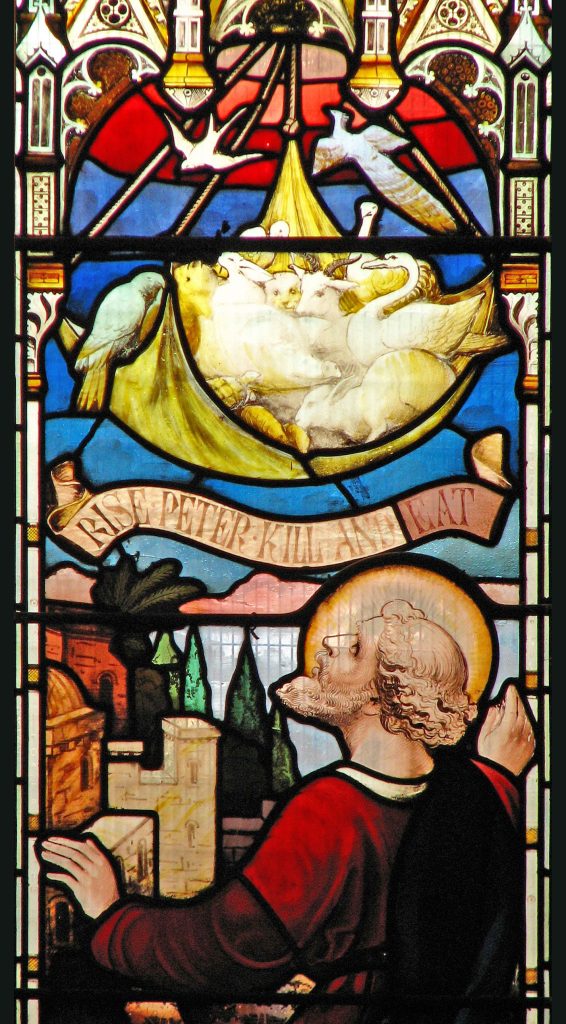
5“I was in the city of Joppa praying, and in a trance I saw a vision. There was something like a large sheet coming down from heaven, being lowered by its four corners, and it came close to me.
Stained glass is not just highly decorative, it’s a medium which has been used to express important religious messages for centuries. Literacy was not widespread in the medieval and Renaissance periods and the Church used stained glass and other artworks to teach the central beliefs of Christianity. In Gothic churches, the windows were filled with extensive narrative scenes in stained glass — like huge and colorful picture storybooks — in which worshipers could ‘read’ the stories of Christ and the saints and learn what was required for their religious salvation. (Source: Victoria and Albert Museum )
Flax Linum usitatissimum, from which linen cloth is made, was cultivated in the Middle East, including Canaan, at least as early as 5000 B.C. A document from Gezer (in Israel) from around King Saul’s time (1000 B.C.) refers to the cultivation of flax and states that flax and wool were the main materials for making cloth. According to Joshua 2:6, the Israelite spies were hidden under flax stalks by Rahab. Flax was grown extensively in Egypt and made into cloth and mats.
Pesheth and pishtah are probably the original Hebrew words for flax, if indeed the plant was domesticated in the Holy Land, as Zohary (Plants of the Bible. Cambridge University Press, 1982) proposes. They may be related to the word pashat, meaning “to strip off” or “to flay,” or to the word pasas, meaning “to disintegrate.” Pesheth and pishtah are used twenty times in the Old Testament, twice referring clearly to the plant itself (Exodus 9:31; Joshua 2:6). Other references are to the processed flax (Judges 15:14 et al.). A few cases refer to finished products, namely wicks (Isaiah 42:3 et al.), cords (Ezekiel 40:3), and items of clothing (Jeremiah 13:1 et al.).
It is likely that the Hebrews acquired the word shesh from the Egyptians during their sojourn in Egypt, since flax was cultivated there also. The Egyptian word for flax was shent (via shen-suten). Shesh is used thirty-eight times in the Old Testament: for the material that Pharaoh put on Joseph, for the Tabernacle curtains and hangings in Exodus, for the ephod, and for the priests’ tunics. The wise woman of Proverbs 31:22 wears it. In Ezekiel 16:10 et al. it is paired with silk, and in Ezekiel 27:7 “shesh from Egypt” is spoken of as material for the sails of ships.
Several references to linen use the Hebrew word bad. In Exodus 28:42 the priests’ underwear are made from bad, and it is used thereafter in Leviticus to describe various items of clothing—coat, breeches, girdle, and turban. It turns up again in Samuel’s and King David’s “ephods” and then again in Ezekiel and Daniel, where we see visions of “a man clothed in bad.”
Linen is referred by the Hebrew word buts in 1‑2 Chronicles, Esther, and Ezekiel, where the robes of the Temple choir, kings, and rich men are described.
The Old Testament has some references to the Hebrew word sadin (“linen garment”): Judges 14:12 (Samson promises them to his opponents), Proverbs 31:24 (the wise woman makes them), and Isaiah 3:23 (the rich women of Jerusalem wear them). The Septuagint uses the Greek word bussos or sindōn in these passages.
The Hebrew word ’etun occurs only in Proverbs 7:16, where it refers to a linen bedspread from Egypt.
In the New Testament there are three primary Greek words for linen: linon/linous, sindōn, and othonē/othonion. Linon is used to refer to garments of the angels in Revelation 15:6 as well as to the “smoldering wick” in Matthew 12:20. The synoptic Gospel writers refer to the linen cloth that Joseph and Nicodemus used to wrap Jesus’ body as a sindōn. Mark uses the same word to refer to the cloth that was worn by the unidentified young man at the time of Jesus’ arrest (Mark 14:51f.). John uses a different Greek word for Jesus’ burial cloths: othonion.
The rich man referred to in the Lazarus story (Luke 16:19) is clothed in “fine linen” (bussos). The Greek word bussos is the root word for bussinos, which refers to tunics, robes and turbans made from linen fabric (Revelation 18:12 et al.).
Flax is a little taller than a sesame plant, about a meter (3 feet) tall. Its leaves are narrow and the flowers are bright blue with five petals. The seed capsule contains oil that is used for cooking and also for thinning paint. After flax ripens, the plants are uprooted and the stalks are left to dry for a while. The stalks are then soaked, dried, and beaten to separate the fibers, which are then combed and woven into cloth.
Linen cloth was relatively costly in Israel, and being light and easy to dye it was highly valued. Their priests wore linen garments to combat sweating (see Ezekiel 44:18). They had to remove these holy garments when they left the Temple, “lest they communicate holiness to the people” (Ezekiel 44:19). The high esteem given to linen by the Jews is shown also by the fact that they used it for burying the dead, and we are told that the Dead Sea Scrolls were wrapped in linen cloths. However, the flax plant was special in other ways. The crushed stalks of flax plants were also used for making rope and lamp wicks. The seed was used for oil.
Today flax is raised more for the oil that comes from the seeds (called linseed oil) than for the fibers, although flax stalks are also made into special kinds of paper.
Metaphorical uses of flax are relatively few in the Bible, and all suggest the weakness of the material. In Judges 15:14 flax fiber is used as a simile for Samson’s fetters (they snapped like linen thread). Isaiah 42:3 says the Messiah will be gentle with weak people (“a dimly burning wick [pishtah] he will not quench”), in contrast to the typical iron-fisted tyrants of the day. Isaiah 43:17 describes the fate of the Babylonian enemies: they will be snuffed out “like a wick [pishtah].”
Linen cloth (or other cloth with a similar name) is surprisingly widespread. Cloth merchants in the translators’ area may know it under a trade language name, and if so, that can be used.In some places it is used only for burying people. In that case, if it is used in translation at all, the difference in culture should be explained in a footnote. Since linen is bleached white, a generic phrase such as “beautiful white cloth” can be considered in many places. In the three metaphorical passages mentioned above, an appropriate cultural image may be substituted, or an adverb expressing weakness or fragility.
On this verse see 10.9-11. From heaven is not explicitly mentioned in the earlier account, though it is implied by the statement that heaven opened (10.11). In many languages a distinction must be made between “sky” and the spiritual world or abode of God. In this context both seem to be involved, though in view of the details of the vision most translators employ “sky” if a choice must be made.
The equivalent of the verb stopped must not suggest something which would normally move horizontally and possibly under its own power, but only that the large sheet which was being lowered from heaven “stopped being lowered,” “was no longer lowered,” or “ceased being lowered.” The Greek text reads “came near to me.”
Quoted with permission from Newman, Barclay M. and Nida, Eugene A. A Handbook on The Acts of the Apostles. (UBS Handbook Series). New York: UBS, 1972. For this and other handbooks for translators see here .
In those days Peter stood up among the brothers (a gathering of about a hundred and twenty) and said: The Greek is literally “In these days, Peter, having stood among the brothers, said (and the gathering was in itself about one hundred and twenty).” But in the Greek, the phrase that the Berean Standard Bible translates as a gathering of about a hundred and twenty in 1:15b occurs between the verb said and what Peter said. The Berean Standard Bible puts the phrase after the word brothers in 1:15a to indicate that it is additional information about the brothers. The Good News Translation indicates the purpose of standing (“to speak”) in this verse and puts the verb “said” in 1:16a. Consider the best place to place the verb “said” with the extra information in 1:15b.
In those days: This phrase refers to the days after Jesus went to heaven. Here are some other ways to translate this phrase:
One day (New Jerusalem Bible) -or-
At this time (New American Standard Bible)
brothers: The Greek word that the Berean Standard Bible literally translates as brothers means “fellow believers,” not Peter’s actual brothers. In some languages, a person may normally address a fellow believer as “brother” or “sibling.” In your translation, you should make it clear that Peter himself was one of those who believed in Jesus.
(a gathering of about a hundred and twenty) and said: This comment by Luke as the author indicates the approximate number of believers who had gathered together there. The Berean Standard Bible puts parentheses around it to show that this is extra information, not a main part of the story.
gathering: This word probably refers to all the people there, both men and women. For example:
the crowd numbered about one hundred twenty persons (New Revised Standard Version)
a hundred and twenty: Some languages do not have words for large numbers such as hundred. If that is true in your language, you may want to:
• Use numerals from the major language. For example:



Leave a Reply
You must be logged in to post a comment.