The name that is transliterated as “Job” in English means “the persecuted,” “hated,” “one ever returning to God,” “he that weeps,” “a desert.” (Source: Cornwall / Smith 1997 )
In Spanish Sign Language it is translated with a sign for “patience,” referring to James 5:11 and many other passages within the book of Job. (Source: Steve Parkhurst)
The Hebrew, Greek and Latin that is transliterated as “Haggai” in English means “festival of the LORD,” “born of a festival day,” “my solemn feast.” (Source: Cornwall / Smith 1997 )
In Swiss-German Sign Language it is translated with a sign that depicts the prophet pointing to God as his message to the people in Jerusalem.
In Hungarian Sign Language it is translated with a sign that suggests that the prophet directly interprets the word of God to the people. (Source: Jenjelvi Biblia and HSL Bible Translation Group)
“Haggai” in Hungarian Sign Language — note that only the first part refers to “Haggai,” the second and third parts refer to “prophet” and “book” (source )
The Greek that is typically translated as “Zealot” in English is translated in Noongar as Mammarap Karni Judea-kang or “True Man of Judea.” (Source: Warda-Kwabba Luke-Ang)
In Hungarian Sign Language it is translated with a sign that refers to party-like group resistance and revolutionism. This sign language expression reflects the historical role of the Zealots, who were proponents of radical, often armed resistance against the Roman occupation in ancient Judea. Thus, the sign does not only identify a name but also visualizes a political-religious attitude. This example again highlights the condensing power of sign language: with a single motion, it is capable of evoking the tension of an entire historical era and the uncompromising, radical enthusiasm and determination of the Zealots. (Source: Jenjelvi Biblia and HSL Bible Translation Group)
The Hebrew, Latin, and Greek that is transliterated as “Hosea” in English means “Jehovah is help or salvation,” “salvation.” (Source: Cornwall / Smith 1997 )
In Swiss-German Sign Language it is translated with a sign that depicts going away and returning, referring to Hosea going away and finding the prostitute Gomer to marry and then returning home with her (see Hosea 1:2 and Hosea 1:3).
In Hungarian Sign Language it is translated with a sign thatrefers to the faithful acceptance of God’s inexplicable command (as one who is able, as it were, to swallow the evil—that is, to endure his wife’s infidelity — see Hosea 3:1). (Source: Jenjelvi Biblia and HSL Bible Translation Group)
“Hosea” in Hungarian Sign Language — note that only the first part refers to “Hosea,” the second and third parts refer to “prophet” and “book” (source )
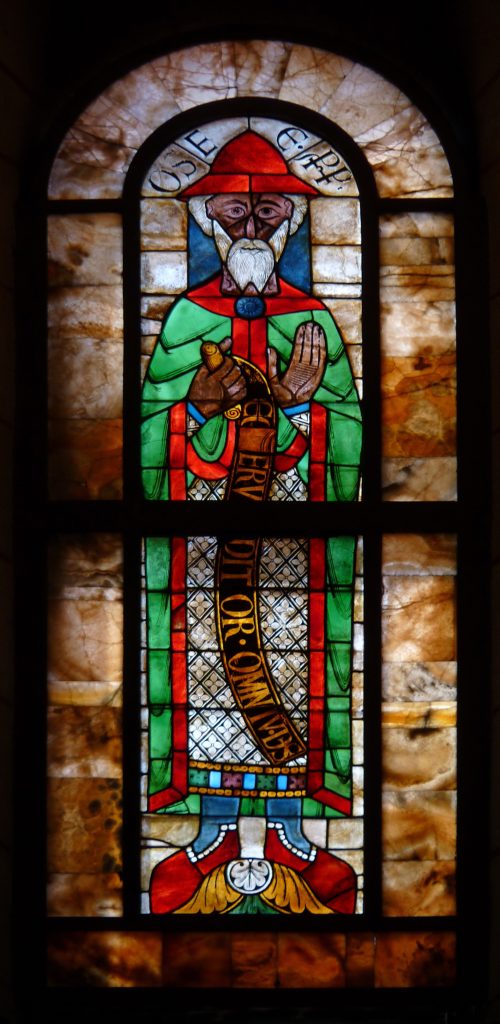
The following is a stained glass window of Hosea in the Augsburg Cathedral in Germany. It is part of the “Prophet windows of Augsburg ” from the 12th century which is assumed to be the oldest remaining set of church windows:
Photo by Hans Bernhard, hosted by Wikimedia Common under the GFDL-CC-BY-SA-all license
Stained glass is not just highly decorative, it’s a medium which has been used to express important religious messages for centuries. Literacy was not widespread in the medieval and Renaissance periods and the Church used stained glass and other artworks to teach the central beliefs of Christianity. In Gothic churches, the windows were filled with extensive narrative scenes in stained glass — like huge and colorful picture storybooks — in which worshipers could ‘read’ the stories of Christ and the saints and learn what was required for their religious salvation. (Source: Victoria and Albert Museum )
In Hungarian Sign Language it is translated with the sign forming the letter ‘j’ near the heart. This also reflects the fact that this apostle was related to Jesus. (Source: Jenjelvi Biblia and HSL Bible Translation Group)
“Jude” in Hungarian Sign Language — not that only the first part refers to “Jude,” with the second part meaning “letter” (source )
The Hebrew, Latin, and Greek that is transliterated as “Joel” in English means “LORD of God,” “the LORD is God,” “the LORD is might.” (Source: Cornwall / Smith 1997 )
In Spanish Sign Language it is translated in two different ways. The first is with a sign depicting “Pentecost flame,” referring to Peter’s speech on Pentecost in which he quotes Joel in Acts 2:16 and following. (Source: Steve Parkhurst)
In Hungarian Sign Language it is translated with a sign that refers to the fact that God’s message, through the prophet, was perceived and proclaimed in the widest possible scope (see Joel 2:28). (Source: Jenjelvi Biblia and HSL Bible Translation Group)
“Joel” in Hungarian Sign Language — note that only the first part refers to “Joel,” the second and third parts refer to “prophet” and “book” (source )
The Aramaic or Syriac that is transliterated in English as “Golgotha” is translated in Hungarian Sign Language with a two-handed sign: the lower hand indicates the place of the skull (see Mark 15:22 et al.), while the other hand depicts the sign for the three crosses of Golgotha (see Mark 15:7 et al.). (Source: Jenjelvi Biblia and HSL Bible Translation Group)
The Hebrew and Latin that is transliterated as “Amos” in English is translated in Spanish Sign Language with the sign for “renovate / renew,” particularly referring to Amos 9:11. (Source: Steve Parkhurst)
In Swiss-German Sign Language it is translated with the sign that depicts Amos’ move from the Southern Kingdom of Judah into the Northern Kingdom of Israel to prophesy against it.
In Hungarian Sign Language it is translated with a sign reflecting the meaning and significance of the Hebrew name: burden-bearer or one who carries a load. While the biblical text does not explicitly define the name, its meaning indirectly alludes to the prophet’s ministry, as he proclaimed heavy judgments (burdens) against Israel. “I will crush you as a cart crushes, when loaded with grain.” (Amos 2:13). (Source: Jenjelvi Biblia and HSL Bible Translation Group)
“Amos” in Hungarian Sign Language — note that only the first part refers to “Amos,” the second and third parts refer to “prophet” and “book” (source )
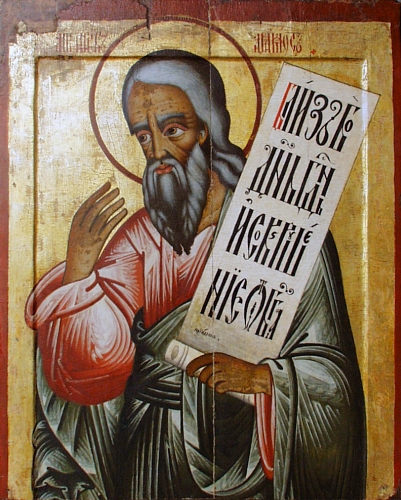
Following is a Russian Orthodox icon of Amos from the 18th century (found in the Transfiguration Church, Kizhi Monastery, Karelia, Russia). The words on the scroll are extracted from Isaiah 13:6: “For the day of the Lord is near; it will come like destruction from the Almighty!”
Orthodox Icons are not drawings or creations of imagination. They are in fact writings of things not of this world. Icons can represent our Lord Jesus Christ, the Virgin Mary, and the Saints. They can also represent the Holy Trinity, Angels, the Heavenly hosts, and even events. Orthodox icons, unlike Western pictures, change the perspective and form of the image so that it is not naturalistic. This is done so that we can look beyond appearances of the world, and instead look to the spiritual truth of the holy person or event. (Source )