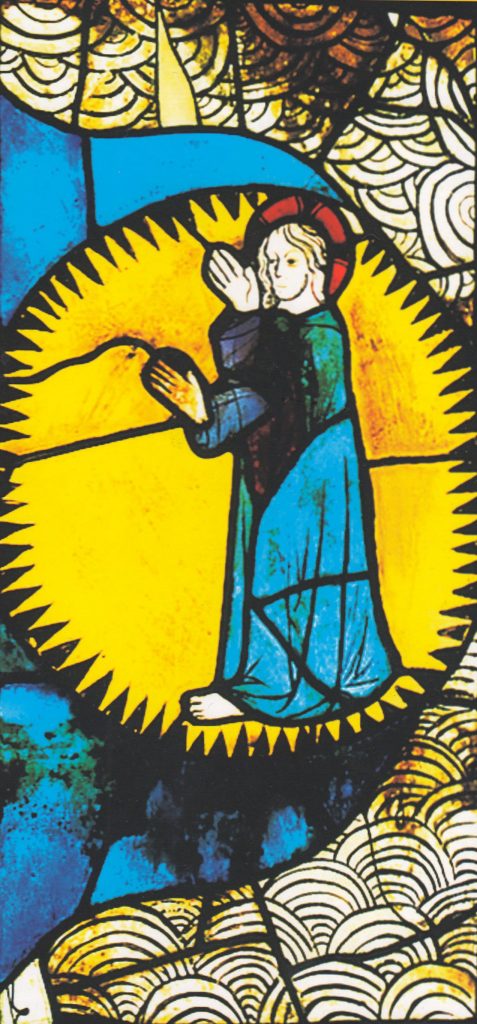
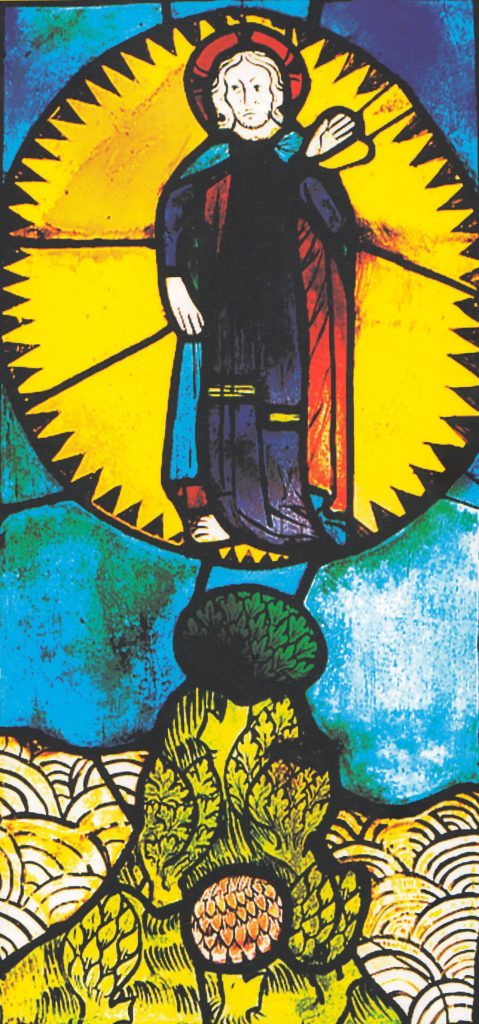
The following is a stained glass window from the Three choir windows in the Marienkirche, Frankfurt (Oder), Germany, of the 14th century, depicting God creating the plants:
Source: Der gläserne Schatz: Die Bilderbibel der St. Marienkirche in Frankfurt (Oder), Neuer Berlin Verlag, 2005, copyright for this image: Brandenburgisches Landesamt für Denkmalpflege und Archäologisches Landesmuseum
Stained glass is not just highly decorative, it’s a medium which has been used to express important religious messages for centuries. Literacy was not widespread in the medieval and Renaissance periods and the Church used stained glass and other artworks to teach the central beliefs of Christianity. In Gothic churches, the windows were filled with extensive narrative scenes in stained glass — like huge and colorful picture storybooks — in which worshipers could ‘read’ the stories of Christ and the saints and learn what was required for their religious salvation. (Source: Victoria and Albert Museum )
The following is a stained glass window from the Three choir windows in the Marienkirche, Frankfurt (Oder), Germany, of the 14th century, depicting God separating the waters:
Source: Der gläserne Schatz: Die Bilderbibel der St. Marienkirche in Frankfurt (Oder), Neuer Berlin Verlag, 2005, copyright for this image: Brandenburgisches Landesamt für Denkmalpflege und Archäologisches Landesmuseum
Stained glass is not just highly decorative, it’s a medium which has been used to express important religious messages for centuries. Literacy was not widespread in the medieval and Renaissance periods and the Church used stained glass and other artworks to teach the central beliefs of Christianity. In Gothic churches, the windows were filled with extensive narrative scenes in stained glass — like huge and colorful picture storybooks — in which worshipers could ‘read’ the stories of Christ and the saints and learn what was required for their religious salvation. (Source: Victoria and Albert Museum )
The following is a stained glass window from the Three choir windows in the Marienkirche, Frankfurt (Oder), Germany, of the 14th century, depicting God creating dry land:
Source: Der gläserne Schatz: Die Bilderbibel der St. Marienkirche in Frankfurt (Oder), Neuer Berlin Verlag, 2005, copyright for this image: Brandenburgisches Landesamt für Denkmalpflege und Archäologisches Landesmuseum
Stained glass is not just highly decorative, it’s a medium which has been used to express important religious messages for centuries. Literacy was not widespread in the medieval and Renaissance periods and the Church used stained glass and other artworks to teach the central beliefs of Christianity. In Gothic churches, the windows were filled with extensive narrative scenes in stained glass — like huge and colorful picture storybooks — in which worshipers could ‘read’ the stories of Christ and the saints and learn what was required for their religious salvation. (Source: Victoria and Albert Museum )
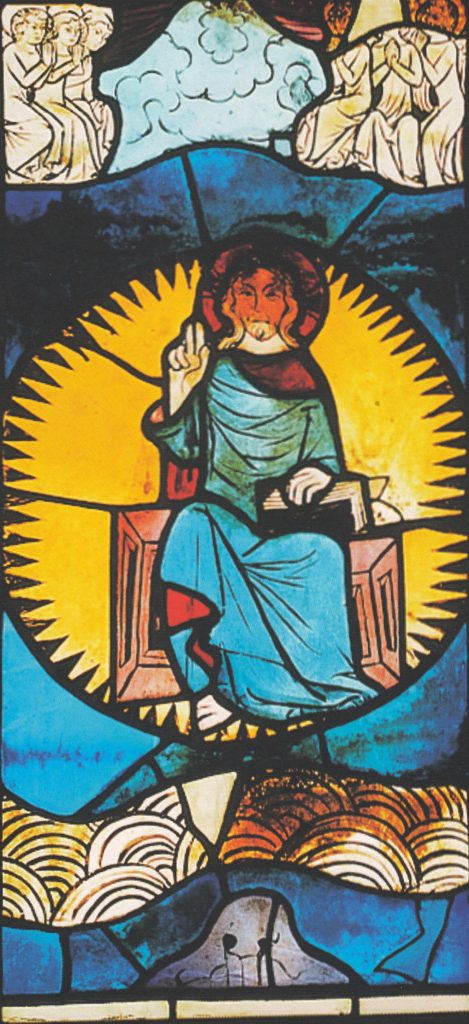
The following is a stained glass window from the Three choir windows in the Marienkirche, Frankfurt (Oder), Germany, of the 14th century, depicting God Above the Primordial Water:
Source: Der gläserne Schatz: Die Bilderbibel der St. Marienkirche in Frankfurt (Oder), Neuer Berlin Verlag, 2005, copyright for this image: Brandenburgisches Landesamt für Denkmalpflege und Archäologisches Landesmuseum
Stained glass is not just highly decorative, it’s a medium which has been used to express important religious messages for centuries. Literacy was not widespread in the medieval and Renaissance periods and the Church used stained glass and other artworks to teach the central beliefs of Christianity. In Gothic churches, the windows were filled with extensive narrative scenes in stained glass — like huge and colorful picture storybooks — in which worshipers could ‘read’ the stories of Christ and the saints and learn what was required for their religious salvation. (Source: Victoria and Albert Museum )
The following is a stained glass window from the Three choir windows in the Marienkirche, Frankfurt (Oder), Germany, of the 14th century, depicting a traditionally imagined Lucifer’s Fall:
Source: Der gläserne Schatz: Die Bilderbibel der St. Marienkirche in Frankfurt (Oder), Neuer Berlin Verlag, 2005, copyright for this image: Brandenburgisches Landesamt für Denkmalpflege und Archäologisches Landesmuseum
Stained glass is not just highly decorative, it’s a medium which has been used to express important religious messages for centuries. Literacy was not widespread in the medieval and Renaissance periods and the Church used stained glass and other artworks to teach the central beliefs of Christianity. In Gothic churches, the windows were filled with extensive narrative scenes in stained glass — like huge and colorful picture storybooks — in which worshipers could ‘read’ the stories of Christ and the saints and learn what was required for their religious salvation. (Source: Victoria and Albert Museum )
The Hebrew in Ezekiel 9:4 and Ezekiel 9:6 that is translated as “mark” or “sign” in Protestant English Bibles was translated in the LatinVulgate translation as signa thau or “signs of Thau.” The Hebrew had used tav (תָּו) which means “mark” or “sign,” but was interpreted here as strictly referring to tav (taw) (ת), the last letter of the Hebrew alphabet.
This is a tradition that Catholic Bibles, for into the 1940s which the Vulgate was the source version, have maintained until the present day. While the 16th century EnglishDhouay-Rheims version translated this directly as mark Thau, later versions either translated this as “X” (New American Bible, including its Revised Edition), but were more commonly using cross (Knox, Jerusalem Bible, New Jerusalem Bible, New Catholic Bible, Christian Community Bible). In a footnote it usually says something like this: “Literally, ‘with a tau.’ This was the last letter of the Hebrew alphabet, and in the old script a cross was the symbol for it.”
Indeed, this is what tav looked like historically:
Protestant Bibles in English, with the exception of the recent Evangelical Heritage Version (2019), all use a form of “mark.”
Other languages have the same tradition. The French Catholic La Bible de Jérusalem uses croix, the Mandarin ChineseSigao translation says 一個十字記號 (yīge shízì jìhào) or “a mark in the sign of a cross,” the PortugueseBíblia Ave Maria uses cruz, the PolishBiblia Tysiąclecia uses Taw (and mentions in a footnote that taw used to be written in the form of a cross), the German EinheitsübersetzUng has Taw as well, and the SpanishEl Libro del Pueblo de Dios has “T.”
This last translation (“T”) also found its way into a series of stained glass window from the Three choir windows in the Marienkirche, Frankfurt (Oder), Germany, of the 14th century (note the “T” in the antichrist’s halo as well as on the forehead on his followers):
Incidentally, the German word for devil is “Teufel” (in the spelling “tiuvel” in the 14th century), which likely helped the choice of the “T” for the mark.
Painting by Wang Suda 王肅達 (1910-1963),
Copyright by the Catholic University Peking, China
Text under painting translated from Literary Chinese into English: Jesus Ascended to Heaven
The Lord returned to Heaven and was seated at the right hand of Father
Image taken from Chinese Christian Posters . For more information on the “Ars Sacra Pekinensis” school of art, see this article , for other artworks of that school in TIPs, see here.
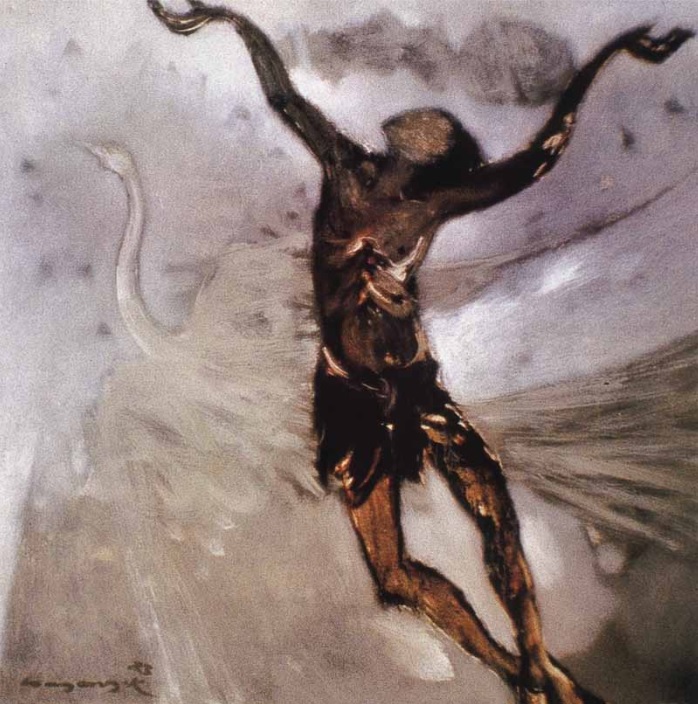
Following is a painting (“Ascension of Jesus”) by Bagong Kussudiardja (1928-2004):
“Bagong Kussudiardja was born in Indonesia and brought up among artists. He began to study the classical dances of Java at the age of 18 and his love of dance has always been foremost in his life. After independence in 1945, Bagong began to experiment with dances which would reflect the new spirit in Indonesia.
Bagong takes a close interest in all aspects of the arts. He is a skilled batik painter and as the painting indicates, his oil paintings also rank with the finest. His painting of the dancing Christ ascending to heaven was prepared for the Second Conference of the Asian Christian Art Association held in the Philippines.” (Source for this and the image: The Bible Through Asian Eyes by Masao Takenaka and Ron O’Grady 1991)
The following is a church window based on an image of Annie Vallotton. This is installed in a church of the Union des Églises Baptistes du Cameroun in Mowo (Mokong), Cameroon.
Photo and the following description by Ken Hollingsworth
“The windows are open with no screens or glass. The pictures were fabricated by projecting the picture using an overhead projector on a piece of plywood. They were drawn on the plywood with charcoal. Then the fabricator cut pieces of iron rebar to make the picture. Then the iron pieces were welded together. Later, when the pictures were installed, they were painted with different colors to help the people ‘see’ the picture.”
The following is a stained glass window from the Three choir windows in the Marienkirche, Frankfurt (Oder), Germany, of the 14th century:
Source: Der gläserne Schatz: Die Bilderbibel der St. Marienkirche in Frankfurt (Oder), Neuer Berlin Verlag, 2005, copyright for this image: Brandenburgisches Landesamt für Denkmalpflege und Archäologisches Landesmuseum
Stained glass is not just highly decorative, it’s a medium which has been used to express important religious messages for centuries. Literacy was not widespread in the medieval and Renaissance periods and the Church used stained glass and other artworks to teach the central beliefs of Christianity. In Gothic churches, the windows were filled with extensive narrative scenes in stained glass — like huge and colorful picture storybooks — in which worshipers could ‘read’ the stories of Christ and the saints and learn what was required for their religious salvation. (Source: Victoria and Albert Museum )
The following is a church window based on an image of Annie Vallotton. This is installed in a church of the Union des Églises Baptistes du Cameroun in Mowo (Mokong), Cameroon.
Photo and the following description by Ken Hollingsworth
“The windows are open with no screens or glass. The pictures were fabricated by projecting the picture using an overhead projector on a piece of plywood. They were drawn on the plywood with charcoal. Then the fabricator cut pieces of iron rebar to make the picture. Then the iron pieces were welded together. Later, when the pictures were installed, they were painted with different colors to help the people ‘see’ the picture.”