
The Daughter of Jairus

Following is a 1973 painting of the JESUS MAFA project, a response to New Testament readings from the Lectionary by a Christian community in Cameroon, Africa. Each of the readings was selected and adapted to dramatic interpretation by the community members. Photographs of their interpretations were made, and these were then transcribed to paintings:

From Art in the Christian Tradition , a project of the Vanderbilt Divinity Library, Nashville, TN. Image retrieved March 23, 2026. Original source: librairie-emmanuel.fr.

The following is a 2006 stained glass window by Annemiek Punt from the Nieuwe Kerk, Delft, Netherlands:
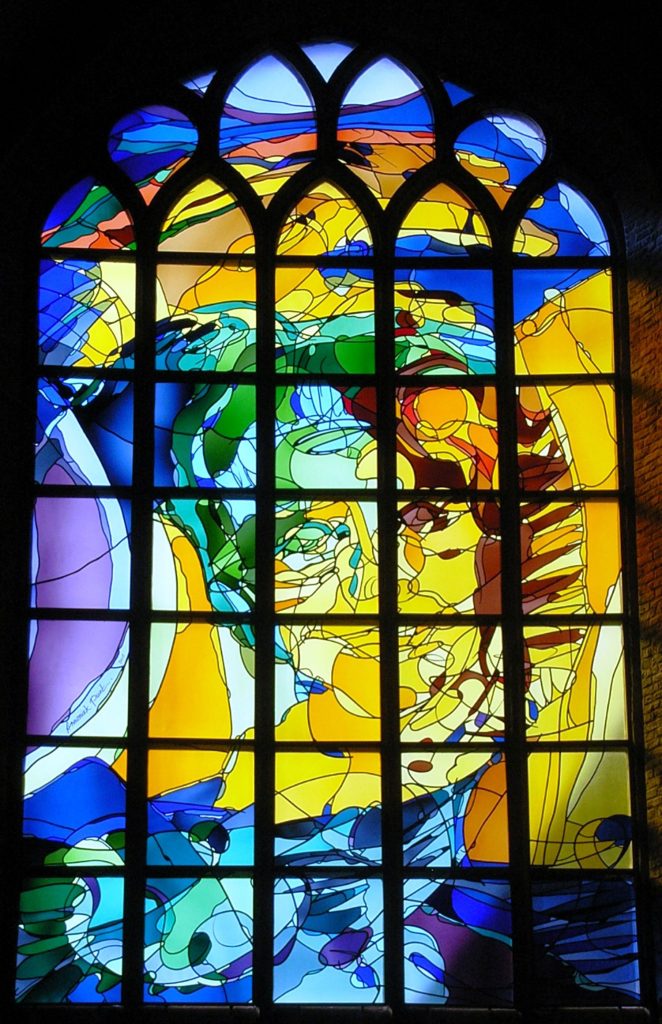
Source: Art in the Christian Tradition , a project of the Vanderbilt University Divinity Library, Nashville, TN. Original source: Wikimedia

Stained glass is not just highly decorative, it’s a medium which has been used to express important religious messages for centuries. Literacy was not widespread in the medieval and Renaissance periods and the Church used stained glass and other artworks to teach the central beliefs of Christianity. In Gothic churches, the windows were filled with extensive narrative scenes in stained glass — like huge and colorful picture storybooks — in which worshipers could ‘read’ the stories of Christ and the saints and learn what was required for their religious salvation. (Source: Victoria and Albert Museum )

complete verse (Mark 5:42)

Following are a number of back-translations of Mark 5:42:

  • Uma: “The child got/woke up and immediately walked. (Her age was twelve years.) No kidding the surprise of the people who saw [this].” (Source: Uma Back Translation)
  • Yakan: “Immediately the child got up and walked about in the house. She was twelve years old. They were very amazed.” (Source: Yakan Back Translation)
  • Western Bukidnon Manobo: “The child got up and immediately began to walk around. She was twelve years old. The mother and father of the child were very much amazed.” (Source: Western Bukidnon Manobo Back Translation)
  • Kankanaey: “She truly got-right-up and walked. (That young-lady was twelve years old.) They were extremely amazed.” (Source: Kankanaey Back Translation)
  • Tagbanwa: “It’s like the child was-suddenly-wakened, and sat up at once, going on to stand up and walk around, for she was twelve years old. Those companions of his/hers were really amazed.” (Source: Tagbanwa Back Translation)

Translation commentary on Mark 5:42

Exegesis:

anestē kai periepatei ‘got up and walked’: perhaps, ‘rose and started walking about.’

anistēmi (cf. 1.35) ‘rise,’ ‘get up.’

peripateō (cf. 2.9) ‘walk,’ ‘walk about.’

exestēsan … ekstasei megalē ‘they were amazed with a great amazement’ (cf. 4.41 ‘they feared a great fear’ for another example of this form of intensive statement).

existēmi (cf. 2.12) ‘to astonish,’ ‘to amaze,’ ‘to confound’: in the active aorist (as here) the verb has a passive sense, ‘to be astonished,’ ‘to be amazed.’

ekstasis (16.8) has the weakened sense of ‘bewilderment,’ ‘astonishment.’

Translation:

The Greek imperfect in the verb translated ‘walked’ has suggested to some translators the value of translating ‘was walking,’ but this may not always be done. For example, in one translation the imperfect tense suggested that she was walking, before she got up. Hence, ‘stood up and started to walk’ is preferable.

Twelve years is translated quite idiomatically in some languages, e.g. ‘her winters are twelve’ (Navajo) or ‘her seasons were ten on the head of two’ (Shilluk).

Quoted with permission from Bratcher, Robert G. and Nida, Eugene A. A Handbook on the Gospel of Mark. (UBS Handbook Series). New York: UBS, 1961. For this and other handbooks for translators see here .

SIL Translator's Notes on Mark 5:42

5:42a

the girl got up: The Greek word that the Berean Standard Bible translates as got up can either mean “to stand up” or “to rise from the dead.” The context shows that both of these things happened: she became alive again, and she stood up. In some languages it may be necessary to make this explicit. For example:

…the little girl became alive again. She stood up…

5:42b

She was twelve years old: This is background information. Many translations use parentheses to indicate this. (Mark may have said this to explain that the girl was old enough to walk. The terms that have been used in the story to refer to her (“my little daughter,” “child,” and “little girl”) could also refer to a baby.) Indicate it in a natural way in your language. For example:

By the way, the child/girl was twelve years old.

In some languages it may be more natural to mention the age of the girl elsewhere in the story, for example, at 5:40d, 5:41a, or 5:42a. The Contemporary English Version says:

41aHe took the twelve-year-old girl by the hand

5:42c

and at once: The words and at once refer to the event of the little girl beginning to live again.

they were utterly astounded: The Greek clause that the Berean Standard Bible translates as they were utterly astounded is literally “they were astonished with great astonishment.” This clause describes an intense feeling of surprise mixed with fear or awe at the miracle that Jesus had just done. Translate it with an expression in your language that could describe how people would feel if they saw someone raised from the dead. You may have an idiom for this.

© 2008 by SIL International®

Made available under the terms of a Creative Commons Attribution-ShareAlike 4.0 License (CC BY-SA) creativecommons.org/licenses/by-sa/4.0

All Scripture quotations in this publication, unless otherwise indicated, are from The Holy Bible, Berean Standard Bible.
BSB is produced in cooperation with Bible Hub, Discovery Bible, OpenBible.com, and the Berean Bible Translation Committee.