The Hebrew in Genesis 3:18 that is translated as “thistles” in English is translated in Elhomwe as epullathi or “bitter fruit” (which cannot be eaten). (Source: project-specific translation notes in Paratext)
See also thorns.

וְק֥וֹץ וְדַרְדַּ֖ר תַּצְמִ֣יחַֽ לָ֑ךְ וְאָכַלְתָּ֖ אֶת־עֵ֥שֶׂב הַשָּׂדֶֽה׃
18thorns and thistles it shall bring forth for you;
and you shall eat the plants of the field.
The Hebrew in Genesis 3:18 that is translated as “thistles” in English is translated in Elhomwe as epullathi or “bitter fruit” (which cannot be eaten). (Source: project-specific translation notes in Paratext)
See also thorns.
Compare Genesis 3:17 – Genesis 3:19 and 1 Meqabyan 27:19 (Ethiopian Maccabees).
For the phrase “thorns and thistles it shall bring forth for you,” see Hebrews 6:8.
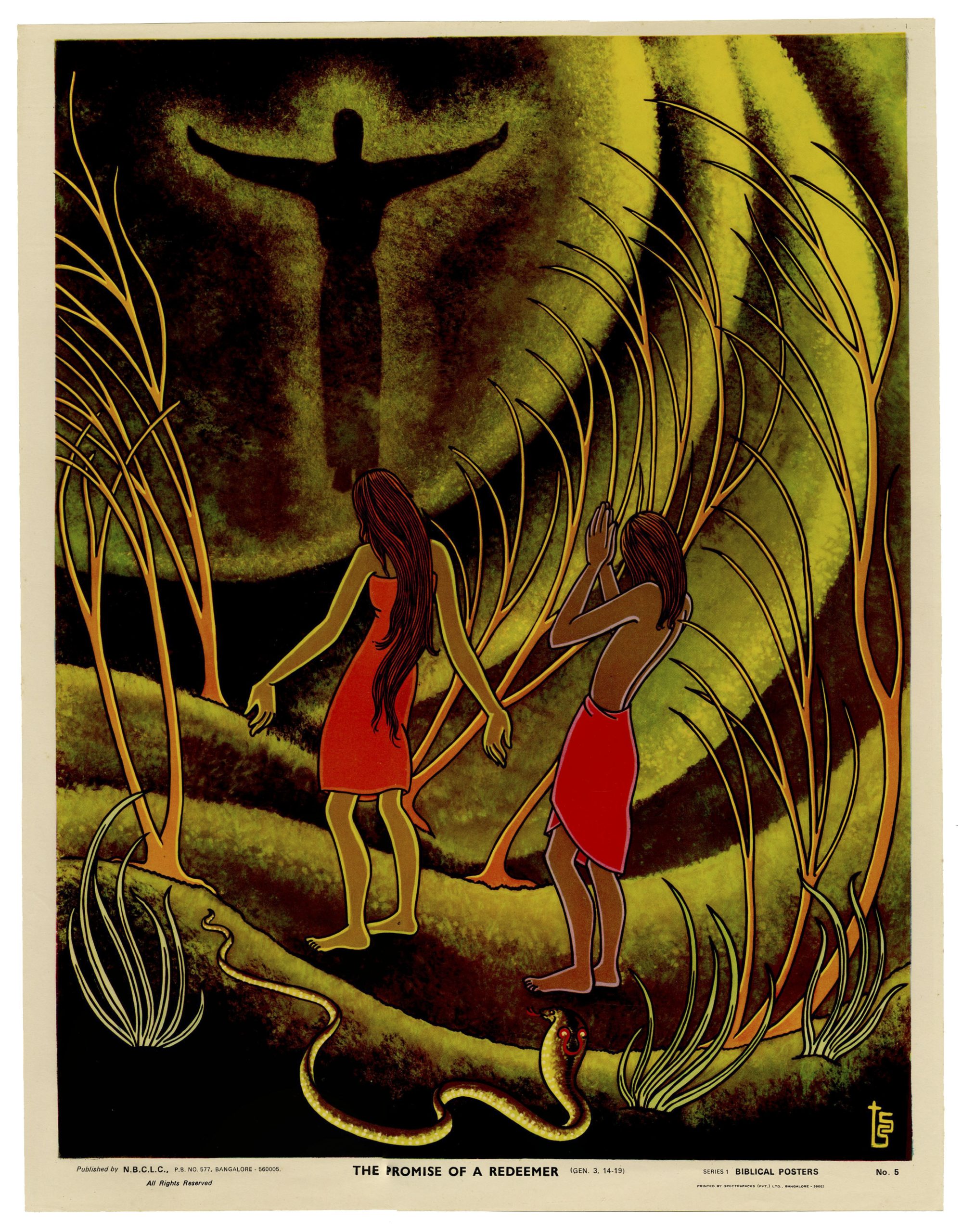
Artwork by Sister Marie Claire , SMMI (1937–2018) from Bengaluru, India.
For more information about images by Sister Marie Claire and ways to purchase them as lithographs, see here .
For other images of Sister Marie Claire paintings in TIPs, see here.
The following is a stained glass window from the Three choir windows in the Marienkirche, Frankfurt (Oder), Germany, of the 14th century, depicting God judging Adam and Eve:

Source: Der gläserne Schatz: Die Bilderbibel der St. Marienkirche in Frankfurt (Oder), Neuer Berlin Verlag, 2005, copyright for this image: Brandenburgisches Landesamt für Denkmalpflege und Archäologisches Landesmuseum
Stained glass is not just highly decorative, it’s a medium which has been used to express important religious messages for centuries. Literacy was not widespread in the medieval and Renaissance periods and the Church used stained glass and other artworks to teach the central beliefs of Christianity. In Gothic churches, the windows were filled with extensive narrative scenes in stained glass — like huge and colorful picture storybooks — in which worshipers could ‘read’ the stories of Christ and the saints and learn what was required for their religious salvation. (Source: Victoria and Albert Museum )
See also other stained glass windows from the Marienkirche in Frankfurt.
Following is the translation of Genesis 3 into Jamaican Sign Language:
Source: Jamaican Sign Language Bible Translation
3:1 In the garden that Yahweh created there were many animals. Out of all the animals, there was one very cunning creature compared to a serpent who was very deceitful.
It happened that the man and the woman were walking in the garden and the serpent approached them and spoke to them cunningly. To the woman he said, “Did Yahweh really say, ‘You must not eat from any fruit tree in the garden’?”
3:2 The woman replied to the serpent, “No, Yahweh gave us all the trees in the garden to eat from.
3:3 But there is one tree in the middle of the garden whose fruit we must not eat nor touch. If we do, our lives will be ruined and there will be death thereafter.
3:4 The serpent said to the woman, “‘Your lives will be ruined and you will die thereafter?’ Ha. No, you will not die.
3:5 Yahweh knows that when you eat from this tree your eyes will be opened and you will become enlightened. Yahweh knows good and evil, if you know good and evil you will become like God.”
3:6 The woman looked at the tree with its many fruits with desire. The fruits were pleasing to her eyes and aroused her desire for wisdom. She picked the fruit and ate it. She gave some of the fruit to her husband who also ate it.
3:7 Suddenly, their eyes were opened, they looked at themselves and realized that they were naked. They had transgressed. They tried to cover their bodies. They ran to find large fig leaves which they gathered and weaved together to hide their nakedness.
3:8 In the cool of the evening, Yahweh walked through the garden. The man and woman were still trying to cover their bodies when they heard his footsteps. The man and woman hid fearfully behind the trees.
3:9 Yahweh called to the man “Where are you? Why have you not come to me?”
3:10 The man emerged from behind the trees and answered Yahweh, “I heard you but because I was naked, I was afraid to come to you, so I hid behind the trees.”
3:11 And Yahweh replied, “Who told you that you were naked? Did you eat from the tree which I commanded you not to eat from?”
3:12 Ashamedly, the man replied, “It was the woman you created from my rib to be my companion who picked the fruit from the tree and gave it to me to eat.”
3:13 And Yahweh said to the woman, “What have you done?”
Fearfully, the woman emerged from the trees and replied, “It was the serpent who deceived me. I fell for his trick and ate the fruit from the tree.”
3:14 And Yahweh looked at the serpent and cursed it saying, “Above all the animals, all livestock and wild animals, you are the least. You will be punished by remaining low and crawling on your belly in the dust, you will breathe dust for the rest of your life.
3:15 The serpent and the woman will be enemies; your offspring will be enemies. One of her descendants will crush your head and you will bite his feet.”
3:16 To the woman Yahweh spoke, “For the rest of your life you face struggles and hardship, you will suffer severe childbearing, severe labor and the burden of child rearing will be hard. You will desire a husband as your partner, but your husband will rule over you.”
3:17 To the man Yahweh spoke, “I commanded you not to eat from the tree, but you listened to your wife and ate it. For the rest of your life, you will face struggles and hardship. You will work hard to plow the land for food
3:18 but the soil will produce thorns and weeds that will ruin your crops.
3:19 You will sweat and work hard to gather food for the rest of your life. When your body dies it will break down and return to the dust from which it came. I, Yahweh, created man from dust and to the dust you will return.”
3:20 The man Adam named the woman Eve because she would become the mother of all the living. Eve.
3:21 Yahweh made clothes from animal skin and clothed them.
3:22 And Yahweh said to them, “You have eaten from the tree and transgressed. Now you are like us; you know good and evil. If one eats from the tree of life they will live forever. If you also eat from the tree of life, you will live forever. This cannot be allowed, you must leave.”
3:23 In the garden where they were, Yahweh sent them away. The same soil that Yahweh created human from is the same soil Adam will plow and toil laboriously.
3:24 They left the garden walking towards the East. When they left Yahweh commanded the heavenly beings to guard the tree of life on either side. In the center he placed a sword of fire flashing back and forth. Adam and Eve will never be able to return, the garden remains guarded.
Back-translation by Amakedia Wallen, coordinated by Tashi Widmer
Following are a number of back-translations as well as a sample translation for translators of Genesis 3:18:
No comments yet.


Leave a Reply
You must be logged in to post a comment.