Following are a number of back-translations as well as a sample translation for translators of 2 Samuel 12:1:
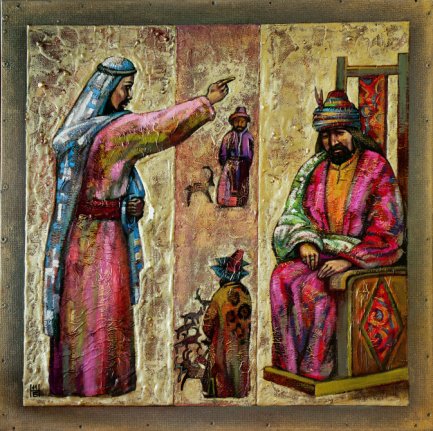
Kupsabiny: “God sent the prophet Nathan to go to where David was. Nathan went and told David that, ‘There were two people who were living in one village area. One was rich but the other one was poor.” (Source: Kupsabiny Back Translation)
Newari: “The LORD sent the prophet Nathan to David’s place, and, going before David, he spoke like this, "In a [certain] city there were two men, one was rich, the other was poor.” (Source: Newari Back Translation)
Hiligaynon: “Now, the LORD sent Prophet Natan to David. When- he -arrived to David, he said, ‘There were two men who were-living in a town. One was rich and the other one was poor.” (Source: Hiligaynon Back Translation)
English: “Yahweh told the prophet Nathan what David had done, and he sent Nathan to tell this story to David: ‘I heard about two men who were living in a certain city. One was rich and the other was poor.” (Source: Translation for Translators)
And: the transition word used here will be determined in part by the decision about how the last part of verse 27 in the previous chapter is handled. If it is made a part of this section, it will be possible to translate 11.27b and the first part of this verse as follows: “Because the LORD was angry about what David had done, he sent Nathan the prophet….” If the section break is made at the beginning of the chapter, it may be better to leave the Hebrew conjunction untranslated, as in Good News Translation, New International Version, New Jerusalem Bible, and New American Bible. Without a section heading at this point, An American Translation translates the transition word “Accordingly….” Similarly Knox begins “So it was that [the LORD sent Nathan…].”
There is no record in this verse of the usual formulas of politeness that are typical of encounters with a king. Apparently the prophet launches directly into his parable without showing the customary deference. This direct approach should be retained in the receptor language if at all possible.
Nathan: Nathan is introduced as “the prophet” in 7.2. Since readers may not remember that he was a prophet, many common language translations add that information again at this point (Contemporary English Version, Parola Del Signore: La Bibbia in Lingua Corrente, Die Bibel im heutigen Deutsch, Bible en français courant, as well as Good News Translation).
In a certain city: literally “in one town [or, city],” that is, “in the same city” (New Jewish Publication Society’s Tanakh). Since the size of the place where the two men lived is unimportant to the story, those languages that usually translate “city” as “large village” will not need to add the adjective. In fact New International Version, Contemporary English Version, and New American Bible as well as Good News Translation translate “town.” What is important is that the two men lived in the same location.
Rich … poor: the two terms used are clearly intended to show a sharp contrast in personal and material possessions. The word translated poor comes from a root meaning “to be in need” or “to lack.” The detailed meaning of the two terms is filled out by the rest of the story.
Quoted with permission from Omanson, Roger L. and Ellington, John E. A Handbook on the First and Second Books of Samuel, Volume 2. (UBS Helps for Translators). New York: UBS, 2001. For this and other handbooks for translators see here .


Leave a Reply
You must be logged in to post a comment.