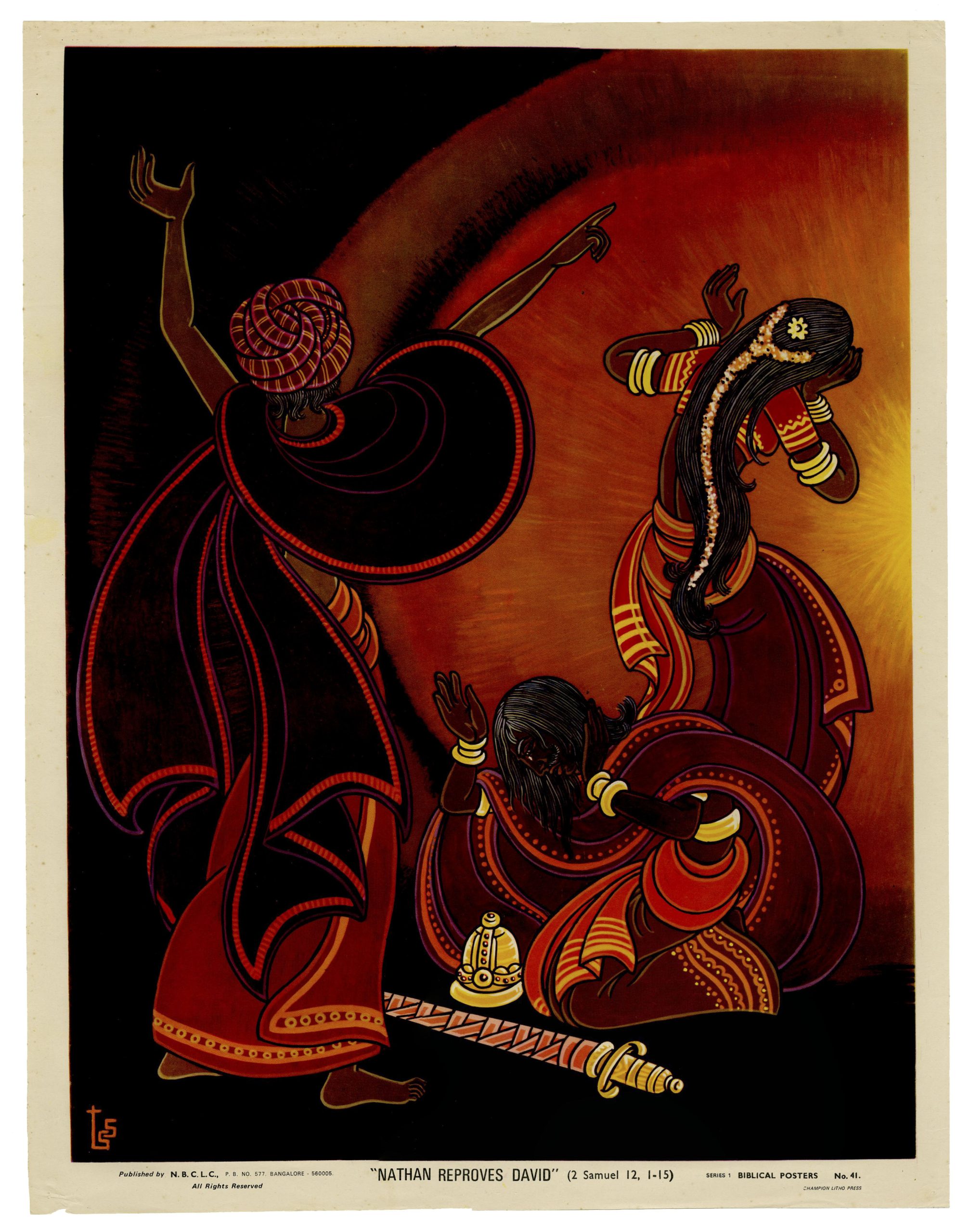
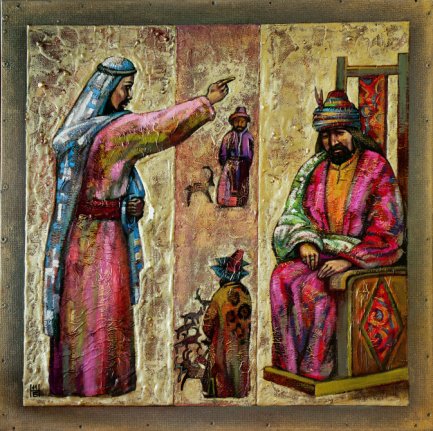
Nathan Reproves David

Artwork by Sister Marie Claire , SMMI (1937–2018) from Bengaluru, India.

For more information about images by Sister Marie Claire and ways to purchase them as lithographs, see here .

For other images of Sister Marie Claire paintings in TIPs, see here.

The following artwork is part of a series of 56 paintings on biblical themes by Kazakh artist Nelly Bube (born 1949):

Copyright by Norwegian Bible Society , used with permission.

For other images of Nelly Bube in TIPs, see here.

complete verse (2 Samuel 12:2)

Following are a number of back-translations as well as a sample translation for translators of 2 Samuel 12:2:

  • Kupsabiny: “The one who was rich had cows which were very many and sheep,” (Source: Kupsabiny Back Translation)
  • Newari: “The rich man had many [flocks] of sheep and goats and [many] herds of cows and bulls.” (Source: Newari Back Translation)
  • Hiligaynon: “The rich-man had so many sheep and cattle,” (Source: Hiligaynon Back Translation)
  • English: “The rich man owned a lot of cattle and sheep.” (Source: Translation for Translators)

Translation commentary on 2 Samuel 12:2

Had very many: the Good News Translation rendering seems a bit weak here. The Hebrew uses both the verb meaning “to be many” (or “to multiply”) and a qualifying adverb that carries the idea of “exceedingly” or “especially.” It is the same word used to qualify the beauty of Bathsheba in 11.2 and the verb “be ashamed” in 10.5. Here New International Version speaks of “a very large number…,” while New Jerusalem Bible has “in great abundance.”

Flocks and herds: on the meaning of these two terms, see the comments on 1 Sam 30.20. In the culture of the Old Testament as in certain cultures today, wealth was measured primarily by the number of livestock a person had.

Quoted with permission from Omanson, Roger L. and Ellington, John E. A Handbook on the First and Second Books of Samuel, Volume 2. (UBS Helps for Translators). New York: UBS, 2001. For this and other handbooks for translators see here .