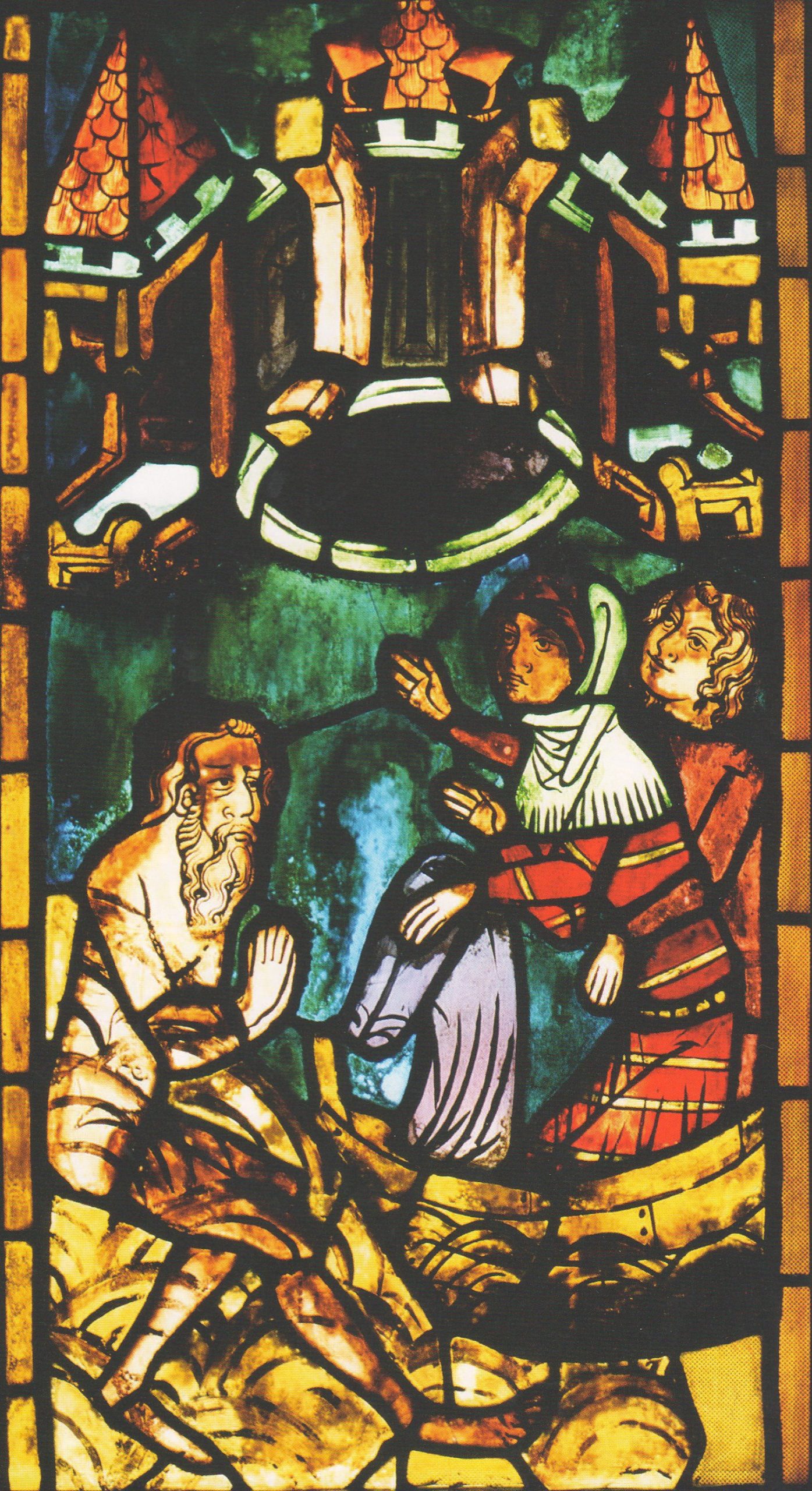
The following is a stained glass window from the Three choir windows in the Marienkirche, Frankfurt (Oder), Germany, of the 14th century, depicting the healing of Naaman:
Source: Der gläserne Schatz: Die Bilderbibel der St. Marienkirche in Frankfurt (Oder), Neuer Berlin Verlag, 2005, copyright for this image: Brandenburgisches Landesamt für Denkmalpflege und Archäologisches Landesmuseum
Stained glass is not just highly decorative, it’s a medium which has been used to express important religious messages for centuries. Literacy was not widespread in the medieval and Renaissance periods and the Church used stained glass and other artworks to teach the central beliefs of Christianity. In Gothic churches, the windows were filled with extensive narrative scenes in stained glass — like huge and colorful picture storybooks — in which worshipers could ‘read’ the stories of Christ and the saints and learn what was required for their religious salvation. (Source: Victoria and Albert Museum )
Following are a number of back-translations as well as a sample translation for translators of 2 Kings 5:2:
Kupsabiny: “There was a time when the soldiers of Syria were fighting the country of Israel until they took/caught a small girl and went with her. That girl came to stay in the home of Naaman so that she could help the lady of the house.” (Source: Kupsabiny Back Translation)
Newari: “Once when the army of Aram attacked Israel, the soldiers of Aram captured a teenage girl and brought her to Aram. That girl became the maid servant of the wife of Naaman, the commanding general.” (Source: Newari Back Translation)
Hiligaynon: “When the soldiers of Aram attacked Israel, they captured a young-girl/[a dalagita is around 12 years old] who became a servant of the wife of Naaman.” (Source: Hiligaynon Back Translation)
English: “Some time previously, groups of soldiers/marauders from Syria had raided/attacked the land of Israel, and they had captured a young girl and taken her to Syria. She became a servant for Naaman’s wife.” (Source: Translation for Translators)
Now the Syrians on one of their raids had carried off a little maid from the land of Israel: Syria and Israel were often at war. They were apparently at peace during the time that the Naaman incident occurred. The girl who is the key to this story had been captured by the Syrians on one of their previous attacks against Israel. In some languages it will have to be stated clearly at this point that the raid was “against Israel,” as Good News Translation has done.
The verb tense of had carried off should show that this was something that had happened some time prior to the appearance of Naaman’s leprosy. Some languages may require a restructuring of the entire verse beginning with “Some time before this, the Syrians had captured…” or something similar.
A little maid is translated “a young girl” by several English versions (New Revised Standard Version, New Jewish Publication Society’s Tanakh, New International Version). The actual age of the girl is uncertain. The Hebrew word translated maid is used in the Old Testament of young single girls who are still virgins or of young married women, so the reference need not be to a little child (see the comments on 1 Kgs 1.2). In this context the Hebrew word translated little probably refers more to age than to physical size (see the comments on 1 Kgs 11.17). In those languages where the age is important in deciding which word to use, translators should probably consider that the girl was less than fifteen years old.
She waited on … is literally “she was before….” This expression is used often to speak of one who “serves” another person. Contemporary English Version translates “she became a servant of…” (similarly New American Bible). Compare 1 Sam 19.7.
Quoted with permission from Omanson, Roger L. and Ellington, John E. A Handbook on 1-2 Kings, Volume 2. (UBS Helps for Translators). New York: UBS, 2008. For this and other handbooks for translators see here .


Leave a Reply
You must be logged in to post a comment.