12Are not Abana and Pharpar, the rivers of Damascus, better than all the waters of Israel? Could I not wash in them and be clean?” He turned and went away in a rage.
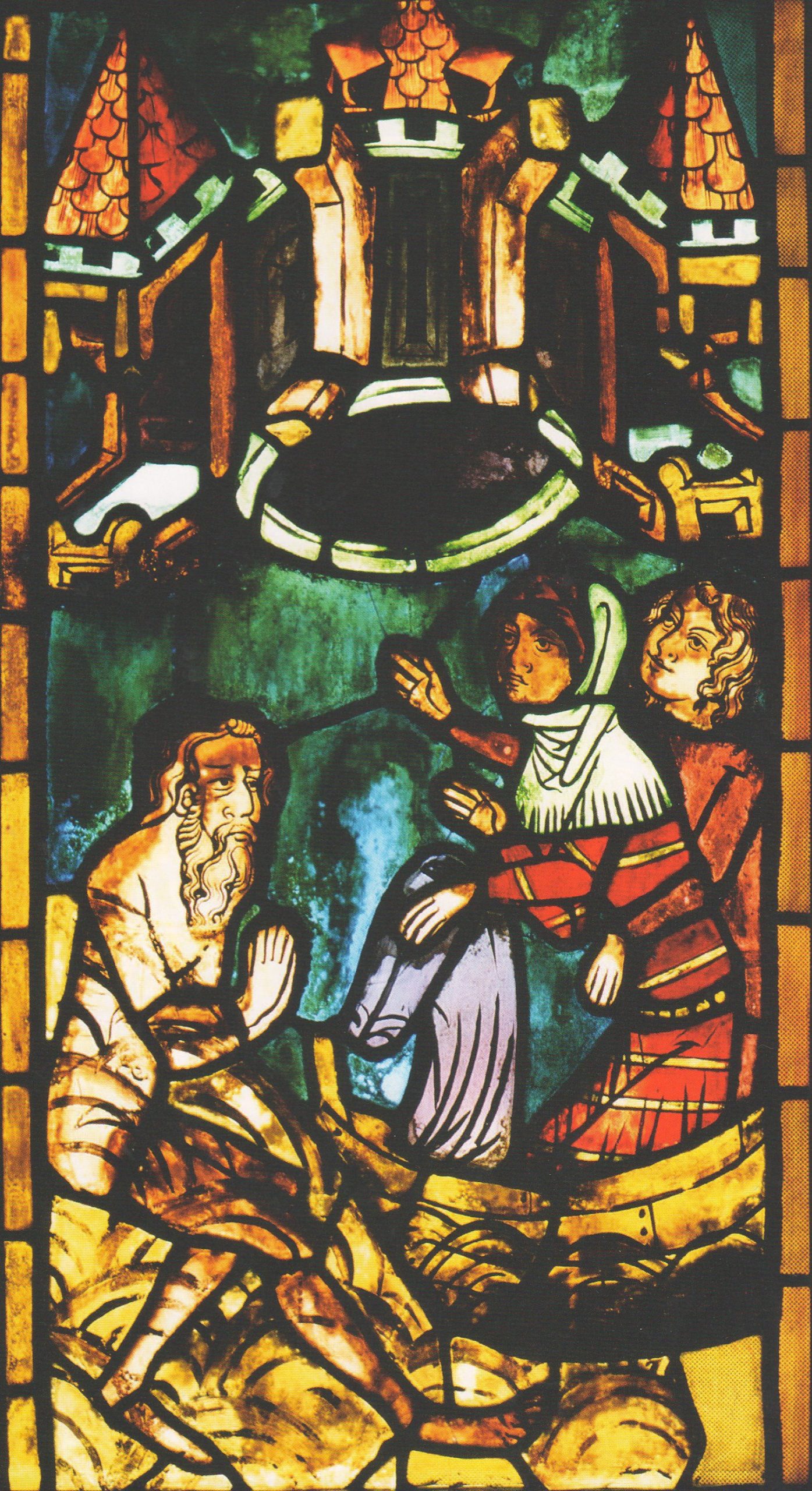
The following is a stained glass window from the Three choir windows in the Marienkirche, Frankfurt (Oder), Germany, of the 14th century, depicting the healing of Naaman:
Source: Der gläserne Schatz: Die Bilderbibel der St. Marienkirche in Frankfurt (Oder), Neuer Berlin Verlag, 2005, copyright for this image: Brandenburgisches Landesamt für Denkmalpflege und Archäologisches Landesmuseum
Stained glass is not just highly decorative, it’s a medium which has been used to express important religious messages for centuries. Literacy was not widespread in the medieval and Renaissance periods and the Church used stained glass and other artworks to teach the central beliefs of Christianity. In Gothic churches, the windows were filled with extensive narrative scenes in stained glass — like huge and colorful picture storybooks — in which worshipers could ‘read’ the stories of Christ and the saints and learn what was required for their religious salvation. (Source: Victoria and Albert Museum )
Following are a number of back-translations as well as a sample translation for translators of 2 Kings 5:12:
Kupsabiny: “And furthermore, is the river Abana and that of Pharpar over there by Damascus not better than all the rivers of Israel? Could I not have been able to wash myself in those rivers and become clean?’ Then Naaman began to go home very angry.” (Source: Kupsabiny Back Translation)
Newari: “What! Aren’t the Abana and Pharpar rivers which are in Damascus better than the rivers of Israel? What! could I not have become pure by immersing myself in them?" So he turned and went off in a rage.” (Source: Newari Back Translation)
Hiligaynon: “Are not the rivers of Abana and Farfar in Damascus better than other rivers here in Israel? Why should- not I -wash (myself) there so-that I will-be-cured?’ So he went-(away) in very angry.” (Source: Hiligaynon Back Translation)
English: “Surely the Abana River and the Pharpar River in Damascus in my own country of Syria are better than any of the rivers in Israel! Why can I not wash in those rivers and be healed?’ So he turned and walked away with great anger/disgust.” (Source: Translation for Translators)
Since this verse constitutes a second aspect of Naaman’s argument, Good News Translation finds it necessary to begin it with “Besides.” Something like this may also be required in other languages.
Abana and Pharpar, the rivers of Damascus: The first of these two rivers was just north of Damascus, and the other was just south of Damascus. A marginal note in the traditional Hebrew text gives the name of the first river as “Amana[h]” rather than Abana. Two ancient versions also have the same name as the marginal reading. “Amana[h]” is adopted by several modern translations (New Jewish Publication Society’s Tanakh, Nouvelle version Segond révisée, La Bible du Semeur, Moffatt, Jewish Publication Version). Non-biblical references from the ancient world to this river call it “Amanah,” but the same river is intended regardless of the spelling. Translators are advised to follow the majority of modern versions in using the name Abana. The problem is not mentioned in Hebrew Old Testament Text Project or Critique Textuelle de l’Ancien Testament.
For Damascus see 1 Kgs 11.24.
All the waters of Israel: Naaman is not arguing that the two rivers of Damascus were better than all the waters of Israel collectively, but rather that they were superior to any particular body of water in Israel. No doubt he had in mind especially the Jordan River where he had been told to go and bathe seven times.
One or both of the questions at the beginning of this verse may need to be transformed into statements in the receptor language since they are not asked for the sake of gaining new information. Naaman is quite convinced in his own mind that the rivers of Damascus are much better than other rivers. So it would be possible to translate “Surely the rivers back in Damascus, the Abana and the Pharpar, are better than any river here in Israel. I could have been healed [or, made pure] by washing in them.”
So he turned and went away in a rage: This sentence is omitted by Good News Translation. This was probably done because it repeats the same essential ideas found at the beginning of verse 11 (“Naaman was angry, and went away”). But the repetition makes his rejection all the more emphatic, and unless it is unnatural to do so, these ideas should be repeated in other languages.
Quoted with permission from Omanson, Roger L. and Ellington, John E. A Handbook on 1-2 Kings, Volume 2. (UBS Helps for Translators). New York: UBS, 2008. For this and other handbooks for translators see here .


Leave a Reply
You must be logged in to post a comment.