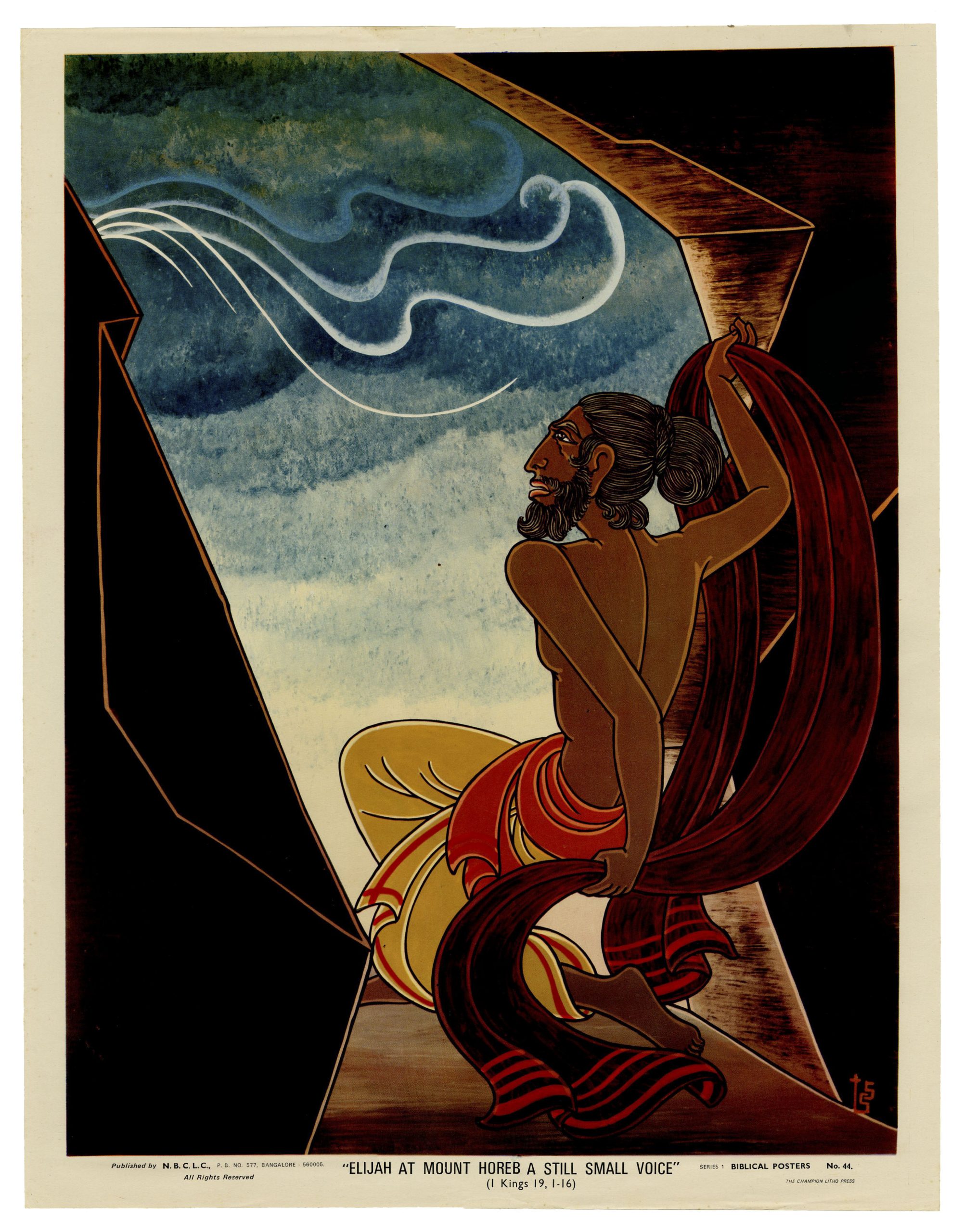
13When Elijah heard it, he wrapped his face in his mantle and went out and stood at the entrance of the cave. Then there came a voice to him that said, “What are you doing here, Elijah?”
The Hebrew that is translated as “cloak,” “shirt,” or “mantle” or similar in English is translated in Newari as gā (गा), the Nepali shawl wrapped around upper part of body, used by both men and women. (Source: Newari Back Translation)
The name that is transliterated as “Elijah” in English means “God-LORD,” “strength of the LORD,” “my God is YHWH.” “the LORD God.” (Source: Cornwall / Smith 1997 )
Orthodox Icons are not drawings or creations of imagination. They are in fact writings of things not of this world. Icons can represent our Lord Jesus Christ, the Virgin Mary, and the Saints. They can also represent the Holy Trinity, Angels, the Heavenly hosts, and even events. Orthodox icons, unlike Western pictures, change the perspective and form of the image so that it is not naturalistic. This is done so that we can look beyond appearances of the world, and instead look to the spiritual truth of the holy person or event. (Source )
Following are a number of back-translations as well as a sample translation for translators of 1 Kings 19:13:
Kupsabiny: “But/And when Elijah heard that whispering, he covered his eyes with a cloth and went to stand at the entrance to the cave. Then he heard a voice saying, ‘What are you doing here, Elijah?’” (Source: Kupsabiny Back Translation)
Newari: “As soon as he heard that voice, Elijah covered his face with his shawl and went out and stood at the entrance to the cave. A voice spoke to him like this, "Elijah, what are you doing here?"” (Source: Newari Back Translation)
Hiligaynon: “When- Elias -heard it, he covered his face with his cloak and came-out and stood at the mouth of the cave. Then there was a voice that said to him, ‘Elias, what are you doing here?’” (Source: Hiligaynon Back Translation)
English: “When Elijah heard that, he wrapped his cloak around his face. He went out of the cave and stood at its entrance. And he heard Yahweh speaking to him, saying again, ‘Elijah, why are you here?’” (Source: Translation for Translators)
He wrapped his face in his mantle: Like Moses, who covered his face so he would not see God (Exo 3.6), Elijah also covers his face in order not to see God. According to Exo 19.21, the people of Israel would perish if they looked at God. Elijah’s mantle or “cloak” (Good News Translation, New Living Translation) was an outer garment apparently made of hair-covered skin (2 Kgs 1.8).
Behold, there came a voice to him: Behold in this context may possibly introduce a concluding sentence, as it sometimes does. New Revised Standard Version (similarly New Jerusalem Bible) says “Then there came a voice to him.” See verse 5. In some languages it may be more natural to say “Then Elijah heard a voice.” Contemporary English Version has “The LORD asked” to make clear who the speaker is. This rendering is acceptable since the next verse shows clearly that Elijah is responding to the LORD.
What are you doing here, Elijah?: For the word order of this question, see the comments on verse 9.
Quoted with permission from Omanson, Roger L. and Ellington, John E. A Handbook on 1-2 Kings, Volume 1. (UBS Helps for Translators). New York: UBS, 2008. For this and other handbooks for translators see here .
19:13a When Elijah heard it, he wrapped his face in his cloak
Hearing the whisper/sound, Elijah put his cloak over his face -or-
At the sound Elijah covered his face with his robe. -or-
Elijah covered his face with his robe when he heard it.
19:13b and went out and stood at the mouth of the cave.
and went out. He stood at the entrance of the cave. -or-
He left the cave and stood at its opening.
19:13c Suddenly a voice came to him and said, “What are you doing here, Elijah?”
A voice spoke to him! It asked/said, “Elijah, what are you (sing) doing here?” -or-
Suddenly, he heard a voice asking him, “Elijah, why are you (sing) here?”



Leave a Reply
You must be logged in to post a comment.