The Hebrew that is transliterated as “Naomi” in English is translated in Spanish Sign Language with the sign for “changed identity” referring to the many life changes that Naomi goes through in the book of Ruth. (Source: Steve Parkhurst)
The Greek that is transliterated as “Herod (Antipas)” in English is translated in Spanish Sign Language with the sign for king and and a sign depicting cutting off the head (of John the Baptist), referring to Matthew 14:10 et al. (Source: Steve Parkhurst)
The Hebrew that is transliterated as “Rachel” in English is translated in Spanish Sign Language with a sign that signifies the eyelashes, referring to “beautiful eyes” as the opposite of Leah (see Genesis 29:17). (Source: Steve Parkhurst)
The Hebrew, Latin, and Greek that is transliterated as “Hosea” in English means “Jehovah is help or salvation,” “salvation.” (Source: Cornwall / Smith 1997 )
In Swiss-German Sign Language it is translated with a sign that depicts going away and returning, referring to Hosea going away and finding the prostitute Gomer to marry and then returning home with her (see Hosea 1:2 and Hosea 1:3).
In Hungarian Sign Language it is translated with a sign thatrefers to the faithful acceptance of God’s inexplicable command (as one who is able, as it were, to swallow the evil—that is, to endure his wife’s infidelity — see Hosea 3:1). (Source: Jenjelvi Biblia and HSL Bible Translation Group)
“Hosea” in Hungarian Sign Language — note that only the first part refers to “Hosea,” the second and third parts refer to “prophet” and “book” (source )
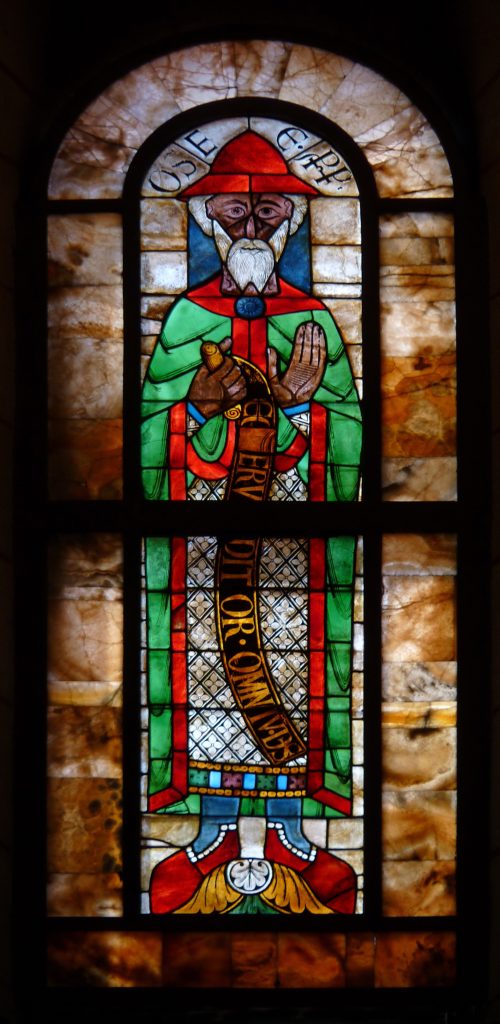
The following is a stained glass window of Hosea in the Augsburg Cathedral in Germany. It is part of the “Prophet windows of Augsburg ” from the 12th century which is assumed to be the oldest remaining set of church windows:
Photo by Hans Bernhard, hosted by Wikimedia Common under the GFDL-CC-BY-SA-all license
Stained glass is not just highly decorative, it’s a medium which has been used to express important religious messages for centuries. Literacy was not widespread in the medieval and Renaissance periods and the Church used stained glass and other artworks to teach the central beliefs of Christianity. In Gothic churches, the windows were filled with extensive narrative scenes in stained glass — like huge and colorful picture storybooks — in which worshipers could ‘read’ the stories of Christ and the saints and learn what was required for their religious salvation. (Source: Victoria and Albert Museum )
The name that is transliterated in English as “Abel” means “a breath,” “vanity,” “vapor.” (Source: Cornwall / Smith 1997 )
In Finnish Sign Language it is translated with the sign signifying “smoke” (referring to his offering mentioned in Genesis 4:4). (Source: Tarja Sandholm)
The Greek that is transliterated as “Lazarus” in English is translated in Spanish Sign Language with a sign depicting that he is bound in clothes, referring to John 11:44. (Source: Steve Parkhurst)
“Timothy” is the anglicized form of Timotheus, meaning “honoring God,” “honored of God,” “worshiping God,” “valued of God.” (Source: Cornwall / Smith 1997 )
It is translated in American Sign Language with a sign that combines the signs for the letter T and “young,” referring to 1 Timothy 4:12 et al. (Source: Ruth Anna Spooner, Ron Lawer)
“Timothy” in American Sign Language, source: Deaf Harbor
The Hebrew, Latin, and Greek that is transliterated as “Joel” in English means “LORD of God,” “the LORD is God,” “the LORD is might.” (Source: Cornwall / Smith 1997 )
In Spanish Sign Language it is translated in two different ways. The first is with a sign depicting “Pentecost flame,” referring to Peter’s speech on Pentecost in which he quotes Joel in Acts 2:16 and following. (Source: Steve Parkhurst)
In Hungarian Sign Language it is translated with a sign that refers to the fact that God’s message, through the prophet, was perceived and proclaimed in the widest possible scope (see Joel 2:28). (Source: Jenjelvi Biblia and HSL Bible Translation Group)
“Joel” in Hungarian Sign Language — note that only the first part refers to “Joel,” the second and third parts refer to “prophet” and “book” (source )