
Simon carries the cross

This is a contemporary tempera/gouache on leather painting by an unknown Ethiopian artist. Source: Sacred Art Pilgrim website .

Miriam-Rose Ungunmerr-Baumann (born 1950) was a member of the Daly River Mission church in Australia’s Northern Territory. When it was being redecorated in 1974 she was invited to paint a series of Stations of the Cross. It is unusual for an Aboriginal woman to paint since this is usually the task of the men, but she accepted the challenge and produced a remarkable series of paintings which, like other Aboriginal art, uses symbols to go beyond external shapes to inner meanings and emotions. The Stations of the Cross were painted in acrylic paint on burnie board.

“Ungunmerr-Baumann explains the symbolism of the Stations of the Cross: ‘The third stop shows Jesus falling for the first time (below). In Jesus’ weakened state the weight of the cross forces him to fall. The patterns on his body show the physical stress he is under. The circles on his head indicate the pain and sorrow locked up inside him. The patterns on the cross show the increasing weight on his shoulders. In the Fifth Station, Simon of Cyrene helps Jesus carry the cross (opposite). When Simon takes hold of the cross, his body merges with that of Jesus. The pattern on Jesus’ head is open: he is giving grace to Simon to strengthen him. When Simon took hold of the cross, something happened inside him: the sun rose inside his head, his mind burst with a new belief, he became a new man. The resurrection had already begun.’ She prays: ‘Jesus you take your heavy cross, It gives you pain. Help all who suffer. Forgive us for the pain we give you and others.'” (Source for this and the image: The Bible Through Asian Eyes by Masao Takenaka and Ron O’Grady 1991)

The Angry Christ

Painting by Lino Pontebon, “an artist from the Negros island of the Philippines. The area in which he lives has been the scene of considerable military action and this has added to the already hard life of the peasants. His painting of the angry Christ captures a mood in the Philippines and reflects the prevailing anger of the people at being manipulated by forces beyond their control.

The painting became popular in many parts of the world, especially among the young. It counteracts the image of ‘gentle Jesus meek and mild’ with the reminder that Jesus also became angry at injustice.”

(Source for this and the image: The Bible Through Asian Eyes by Masao Takenaka and Ron O’Grady 1991)

Doubting Thomas

Mural, St. Joseph’s Church, New Plymouth, New Zealand, by Michael Smither.

Michael Smither was commissioned to prepare 14 Stations of the Cross for St Joseph’s Church in New Plymouth, New Zealand and although there was controversy because parishioners thought they were too stark, he was, nevertheless, later invited to paint a mural on the back wall of the church. He has completed the mural of “Doubting Thomas” (opposite) and a a second mural on the baptism of Jesus (see here ).

“When he was a child, Michael Smither was taught that doubt was a sinful and negative trait but, despite this, he always had a sneaking respect for Thomas as a person who had the strength to stand alone and make a personal search for the truth. When asked to paint a church mural, he chose Thomas because, he said, ‘he was, for me, one of the most courageous of the apostles. He had to find out for himself. It was a courageous thing to do. I named one of my children Thomas.'” (Source for this and the image: The Bible Through Asian Eyes by Masao Takenaka and Ron O’Grady 1991)
Jesus Ascended to Heaven

Painting by Wang Suda 王肅達 (1910-1963),
Copyright by the Catholic University Peking, China

Text under painting translated from Literary Chinese into English:
Jesus Ascended to Heaven
The Lord returned to Heaven and was seated at the right hand of Father

Image taken from Chinese Christian Posters . For more information on the “Ars Sacra Pekinensis” school of art, see this article , for other artworks of that school in TIPs, see here.

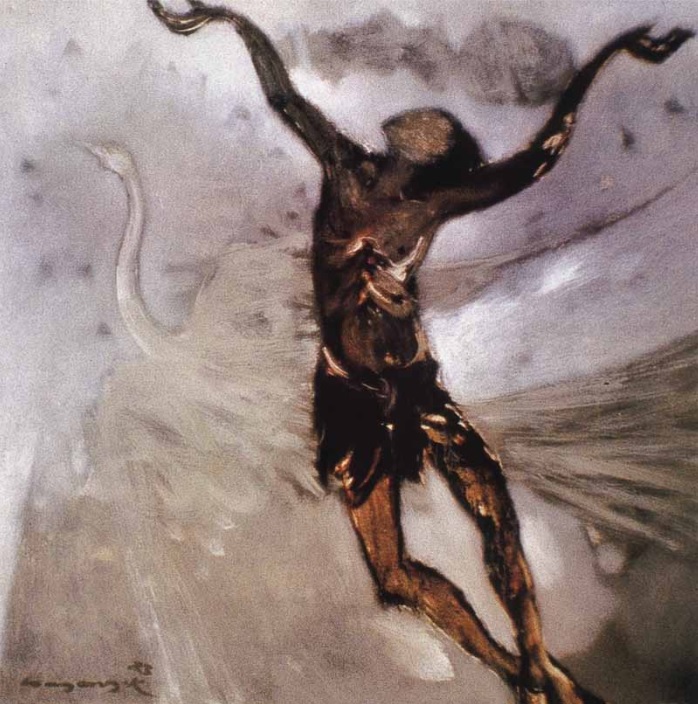
Following is a painting (“Ascension of Jesus”) by Bagong Kussudiardja (1928-2004):

“Bagong Kussudiardja was born in Indonesia and brought up among artists. He began to study the classical dances of Java at the age of 18 and his love of dance has always been foremost in his life. After independence in 1945, Bagong began to experiment with dances which would reflect the new spirit in Indonesia.

Bagong takes a close interest in all aspects of the arts. He is a skilled batik painter and as the painting indicates, his oil paintings also rank with the finest. His painting of the dancing Christ ascending to heaven was prepared for the Second Conference of the Asian Christian Art Association held in the Philippines.” (Source for this and the image: The Bible Through Asian Eyes by Masao Takenaka and Ron O’Grady 1991)

The following is a church window based on an image of Annie Vallotton. This is installed in a church of the Union des Églises Baptistes du Cameroun in Mowo (Mokong), Cameroon.

Photo and the following description by Ken Hollingsworth

“The windows are open with no screens or glass. The pictures were fabricated by projecting the picture using an overhead projector on a piece of plywood. They were drawn on the plywood with charcoal. Then the fabricator cut pieces of iron rebar to make the picture. Then the iron pieces were welded together. Later, when the pictures were installed, they were painted with different colors to help the people ‘see’ the picture.”

The following is a stained glass window from the Three choir windows in the Marienkirche, Frankfurt (Oder), Germany, of the 14th century:

Source: Der gläserne Schatz: Die Bilderbibel der St. Marienkirche in Frankfurt (Oder), Neuer Berlin Verlag, 2005, copyright for this image: Brandenburgisches Landesamt für Denkmalpflege und Archäologisches Landesmuseum

Stained glass is not just highly decorative, it’s a medium which has been used to express important religious messages for centuries. Literacy was not widespread in the medieval and Renaissance periods and the Church used stained glass and other artworks to teach the central beliefs of Christianity. In Gothic churches, the windows were filled with extensive narrative scenes in stained glass — like huge and colorful picture storybooks — in which worshipers could ‘read’ the stories of Christ and the saints and learn what was required for their religious salvation. (Source: Victoria and Albert Museum )

See also other stained glass windows from the Marienkirche in Frankfurt.

The 12-year old Jesus in the temple

Hand colored stencil print on washi by Sadao Watanabe (1982).

Image taken with permission from the SadaoHanga Catalogue where you can find many more images and information about Sadao Watanabe. For other images of Sadao Watanabe art works in TIPs, see here.

Following is an image by He Qi:

He Qi © 2021 All Rights Reserved.

Image taken from He Qi Art . For purchasing prints of this and other artworks by He Qi go to heqiart.com . For other images of He Qi art works in TIPs, see here.

The following is an artwork by Vinayak Shivaram Masoji (1897–1977):

“V.S. Masoji is a Bengali Indian artist who studied at Shantiniketan, an artist’s institution founded by the national poet of Bengal, Rabindranath Tagore.” (Source for this and the image: The Bible Through Asian Eyes by Masao Takenaka and Ron O’Grady 1991)

Following is a 1973 painting of the JESUS MAFA project, a response to New Testament readings from the Lectionary by a Christian community in Cameroon, Africa. Each of the readings was selected and adapted to dramatic interpretation by the community members. Photographs of their interpretations were made, and these were then transcribed to paintings:

Jesus sits in front of some religious leaders listening and asking questions as they listen to him, their astonishment evident in their facial expressions. In the background we see Mary and Joseph approaching, undoubtedly relieved to find their child safe and sound. We are reminded of Jesus’ humanity in this story. He was a child who did not fully consider the feelings of his parents and the consequences of his actions. He grew not only physically, but intellectually and emotionally as well. Through Jesus’ increase in wisdom, we are reminded that we too are called to grow into deeper understanding. And that requires that we ask questions whose answers may challenge our long-held beliefs and theologies.

From Art in the Christian Tradition , a project of the Vanderbilt Divinity Library, Nashville, TN. Image retrieved March 23, 2026. Original source: librairie-emmanuel.fr.

The following is a stained glass window from Mary Lowndes after William Holman Hunt, made by Lowndes and Drury, 1910. From St Martin & All Saints Church, Oxford:

Photo by the wub, hosted by Wikimedia Commons under a Creative Commons CC0 1.0 Universal Public Domain Dedication license

Stained glass is not just highly decorative, it’s a medium which has been used to express important religious messages for centuries. Literacy was not widespread in the medieval and Renaissance periods and the Church used stained glass and other artworks to teach the central beliefs of Christianity. In Gothic churches, the windows were filled with extensive narrative scenes in stained glass — like huge and colorful picture storybooks — in which worshipers could ‘read’ the stories of Christ and the saints and learn what was required for their religious salvation. (Source: Victoria and Albert Museum )

Judas (Iscariot)

The term that is transliterated as “Judas” in English means “Praise of the LORD.” The name Iscariot means “man of Kerioth” or “a man of murder.” (Source: Cornwall / Smith 1997 )

It is translated in American Sign Language with the sign for the letter J and the sign signifying holding a bag of money, referring to John 12:6. (Source: Ruth Anna Spooner, Ron Lawer)


“Judas” in American Sign Language, source: Deaf Harbor

In Spanish Sign Language it is translated with with the sign for “kiss,” referring to Matthew 26:49 et al. (Source: Steve Parkhurst)


“Judas” in Spanish Sign Language, source: Sociedad Bíblica de España

In Hungarian Sign Language it is based on the sign for betrayal. (Source: Jenjelvi Biblia and HSL Bible Translation Group)


“Judas” in Hungarian Sign Language (source )

For more information on translations of proper names with sign language see Sign Language Bible Translations Have Something to Say to Hearing Christians .

Painting by Nalini Jayasuriya (1927 – 2014). “Jayasuriya grew up in Sri Lanka and later studied art in England. She experimented with many forms of art hut is best known for her acrylic and pastel paintings on Biblical themes. She has written extensively on art subjects and held many exhibitions. In her painting of Judas the tortured face of the disciple reflects some of the complexities of the man who betrayed Jesus.” (Source for this and the image: The Bible Through Asian Eyes by Masao Takenaka and Ron O’Grady 1991)

See more images of Nalini Jayasuriya.

Learn more on Bible Odyssey: Judas .