Miriam

The name “Miriam” or “Abataza” means “bitterness,” “rebellion” and “star of the sea.” (Source: Cornwall / Smith 1997 )

In some Semitic languages, the transliteration for “Miriam” is identical to “Mary,” testifying to the fact that these names are identical (Arabic and the many translations that are reliant on Arabic: مَرْيَم, Hebrew: מִרְיָם, Ge’ez / Amharic and related languages: ማርያም).

It is translated in Spanish Sign Language with the sign for “tambourine” referring to Exodus 15:20. (Source: Steve Parkhurst)


“Miriam” in Spanish Sign Language, source: Sociedad Bíblica de España

For more information on translations of proper names with sign language see Sign Language Bible Translations Have Something to Say to Hearing Christians .

The following is part of an artwork by Indian-German artist Lucy D’Souza-Krone (b. 1949):

“D’Souza’s painting of Miriam dancing at the river is one of a series of ‘Biblical Women’ reproduced as the 1990 Lenten veil of Misereor, Germany. Miriam, the prophetess and sister of Moses and Aaron, celebrated the liberation of her people from their Egyptian oppressors. Her dance was supported by other women who joined with her in an act of celebration. Writing of the story the artist adds that ‘water is a predominant element in the scene reminding us also of the physical hardship facing women in India as they often have to walk many miles for a pot of water.'” (Source for this and the image: The Bible Through Asian Eyes by Masao Takenaka and Ron O’Grady 1991)

Learn more on Bible Odyssey: Miriam .

Hagar and Her Child in the Wilderness

Artwork by Sister Marie Claire , SMMI (1937–2018) from Bengaluru, India.

For more information about images by Sister Marie Claire and ways to purchase them as lithographs, see here . For other images of Sister Marie Claire paintings in TIPs, see here.

The following is an artwork by Frank Wesley (1923-2002):

“Frank Wesley is a fifth generation Indian Christian born in 1923 in Azamgarh, Uttar Pradesh, India. He comes from a long line of artists. Wesley studied art in Lucknow where his Hindu professor inspired him not only in his art but also in an appreciation of Jesus Christ and his teaching.

Hagar was painted in water colour on paper and is in a private collection in Bangalore, India. The color washes have been manipulated with a palette knife on rough paper to emphasize the hard rocks which symbolize Hagar’s life as a bond-maid.

“Abraham and Sarah are honored as the founders of the nation of Israel. Abraham’s trust in God to lead him out of Babylon and his willingness to sacrifice his own son are quoted as signs of his great faith. But because Abraham and Sarah were people of wealth and privilege most Asian Christians have difficulty identifying with them. In recent years, many Asians have rediscovered Hagar as a person with whom they can have genuine empathy. Frank Wesley’s moving painting shows Hagar alone in the wilderness. She is prepared to die when the angel meets her. In the midst of hopelessness, God reveals to her that her son Ishmael will be the father of a great nation.” (Source for this and the image: The Bible Through Asian Eyes by Masao Takenaka and Ron O’Grady 1991)

Doubting Thomas

Mural, St. Joseph’s Church, New Plymouth, New Zealand, by Michael Smither.

Michael Smither was commissioned to prepare 14 Stations of the Cross for St Joseph’s Church in New Plymouth, New Zealand and although there was controversy because parishioners thought they were too stark, he was, nevertheless, later invited to paint a mural on the back wall of the church. He has completed the mural of “Doubting Thomas” (opposite) and a a second mural on the baptism of Jesus (see here ).

“When he was a child, Michael Smither was taught that doubt was a sinful and negative trait but, despite this, he always had a sneaking respect for Thomas as a person who had the strength to stand alone and make a personal search for the truth. When asked to paint a church mural, he chose Thomas because, he said, ‘he was, for me, one of the most courageous of the apostles. He had to find out for himself. It was a courageous thing to do. I named one of my children Thomas.'” (Source for this and the image: The Bible Through Asian Eyes by Masao Takenaka and Ron O’Grady 1991)

Jesus Ascended to Heaven

Painting by Wang Suda 王肅達 (1910-1963),
Copyright by the Catholic University Peking, China

Text under painting translated from Literary Chinese into English:
Jesus Ascended to Heaven
The Lord returned to Heaven and was seated at the right hand of Father

Image taken from Chinese Christian Posters . For more information on the “Ars Sacra Pekinensis” school of art, see this article , for other artworks of that school in TIPs, see here.

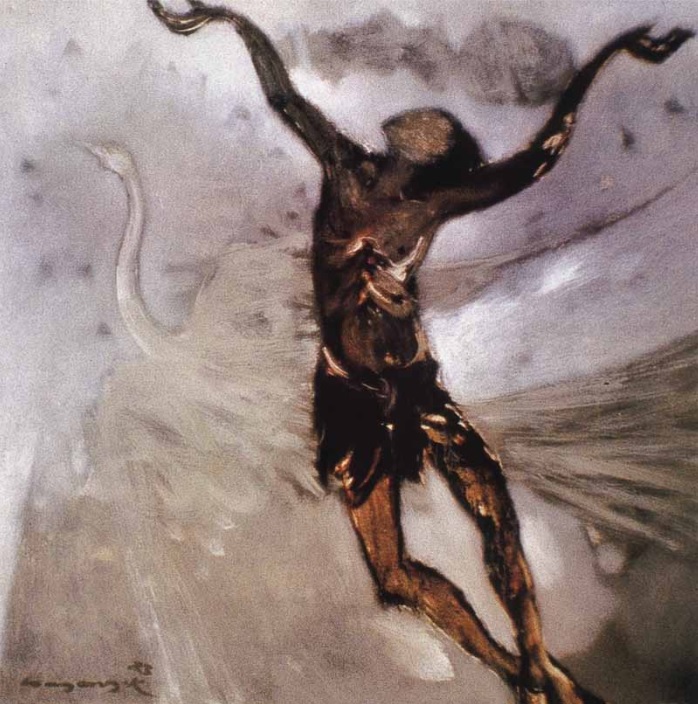
Following is a painting (“Ascension of Jesus”) by Bagong Kussudiardja (1928-2004):

“Bagong Kussudiardja was born in Indonesia and brought up among artists. He began to study the classical dances of Java at the age of 18 and his love of dance has always been foremost in his life. After independence in 1945, Bagong began to experiment with dances which would reflect the new spirit in Indonesia.

Bagong takes a close interest in all aspects of the arts. He is a skilled batik painter and as the painting indicates, his oil paintings also rank with the finest. His painting of the dancing Christ ascending to heaven was prepared for the Second Conference of the Asian Christian Art Association held in the Philippines.” (Source for this and the image: The Bible Through Asian Eyes by Masao Takenaka and Ron O’Grady 1991)

The following is a church window based on an image of Annie Vallotton. This is installed in a church of the Union des Églises Baptistes du Cameroun in Mowo (Mokong), Cameroon.

Photo and the following description by Ken Hollingsworth

“The windows are open with no screens or glass. The pictures were fabricated by projecting the picture using an overhead projector on a piece of plywood. They were drawn on the plywood with charcoal. Then the fabricator cut pieces of iron rebar to make the picture. Then the iron pieces were welded together. Later, when the pictures were installed, they were painted with different colors to help the people ‘see’ the picture.”

The following is a stained glass window from the Three choir windows in the Marienkirche, Frankfurt (Oder), Germany, of the 14th century:

Source: Der gläserne Schatz: Die Bilderbibel der St. Marienkirche in Frankfurt (Oder), Neuer Berlin Verlag, 2005, copyright for this image: Brandenburgisches Landesamt für Denkmalpflege und Archäologisches Landesmuseum

Stained glass is not just highly decorative, it’s a medium which has been used to express important religious messages for centuries. Literacy was not widespread in the medieval and Renaissance periods and the Church used stained glass and other artworks to teach the central beliefs of Christianity. In Gothic churches, the windows were filled with extensive narrative scenes in stained glass — like huge and colorful picture storybooks — in which worshipers could ‘read’ the stories of Christ and the saints and learn what was required for their religious salvation. (Source: Victoria and Albert Museum )

See also other stained glass windows from the Marienkirche in Frankfurt.

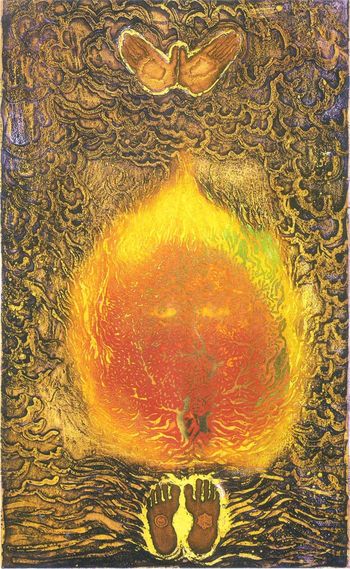
The Burning Bush

Artwork by Indian artist Paul Koli (b. 1945). “Paul Koli is Professor of the Print Making Class of the Sir J.J. School of Art, Bombay. His print ‘Burning Bush’ was produced in 1984 and was part of a collection of Christian art which traveled through Europe and America in 1988/89. It shows a strong command of color in printing.” (Source for this and the image: The Bible Through Asian Eyes by Masao Takenaka and Ron O’Grady 1991)

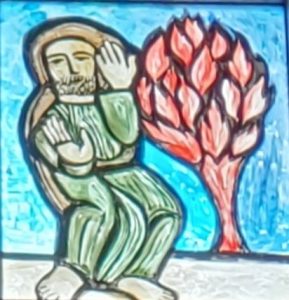
The following is a stained glass window in the Sacred Heart Cathedral in Chiang Mai, Thailand, depicting Moses and the burning bush:

Photo by Jost Zetzsche

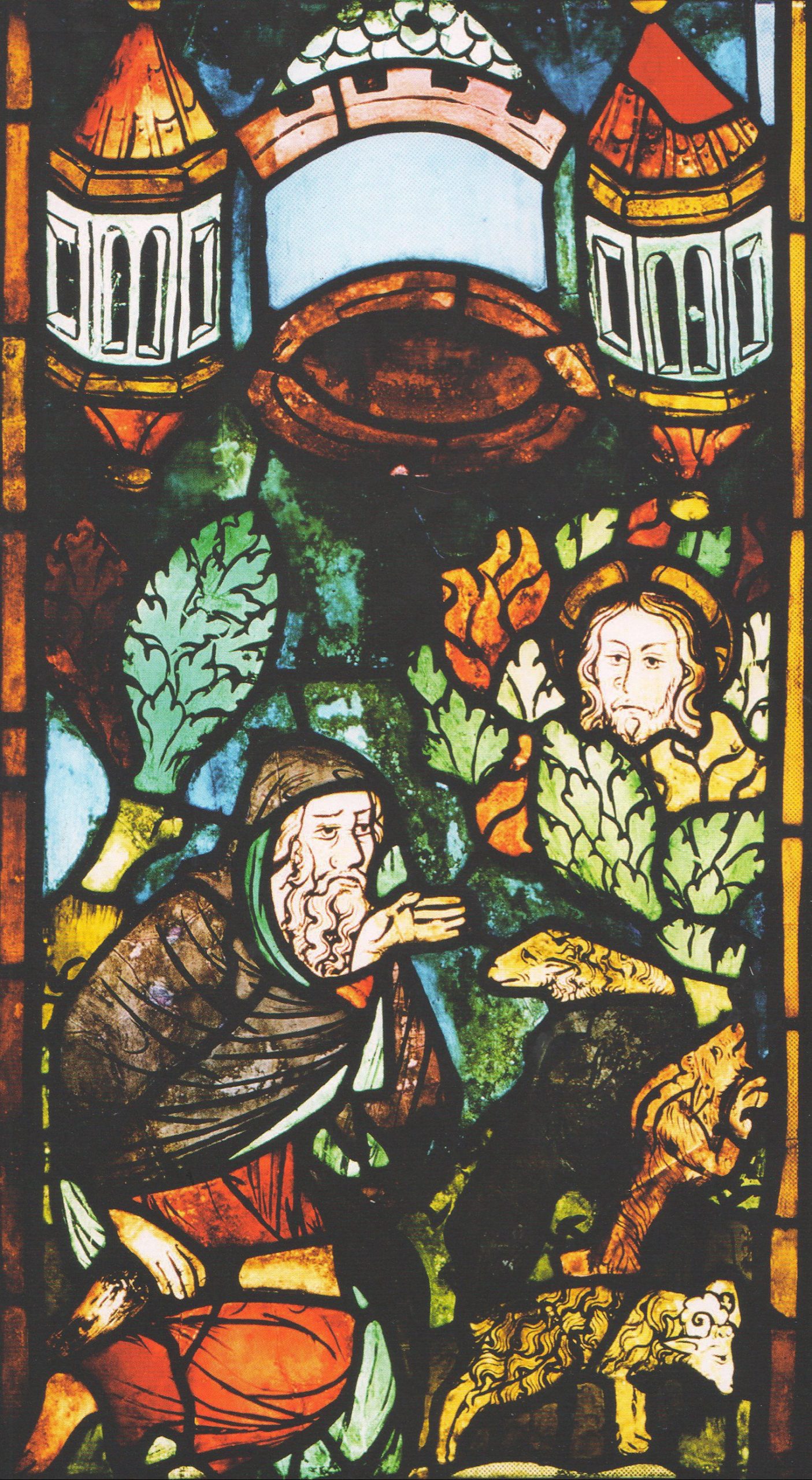
The following is a stained glass window from the Three choir windows in the Marienkirche, Frankfurt (Oder), Germany, of the 14th century:

Source: Der gläserne Schatz: Die Bilderbibel der St. Marienkirche in Frankfurt (Oder), Neuer Berlin Verlag, 2005, copyright for this image: Brandenburgisches Landesamt für Denkmalpflege und Archäologisches Landesmuseum

See also other stained glass windows from the Marienkirche in Frankfurt.

Stained glass is not just highly decorative, it’s a medium which has been used to express important religious messages for centuries. Literacy was not widespread in the medieval and Renaissance periods and the Church used stained glass and other artworks to teach the central beliefs of Christianity. In Gothic churches, the windows were filled with extensive narrative scenes in stained glass — like huge and colorful picture storybooks — in which worshipers could ‘read’ the stories of Christ and the saints and learn what was required for their religious salvation. (Source: Victoria and Albert Museum )

The Tower of Babel

1987 artwork by Japanese artist Takako Horino (b. 1931). “Like many contemporary artists, Takako Horino of Japan is angered at the distorted sense of values in modern society. In her search for an explanation she has turned to the Old Testament and concentrated on the implications of three stories: the ark of Noah, the tower of Babel and the destruction of Sodom. Each of them is an expression of God’s wrath against human stupidity. The tower of Babel compares government fixation with scientific development and weapons of war with its neglect of the people’s welfare. The monolith of the tower and its missiles stands in stark contrast to the broken buildings, churches and institutions below. In the end, all is destroyed. No life exists. A solitary skeleton sitting in front of a television monitor marks the final symbol of humanity’s self-destruction.” (Source for this and the image: The Bible Through Asian Eyes by Masao Takenaka and Ron O’Grady 1991)

The following artwork is by Sister Marie Claire , SMMI (1937–2018) from Bengaluru, India:

For more information about images by Sister Marie Claire and ways to purchase them as lithographs, see here .

For other images of Sister Marie Claire paintings in TIPs, see here.

Gideon separating his troops

Painting by Ryohei Koiso (小磯 良平) (1903-1988). “[He] grew up as an active member of the Kobe church and had a strong ambition to be a painter. Although his family opposed this course his grandmother said, ‘If you are going to be a painter, you should make it your life’s ministry.’ After study in Europe Koiso returned to Tokyo and in 1959 become a professor at Tokyo Art College. His Christian art works provided the illustrations for the Revised Version of the Bible in colloquial Japanese (聖書新共同訳 ).

“His illustration of Gideon’s men at the river shows the research and planning which went into all his works. The painting is produced with a bamboo drawing nib and Chinese ink with a light wash of color.” (Source for this and the image: The Bible Through Asian Eyes by Masao Takenaka and Ron O’Grady 1991)

The Song of Ruth

Detail of an artwork by Yoshihei Miya (宮芳平). “Miya was born in Japan in 1893 in the Niigata Prefecture. He studied in Tokyo Academy and taught in Suwa Girl’s High School. In 1966 he visited the Holy Land and his book of art and poetry from that trip became popular in Japan. He died in 1971 in Kyoto.”

“Ruth’s great love for Naomi — her Jewish mother-in-law, enables her to dedicate her young life to protect and support her. Naomi, herself a widow, was not so keen to go back to Bethlehem with a widowed daughter-in-law who belonged to another race. But Ruth embraced and clung to her… There was nothing in Ruth’s mind which could come between her and Naomi — least of all racial differences. She was totally committed to ‘the other’ in Naomi.

“Ruth’s selfless devotion to her mother-in-law challenges Boaz to a similar response — he takes them both under his wing. On the occasion of the birth of Boaz and Ruth’s son, Obed, the women of Jerusalem, too, find themselves overcoming their racist prejudices in acclaiming Ruth the Moabitess as ‘being better than seven sons.’ — Chitra Fernando (චිත්‍රා ප්‍රනාන්දු), Sri Lanka!”

(Source for this and the image: The Bible Through Asian Eyes by Masao Takenaka and Ron O’Grady 1991)