In the Holy Land at the time of Jesus there was only one wild species of rue common, the Mountain Rue Ruta chalepensis, and it is likely the one referred to by Jesus in his rebuke of the Pharisees in Luke 11:42. Rue is common throughout the Middle East, from Syria to Sinai up to the present. Because of its strong smell it is used in cooking and in medicine up to the present. It was used by the Greeks, Romans, and Jews against snakebite and the stings of bees, wasps and scorpions, not to mention its effectiveness against insanity, epilepsy, and even “the evil eye.”
Rue is a small, shrubby plant that produces many branches at ground level, with many yellow flowers and very sharp-smelling leaves. It can reach up to 1 meter (3 feet) in height.
The ancient Jewish Talmud states that cultivated plants should be tithed. It is possible that the disagreement between Jesus and the Pharisees arose because by New Testament times the people were cultivating rue, dill, and similar plants that had not been cultivated before, and the Pharisees then applied the laws of the Talmud to these little plants, thus complicating the lives of the common people, while at the same time they ignored issues of justice and compassion.
Depending on what translators do with “mint” in Luke 11:42, they may find a cultural substitute for “rue” or a generic phrase for “mint and rue and every herb.” Since the context is not rhetorical and the plant genus is limited to the Middle East, a transliteration of “rue” will be appropriate. Transliterations can be made from the Greek pēganon or from a major language.
There are two main species of tamarisk referred to in the Bible, the Leafless Tamarisk Tamarix aphylla and the much more common Nile Tamarisk Tamarix nilotica. Both species are found throughout the plains and in the wadis (dry stream beds) of the Aravah and the Negev, where they tap water that has soaked into the ground after flash floods. Tamarisks can grow in salty soil, earning them the name “salt cedar” in some places. A third species grows only in the Jordan Valley. None of them has proper leaves but rather fleshy twigs, which are eaten by goats and sheep.
Description The leafless tamarisk grows to a height of 10 meters (33 feet) and can be 1 meter (3 feet) across at the base. The more common Nile tamarisk is smaller and is really a shrub, branching right from the ground. Tamarisks grow in very dry places due to the fact that their roots extend far into the ground. The trunk is often twist-ed. The cedar-like branches hang down like those of the weeping willow. Bedouin shepherds have planted many of them throughout the Negev for their flocks.
The fact that Abraham planted a tamarisk and worshiped Yahweh there (Genesis 21:33) indicates that these trees, like oaks, were associated with the spirit world. According to Zohary (Plants of the Bible. Cambridge University Press, 1982), the “cedar” branches mentioned in the cleansing rituals of Leviticus 14:4 and Numbers 19:6 may possibly have been from tamarisks, although Phoenician juniper trees (very similar to cedar) were also available in some places on the journey of the wandering Israelites. Imported into the western United States, tamarisks have multiplied so fast in stream beds that they are now considered a costly nuisance. In some places they are used in making dyes and in processing leather.
The options for translating “tamarisk” are:
1. Transliterate from a major language, for example, tamarisiki, tamaris, esheli (Hebrew), or eteli/atali (Arabic).
2. Consider the function of the tree, which in Genesis was almost certainly connected to Abraham’s worship of God, and translate as “holy tree” perhaps with a footnote giving the Hebrew and/or English, especially if you have used “holy tree” in Gen 12.6 for “oak.”
3. Simply use “tree” with a footnote stating that the Hebrew specifies ’eshel, that is, tamarisk.
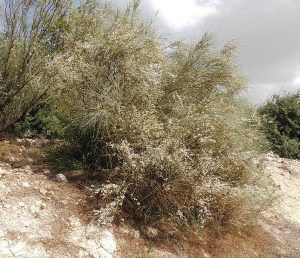
A number of scholars identify rothem as the White Broom Retama raetam, a tough desert shrub found in the Holy Land and Arabia. Earlier, Moldenke (Plants of the Bible. Chronica Botanica. Ronald Press, 1952) contended that rothem refers to a parasitic plant called dog’s club. In the story of Elijah’s flight from Jezebel, the mention of the broom tree in 1 Kings 19:4 provides detail to the image of desolation brought to mind by the word “wilderness” earlier in the verse. The references to rothem in Psalm 120:4 (“. . . with glowing coals of the broom tree”) and Job 30:4 (“. . . and to warm themselves the roots of the broom”) have led scholars to conclude that it is indeed the broom shrub, since it makes a very hot fire, due to the oil in the stems and leaves. The place name Rithmah (“place of rothem”) referred to in Numbers 33:18f. may also refer to the broom. The white broom is found on hills, rocky places, ravines and sandy places throughout the Holy Land, especially near the Dead Sea, in Gilead, on Mount Carmel, in the Syrian desert, and on the Phoenician coast.
The white broom, which is more of a large bush than a shrub, can reach a height of 2 meters (7 feet). It has many small branches, few leaves, and clusters of white flowers that make the shrub a beautiful sight on a hillside.
In 1 Kings 19:4 the New Jerusalem Bible renders rothem as “furze bush,” also known as “gorse,” in an attempt to use a name known to English gardeners, but neither “gorse” nor “furze” are familiar to botanically ignorant city-dwellers of the twenty-first century. Hence, some modern versions use a generic term in 1 Kings, such as “large bush” (Contemporary English Version), “tree” (Good News Bible, and “bush” (New Century Version). In areas where plants are still known by species names, translators can select a shrub that grows in dry, barren areas (assuming it is big enough to offer shade), or transliterate from the Hebrew (rothem) or a major language (for example, retem in Arabic). Otherwise, they can use “small tree” or “shrub.”
In Psalm 120:4 a local kind of wood that produces a very hot fire could be used, since the text is rhetorical, and needs an image of something very hot.
The reference to broom in Job 30:4 poses major textual and exegetical problems, which explains the variety of renderings in modern Bibles. New Revised Standard Version, updated edition reads “they pick mallow and the leaves of bushes, and to warm themselves the roots of the broom.” Good News Bible and the New International Version have these poor folk eating the roots of the broom tree. However, reliable sources tell us that the root of the broom tree is poisonous. That is why Moldenke suggested that it must be another plant, namely the parasite Dog’s Club Cynomorium coccineum, which grows up out of the roots of the broom tree. However, there is good evidence that the writer intended to say the roots were “burned” (as in New Revised Standard Version, updated edition), not “eaten” (as in Good News Bible and New International Version).
In the Contemporary Chichewa translation (2002/2016) it is translated as “mopane tree .” These trees grow in Southern African countries. They can grow up to 18 meters high and their leaves have a butterfly shape. They’re good for firewood and timber as they are in the category of hardwood trees because they can live for up to 100 years. (Source: Mawu a Mulungu mu Chichewa Chalero Back Translation)
Commentators and translators are unanimous in identifying the Hebrew word pol as the Broad Bean Vicia faba or Faba vulgaris. Beans were cultivated in the Middle East for millennia, and they probably originated there. No wild species are now known, and it is quite possible that the ancestors of the bean are extinct. Samples of beans have been found in excavations at Jericho dating to 7,000 8,000 years ago.
The broad bean is an erect plant, not a vine, reaching to 1 meter (3 feet) in height. The stem branches only in the upper part. It has no tendrils like many types of bean have today. The flowers are white, and when they ripen, they form pods containing 3-6 large flat beans of a cream or tan color.
Special significance In 2 Samuel 17:28 people bring food, including beans, to King David as he flees from his son Absalom. In Ezekiel 4:9 Ezekiel is instructed to publicly make “bread” out of wheat, barley, beans, and lentils — whatever he could find — the point probably being that good quality bread will soon be scarce in Jerusalem.
There are at least two hundred species of the genus Vicia to which the broad bean belongs. Vicia itself is part of the vast family of legumes. It is possible that the Hebrew word pol actually refers to more than one type of bean, including what we now know as peas. Since beans and peas are known around the world, translators will probably be able to find a local equivalent. In both contexts (2 Samuel and Ezekiel) the word is used in a list of items, and if a local species of bean is not available to the translator, a transliteration should be used.
Scholars are agreed that the Hebrew word ‘adashah refers to the lentil Lens culinaris (formerly known as Lens esculenta). The Arabic word ‘adas, as well as several references in post-biblical Hebrew, confirm this identification, as does the Greek Septuagint. Seeds found in excavations dating to the sixth or seventh millennium B.C. show that the lentil is one of the first species to be cultivated by humans. In those excavations lentils are often found together with seeds of wheat and barley.
The lentil is a low-branched plant with a weak stem. It has tendrils, like pumpkins and squashes, and pinkish flowers that develop into a pod like a bean. The pod is very short with only one seed inside, about the size of a small pea. In one type of lentil the pea is reddish brown, hence the reference to “red” stew in Genesis 25:30. The pods are often in pairs or sets of three. In the Holy Land lentils grow in the cold season (November-March).
In Ezekiel 4:9 the strange bread, made from six kinds of grains and legumes including lentils, was probably intended to show that food would become scarce and that the people would have to eat whatever they could find. The lentil is typically used in soups and stews, as it was when Jacob used it to trick his brother Esau into giving up his rights as the firstborn son. Lentils were among the foodstuffs brought to David by local people when he was pursued by Absalom.
Lentils are now widespread in Asia, India, and North Africa. In places where they are not known, we suggest using the word for a local type of bean rather than a transliteration. However, in Ezekiel 4:9 “beans” are also mentioned, so a possible rendering for “beans and lentils” is “different kinds of beans.” In Genesis 25:34 a generic expression for “pottage of lentils” would be appropriate, such as “bean soup,” “bean stew,” or “vegetable soup.” If a transliteration from a major language is desired, consider Arabic adas; French cristallin, lentille; Spanish lenteja; Portuguese lentilha; and Swahili adesi.
Ezekiel 27:15 reports traders who brought hovnim to Tyre. Coupled with ivory, the Hebrew word hovnim could have referred to either Asian or African products. In 1982 Zohary (Plants of the Bible. Cambridge University Press, 1982) stated that the identity of the hovnim in Ezekiel is unclear. He said that at best we can say that both Asian and African merchandise were shipped to Dedan, a Phoenician commercial center on the Arabian coast. Since then, however, Hepper (Baker Encyclopedia of Bible Plants, Baker Book House, 1992), who believes that trading with the Far East was less than many other scholars have alleged, has said that this tree is not the Asian Ebony Diospyros ebenum we know today but a leguminous tree Dalbergia melanoxylon, which grows all across Africa along the southern edge of the Sahara Desert. Evidence for this, he says, is that the Old Egyptian cognate hbny found in hieroglyphs refers to Dalbergia melanoxylon.
If hovnim are from Africa, they could be Dalbergia melanoxylon, as Hepper asserts, or one of the many species of the genus Diospyros found throughout the continent, such as Diospyros mespiliformis. The latter is a huge, widespread forest tree up to 35 meters (115 feet) tall. Dalbergia melanoxylon is a smaller, spiny tree reaching a height of 6‑7 meters (20‑23 feet). It inhabits the dry savanna areas from Ethiopia across to Senegal and as far south as southern Africa, where it is called “zebrawood.” The leaves are compound, with the leaflets nearly opposite one another on the spine. It has white flowers that hang in loose clusters, and around October they give way to flat, papery seedpods about 6 centimeters (2.5 inches) long and 1 centimeter (1/2 inch) wide. The Asian ebony, if that is what hovnim refers to, is found in India and Sri Lanka, grows to 10 meters (33 feet) tall, and has evergreen leaves. The inner part of the trunk is black, which makes it an attractive wood for carvers, who inlay the wood with ivory.
There are hundreds of species of ebony in tropical areas of the world (eighty in the Americas, ninety-four in Africa, and two hundred in Asia). In Africa the tree that produces most of the true ebony is Diospyros mespiliformis, which is found all the way from Senegal to the Red Sea and Arabia and southward to Southwest Africa and the Transvaal. In Nigeria it is called kanran or kanyan (Adamawa Fulfuldenelɓe). Surprisingly, both the Yoruba and Igbo Bibles in Nigeria have used eboni, perhaps reflecting the urbanization and Anglicization of those societies (or at least of the translators!). The Hausa word kanya correctly refers to the ebony tree. Diospyrus ebenum, found in India and Sri Lanka, might possibly have been on the world market in Bible times. A local word for this tree could be used in translations. If Hepper is correct, then the Dalbergia melanoxylon, locally known in Africa as “ebony” and also used for carving, should be used. Other transliteration possibilities are ebene (French) and ebenuz (Spanish).
Dalbergia species are also found in Central and South America under the names of palisander, kingwood, or tulipwood. A species in India is called blackwood or rosewood. In all these places the wood is used for radio cabinets, musical instruments, buttons, knife handles, chess pieces, and decorative carvings for tourists.
Although its identity in the Bible is uncertain, galbanum is probably a gum resin from a plant called Fennel Ferula galbaniflua, which grows in India, Iran and Afghanistan, and especially in the high mountains of Iran. The fennel is related to the parsley family. Today most commercial galbanum comes from Lebanon and Iran.
The fennel plant can grow to 1.5 meters (5 feet) in height. It has fine, shiny leaflets, a thick smooth stem, and a flower head like an umbrella. The seeds are shiny and very small. The plant has a milky juice that comes out by it-self from the joints or oozes out from the stem when it is cut. It forms aromatic greenish or yellowish beads when it dries. The taste is bitter and the smell is strong. A kind of fennel grows in Galilee (Ferula communis), but it does not yield the galbanum resin. Another kind, known from Roman coins from Carthage, grew in North Africa under the name silphion (probably Ferula tingitana).
According to Exodus 30:34, galbanum resin was part of the incense prescribed by Moses for burning in the Tabernacle. In Assyria it was used as a fumigant. It could have been the “gum” mentioned in Genesis 37:25. The Roman writer Pliny considered it a powerful remedy.
Translation Since fennel is not well known, most translators will need to transliterate from a major language. Some possibilities are:
1. transliteration from Hebrew: helibena, elbenahi, lebena;
2. transliteration from Latin via English: galbanum;
3. substitution of a local type of gum, adding chelbenah or galbanum as a tag or in a footnote.
4. transliteration of the name of the plant with a classifier: gum of ferula (French), feneli (English), hinojo/ferula (Spanish).
New Revised Standard Version, updated edition renders the Hebrew words qishshu’ah and miqshah as “cucumber.” Zohary (Plants of the Bible. Cambridge University Press, 1982) argues forcefully that these words refer to the Muskmelon Cucumis melo or cantaloupe, and that “garden cucumbers did not exist in Egypt in biblical times” (page 86). Hepper (Baker Encyclopedia of Bible Plants: Flowers and Trees, Fruits and Vegetables, Ecology. Baker Book House, 1992) concurs with this.
Cultivated muskmelons started out in and around Persia (now Iran) before moving into northern India, Kashmir, and Afghanistan. Although truly wild forms of Cucumis melo have not been found in those regions, several related wild species have been noted.
A picture of offerings presented at a funeral in Egypt around 2400 B.C. contains fruit that some experts take to be muskmelons. The Greeks appear to have known the fruit in the third century B.C., and in the first century after Christ it was definitely described by the Roman philosopher Pliny, who said it was something new in Campania in Italy. The Greek physician Galen, in the second century A.D., wrote of its medicinal qualities, and Roman writers of the third century gave directions for growing it and preparing it with spices for eating. The Chinese apparently did not know the muskmelon until it was introduced to their country around the beginning of the Christian Era from the regions west of the Himalayas.
The muskmelon vine has round leaves and tendrils and creeps along the ground like a pumpkin or cucumber. It has tendrils and yellow flowers that develop into a fruit 10-40 centimeters (4-16 inches) in diameter. The fruit becomes yellowish or light green when ripe. The muskmelon is so named because of the distinctive smell of its ripe fruits. “Musk” is a Persian word for a kind of perfume; “melon” is a French word, from the Latin melopepo, meaning “apple-shaped melon.” Latin took words of similar meaning from Greek.
According to Numbers 11:5, the wandering Israelites remembered muskmelons and other tasty food that they had enjoyed in Egypt and complained to Moses. Isaiah 1:8 uses the melon patch (after harvest) as a picture of abandonment, dereliction, and desolation.
Many varieties of muskmelon are known around the world in warm countries. If it is not known, it may be translated contextually. Numbers 11:5 is non-rhetorical, and a transliteration from a major language is recommended (for example, French cantaloupe, Spanish and Portuguese cantalupo, Arabic abd el lawi). However, the reference to the temporary shelter in the melon patch in Isa 1.8 is metaphorical, so a cultural equivalent representing a lonely or abandoned place could be considered. In this verse translators should keep in mind its parallel images, which are “a booth in a vineyard” and “a besieged city.”