Translating Tobit
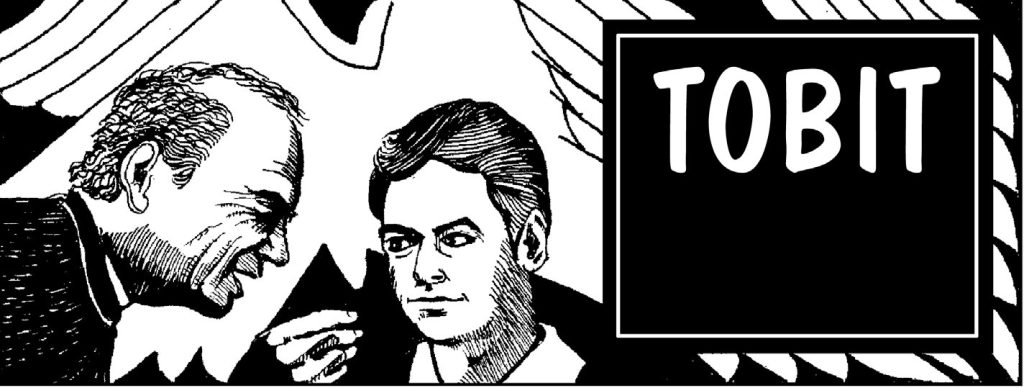
Tobit is a devout Jew living in Nineveh. He becomes blind after performing the good deed of burying a fellow Jew who had been executed. Later he sends his son Tobias with the angel Raphael to claim some money being held for him. Tobias does this, and returns home with a wife, a young woman who had once been plagued by a demon. Tobit regains his sight, and eventually dies with honor and dignity.
Cast of characters in the book of Tobit
The following list of characters is the order in which they occur in the book of Tobit.
Tobit — A pious Israelite man living in exile in Nineveh, capital of Assyria.
Anna — Tobit’s wife.
Tobias — Tobit’s son.
Ahikar — A kinsman of Tobit, and an official in the Assyrian government.
Sarah — A young woman who is an Israelite living in Ecbatana, a city in Media.
Asmodeus — A demon who plagues Sarah.
Gabael — A man living in Media in the city of Rages; Tobit has deposited some money with him.
Raphael — An angel sent by God to assist Tobit and Sarah; in disguise, he goes by the name of Azariah.
The dog — Tobias’s pet.
Raguel — Sarah’s father.
Edna — Sarah’s mother.
Nadab — A kinsman of Tobit and Ahikar.
Some characteristics of the book of Tobit
Tobit is a charming narrative involving the private lives of two Israelite families living in exile far to the east of their homeland, in Assyria and Media. There is no real suspense in the story, since the author tells us early on just what is going to happen. But since the reader knows the course of the story in advance, the author can make use of irony to an extent that might not otherwise be possible.
Most of the characterizations are well done. Anna is an especially believable figure, dominating each scene in which she appears. Her husband Tobit is also convincingly drawn. Sarah and her parents, Raguel and Edna, are less prominent, but still realistic characters. Much of the narrative is about the adventures of Tobit’s son Tobias. However, Tobias never assumes the vigor of the other human characters. He seldom shows any initiative or strong emotion. He follows the directions of his father, of Raphael, and of his father-in-law. It is really not clear how old Tobias is. He is old enough to be married, but why is he not supporting the family after his father loses his sight? Why must his mother go to work? Why does he need company on the journey to Media? Tobias is the one character without personality.
A warm feeling for family life runs through the book. Love and respect are shown between husband and wife: Tobit and Anna, Raguel and Edna. Tobit’s love for Anna is nowhere better seen than when he realizes he has been insensitive to her feelings. Care for the unfortunate, especially in the giving of alms, is a religious duty and a virtue warmly commended. Both the young people, Tobias and Sarah, are admonished to treat their in-laws as their own parents, and both pairs of parents accept them as their own children.
The circumstances of the writing of Tobit
The author of Tobit is unknown. All that can be said is that he or she was a Jew, who wrote probably around the year 200 B.C. It is not known where the book was written. It can be said that the book was originally written in a Semitic language, either Hebrew or Aramaic. Fragments of Tobit in both languages have been found among the Dead Sea Scrolls. Through the centuries, however, Tobit has been known only in its Greek translation.
The text of Tobit
Unfortunately the Greek text of Tobit presents difficult problems. There are three different forms of the Greek text, two of them major. One major form is the longer text found in Codex Sinaiticus (and often called the S text because of this), as well as in the Old Latin version. The Dead Sea fragments also belong in this group. The other major form is the shorter text found in Codex Vaticanus (and often called the B or BA text) and other manuscripts. Scholars have identified a third text form found in a small group of manuscripts. Textual comments in this Handbook will largely refer only to the longer and shorter forms.
The majority of scholars today believe that the longer text is closest to the original form of Tobit. This text has been translated by the New Revised Standard Version (NRSV), Today’s English Version (TEV), the New American Bible (NAB), the New English Bible (NEB), the Revised English Bible (REB), and the New Jerusalem Bible (NJB). In this Handbook it is referred to as “our text” or “the text we are following.” The shorter text was the basis of the Revised Standard Version (RSV). It is referred to in this Handbook as “the alternate text” or “the other text.”
Special problems in translating Tobit
Similar names: There are several pitfalls for the inattentive translator in the proper names in the book of Tobit. Tobit, the father, and Tobias, the son (in some versions called Tobiah), are especially easy to confuse. If the translator is accustomed to writing abbreviated notes, he or she should be careful from the beginning to distinguish the two. There is even Tobiel, but he appears only in 1.1. There is a character Gabael, who must be distinguished from the angel Gabriel, who does not appear in this book. The angel Raphael is a major character, but there is also Raguel, and these two must be distinguished.
Ahikar: This is not exactly a problem for the translator, but it is a name that seems to appear out of nowhere in the book, and the translator needs to know who is meant. Ahikar (often spelled Ahiqar) appears to have been a historical person who served as a court official under the Assyrian kings Sennacherib and Esarhaddon in the seventh century B.C. The name became prominent in the folklore of the time; Ahikar was known as a wise and politically powerful man. A Book of Ahikar, perhaps written as early as the late seventh century, is known from an Aramaic manuscript. Ahikar appears several times in Tobit, where he is a relative, and where we find several parallels to material in the ancient Book of Ahikar. These will be mentioned in the notes as necessary.
Jews/Israelites: Tobit is a member of the tribe of Naphtali, one of the northern tribes of Israel. The action of the book takes place during the Assyrian exile of these people, at a time when the Kingdom of Judah, the southern kingdom, was still secure. The book of Tobit was written at a time when the people of the northern tribes had disappeared from history, and only the people of the tribe of Judah survived. Technically, the word “Jew” applies only to those of the tribe of Judah. This would include the author, but it would not include Tobit himself. The text that we follow actually uses the word “Jews” in one place (11.17) to refer to Tobit’s acquaintances. It is not technically correct, but the author about 200 B.C. clearly recognized his kinship in the faith with the inhabitants of northern Israel several centuries back, and this is what he means by his use of the word. TEV has introduced the word “Jews” in a number of places. Translators may want to think twice before using the word, but the author has set a precedent for doing so.
The dog: Tobias has a pet dog that accompanies him and Raphael on their journey. The dog is mentioned at 6.2, when they leave home, and at 11.4, when they return. In the text as it stands, there is not much reason for the dog to be there at all. But in a few manuscripts (the third form of the text mentioned above under “The text of Tobit”), the dog appears in 11.6, where Tobias’s mother first becomes aware that her son is returning when she sees the dog. This makes a great deal of narrative sense, but none of the major translations adopt this form of the text. Other translators may be bolder. Many other textual decisions must be made in this book, but this one affects the drama of the story.
Verse numbers: Unfortunately there is confusion in the numbering of verses in Tobit, as well as confusion in the text. This is most noticeable in the extended passage from 5.10 to 7.17. NRSV and NAB use one system of numbering; TEV, NEB, and REB use another. In this Handbook the verse numbering is always that of NRSV, and the TEV text printed alongside the NRSV text is that which is equivalent in content, and not always that which has the same verse number.
Outline of contents
Introduction (1.1-2)
The troubles of Tobit and Sarah (1.3–3.17)
Tobit’s religious devotion (1.3-22)
Tobit’s troubles (2.1-14)
Tobit’s prayer (3.1-6)
Sarah’s troubles (3.7-10)
Sarah’s prayer (3.11-15)
God sends the angel Raphael to help Tobit and Sarah (3.16-17)
The journey to Ecbatana (4.1–6.18)
Tobit gives advice to his son Tobias (4.1-21)
Raphael is hired to accompany Tobias (5.1–6.1a)
Tobias and Raphael travel to Ecbatana (6.1b-18)
God answers the prayers of Tobit and Sarah (7.1–12.22)
Preparations for a wedding (7.1-16)
God answers Sarah’s prayers (8.1-21)
Raphael travels to Rages and back (9.1-6)
Tobit and Anna worry about Tobias (10.1-7a)
Tobias and Sarah leave Ecbatana (10.7b-13)
Tobias is welcomed home (11.1-9)
Tobit is healed (11.10-15)
Sarah is welcomed (11.16-18)
Raphael reveals himself (12.1-22)
Conclusion (13.1–14.15)
Tobit’s hymn of praise (13.1–14.1)
Tobit’s dying words and death (14.2-11)
Tobias’s later life and death (14.12-15)
Quoted with permission from Bullard, Roger A. and Hatton, Howard A. A Handbook on Tobit. (UBS Helps for Translators). New York: UBS, 2001. For this and other handbooks for translators see here.

Leave a Reply
You must be logged in to post a comment.