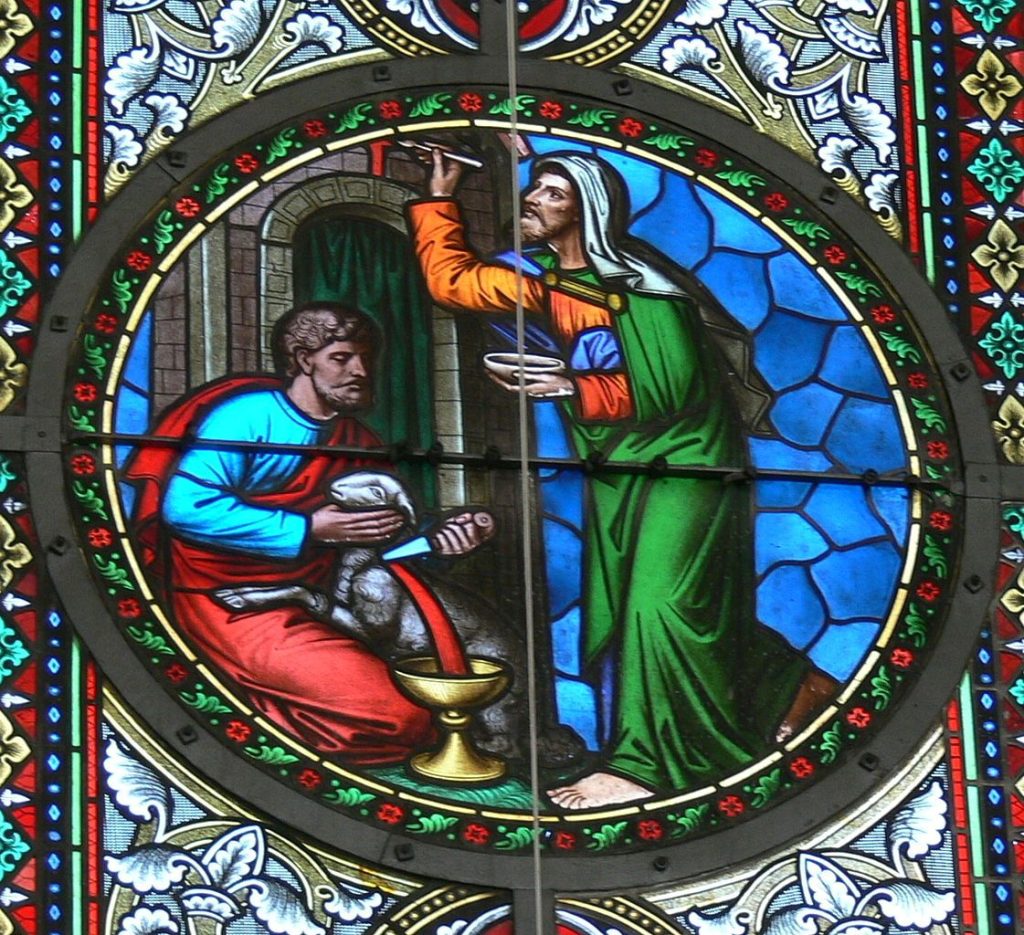
Stained glass is not just highly decorative, it’s a medium which has been used to express important religious messages for centuries. Literacy was not widespread in the medieval and Renaissance periods and the Church used stained glass and other artworks to teach the central beliefs of Christianity. In Gothic churches, the windows were filled with extensive narrative scenes in stained glass — like huge and colorful picture storybooks — in which worshipers could ‘read’ the stories of Christ and the saints and learn what was required for their religious salvation. (Source: Victoria and Albert Museum )
Although the verse begins with the Hebrew conjunction waw, only a few translations try to retain it (King James Version, American Standard Version, New American Standard Bible). The LORD said to Moses and Aaron introduces instructional material into the narrative. (See the introductory remarks above.) In the land of Egypt simply means “in Egypt” (Good News Translation). Even this may seem unnecessary, but it emphasizes that the following instructions are to be understood within the Egyptian setting.
This month refers to the time when the events of chapter 12 took place. It became the first month in the Hebrew calendar, which begins with the new moon appearing during the second half of March or the first half of April. It is not yet named, so translators should not give it a name here. But in 13.4 and 23.15 it is called “Abib.” Much later the Babylonian name “Nisan” was used (see Est 3.7). The Hebrew word for month also means “new moon,” and this will be the natural form in many languages. Shall be is not in the Hebrew (literally “this month for you”), but “is” or “is to be” should be understood here. This is the announcement of a new calendar for the Israelites. For you is plural. Shall be for you may therefore be expressed as “You [plural] must reckon as” and placed at the beginning of the sentence. (See the model at the end of the discussion below.) New Revised Standard Version has “shall mark for you.” The beginning of months is literally the “head of months.”
It shall be the first month of the year for you repeats almost the same words for emphasis. Good News Translation has combined the two clauses into one, but New American Bible rewords the verse so that it does not sound monotonous: “This month shall stand at the head of your calendar; you shall reckon it the first month of the year.” A simpler model is the following: “You [plural] must reckon this month [or, new moon] as the first month of the year.” Also possible is “You must consider this month to be….”
Quoted with permission from Osborn, Noel D. and Hatton, Howard A. A Handbook on Exodus. (UBS Helps for Translators). New York: UBS, 1999. For this and other handbooks for translators see here .



Leave a Reply
You must be logged in to post a comment.