The term that is transliterated as “Hannah” in English is translated in American Sign Language with a modification of the sign for “grace,” referring to the original meaning of the name “Hannah.” (Source: Ruth Anna Spooner, Ron Lawer)
“Hannah” in American Sign Language, source: Deaf Harbor
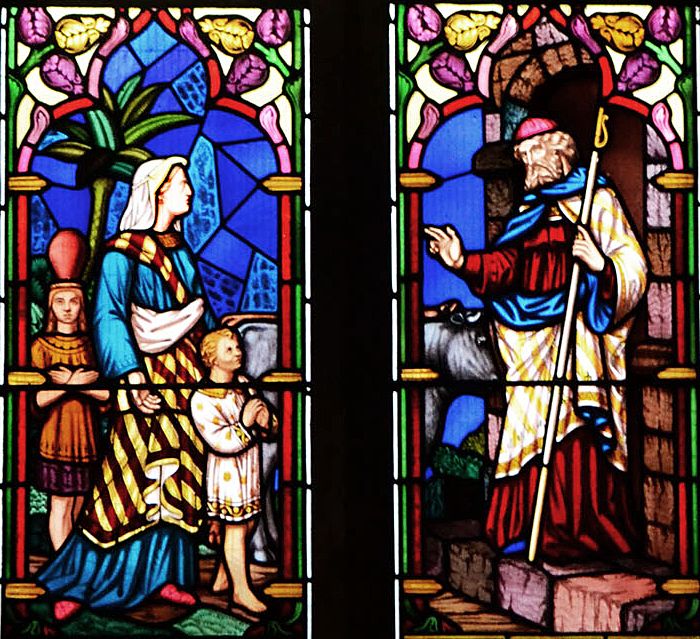
Stained glass is not just highly decorative, it’s a medium which has been used to express important religious messages for centuries. Literacy was not widespread in the medieval and Renaissance periods and the Church used stained glass and other artworks to teach the central beliefs of Christianity. In Gothic churches, the windows were filled with extensive narrative scenes in stained glass — like huge and colorful picture storybooks — in which worshipers could ‘read’ the stories of Christ and the saints and learn what was required for their religious salvation. (Source: Victoria and Albert Museum )
Following are a number of back-translations as well as a sample translation for translators of 1 Samuel 1:8:
Kupsabiny: “There/Then, Elkanah asked Hannah that, ‘My wife, why are you crying? What is hurting/grieving you so that you do not want to eat? Is it not better for you to have a husband who cares for you than ten sons?’” (Source: Kupsabiny Back Translation)
Newari: “Her husband Elkanah asked her, "Hannah, why are you weeping? Why do you stay without eating anything? Why are you being caused to feel so much sorrow? Am I not more to you than ten sons?"” (Source: Newari Back Translation)
Hiligaynon: “Elkana would-say to her, ‘Why are- you (sing.) -crying? Why do- you (sing.) not -want to-eat? Why are- you (sing.) -mourning? Is-it not that I (am) more to you (sing.) than ten children?’” (Source: Hiligaynon Back Translation)
English: “Then Elkanah would say to her, ‘Hannah, why are you crying?/please quit crying! Why are you not eating?/Please eat something! Why are you so upset/sad? You have me; is that not more important to you than if you had ten sons? (OR, I love you more than your sons would love you, even if you had ten sons.)’” (Source: Translation for Translators)
And Elkanah … said to her: the Hebrew has a connecting word translated as And in many translations (Revised Standard Version, Nueva Biblia Española). Often the connection is left implicit in translation and the Hebrew word is not translated (so Good News Translation, New Revised Standard Version, New Jewish Publication Society’s Tanakh). But some translations find it natural to use other transition words, like “So” (Contemporary English Version).
Why is your heart sad? The Hebrew verb means “to be evil” or “to be discontented.” In Hebrew thought the heart designates the most inward part of a person, the center of one’s will and thoughts (see 16.7, which states that the LORD looks on a person’s heart).
The question Am I not more to you than ten sons? is translated literally in most versions. The exact sense, however, is not clear. Perhaps the meaning is “Am I not more devoted to you than ten sons?” (New Jewish Publication Society’s Tanakh). More commonly the sense is understood to be “Don’t I mean more to you than ten sons?” (New International Version). The number ten here, as in Gen 31.7; Num 14.22; Neh 4.6; and Job 19.3, probably has symbolic value, meaning “a large number.” Compare also Ruth 4.15. In many languages the number “ten” will convey the intended meaning. In those cases where Good News Translation or New International Version is accepted as the model, the idea may have to be expressed as “I can surely do more for you than ten sons,” since this question is a rhetorical one, which normally means the same as an emphatic statement.
Quoted with permission from Omanson, Roger L. and Ellington, John E. A Handbook on the First and Second Books of Samuel, Volume 1. (UBS Helps for Translators). New York: UBS, 2001. For this and other handbooks for translators see here .

Leave a Reply
You must be logged in to post a comment.