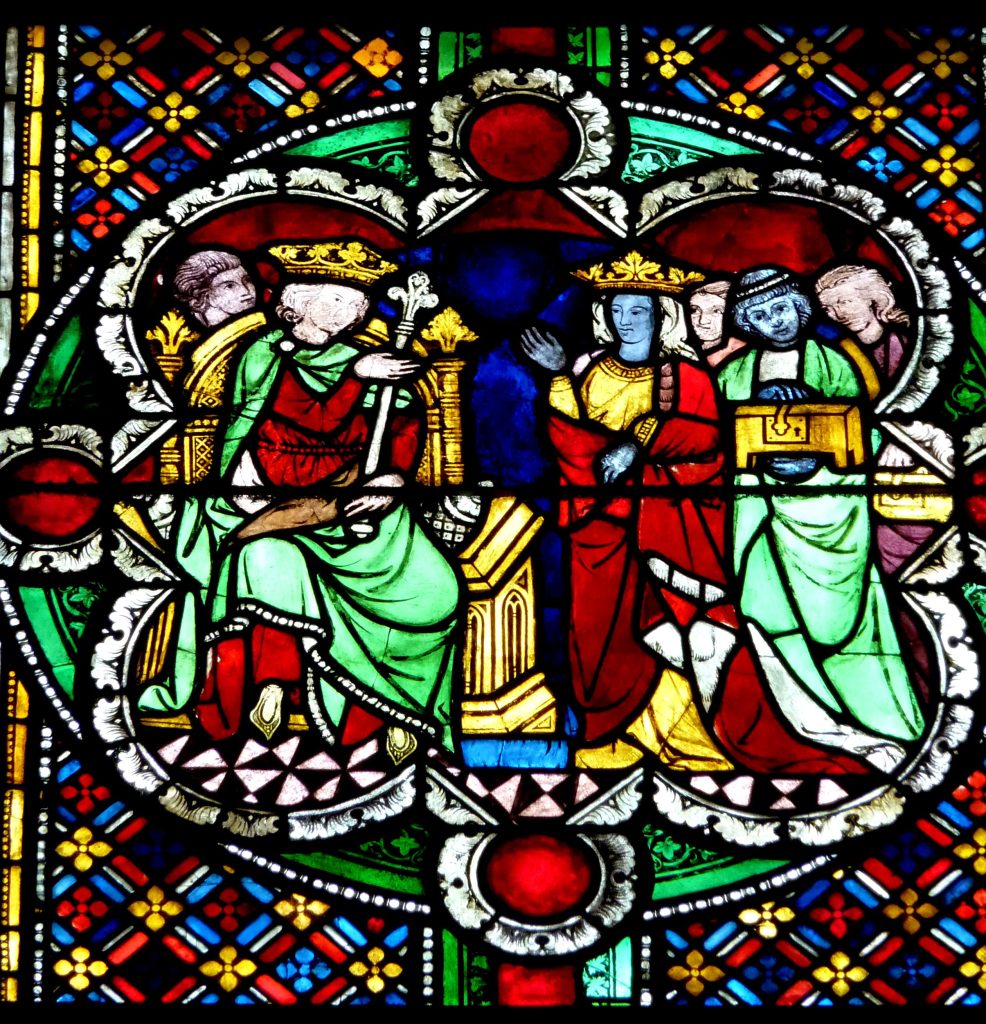
The following is a stained glass window from the Three choir windows in the Marienkirche, Frankfurt (Oder), Germany, of the 14th century, depicting Solomon and the Queen of Sheba:
Source: Der gläserne Schatz: Die Bilderbibel der St. Marienkirche in Frankfurt (Oder), Neuer Berlin Verlag, 2005, copyright for this image: Brandenburgisches Landesamt für Denkmalpflege und Archäologisches Landesmuseum
Stained glass is not just highly decorative, it’s a medium which has been used to express important religious messages for centuries. Literacy was not widespread in the medieval and Renaissance periods and the Church used stained glass and other artworks to teach the central beliefs of Christianity. In Gothic churches, the windows were filled with extensive narrative scenes in stained glass — like huge and colorful picture storybooks — in which worshipers could ‘read’ the stories of Christ and the saints and learn what was required for their religious salvation. (Source: Victoria and Albert Museum )
Stained glass is not just highly decorative, it’s a medium which has been used to express important religious messages for centuries. Literacy was not widespread in the medieval and Renaissance periods and the Church used stained glass and other artworks to teach the central beliefs of Christianity. In Gothic churches, the windows were filled with extensive narrative scenes in stained glass — like huge and colorful picture storybooks — in which worshipers could ‘read’ the stories of Christ and the saints and learn what was required for their religious salvation. (Source: Victoria and Albert Museum )
Following are a number of back-translations as well as a sample translation for translators of 1 Kings 10:11:
Kupsabiny: “(But also when the people of Hiram would bring in ships with gold from Ophir, they too came along with large quantities of expensive wood and expensive stones.” (Source: Kupsabiny Back Translation)
Newari: “(Hiram’s ships would bring gold from Ophir. After that they would also bring sandalwood and valuable precious stones from the ships.” (Source: Newari Back Translation)
Hiligaynon: “(The ships of Hiram also brought to King Solomon gold, many almug woods, and expensive stones, that all came from Ofir.” (Source: Hiligaynon Back Translation)
English: “In the ships that belonged to King Hiram, in which they had previously brought gold from Ophir, they also brought a large amount of juniper wood and gems/valuable stones.” (Source: Translation for Translators)
Verses 11-12 are parenthetical and pick up the comments from 1 Kgs 9.27-28 regarding the fleet of Hiram, which brought gold from Ophir. Osty-Trinquet states in a footnote that these two verses are misplaced and should follow immediately after 1 Kgs 9.28. See also the comments on the placement of these verses in the introductory comments on verses 1-13. Since this is the first mention of Hiram in chapter 10, some translations identify him as “King Hiram” (so Bible en français courant, Parole de Vie).
The words Moreover and “also” (Good News Translation) translate a Hebrew adverb at the beginning of this verse. This adverb indicates that it was not only the queen of Sheba who brought valuable items to Solomon but also Hiram.
Fleet translates a Hebrew word that is singular but has a collective meaning (see 1 Kgs 9.26). Other translations include “ships” (New International Version, Parole de Vie) and “fleet of ships” (Revised English Bible).
For the location of Ophir, see 1 Kgs 9.28. In this verse the place name occurs twice, but in some languages the second occurrence may be replaced by an adverb or left implicit.
Almug wood: A crucial issue here is whether this tree is the same as the “algum” tree mentioned in 2 Chr 9.10 (see also 2 Chr 2.8). If these are really parallel accounts, as they appear to be, the trees should be the same. But the experts are divided. According to our view and that of some authorities, the trees are the same and they are sandalwood from India, via Ophir. But others say the almug is the sandalwood from India and the “algum” is the juniper found in the forests of Lebanon. The translator has three options here:
(1) Transliterate the Hebrew in both 1 Kings and 2 Chronicles and leave the tantalizing similarity. Revised Standard Version, New International Version, Revised English Bible, and New Jerusalem Bible have done this.
(2) Harmonize the two passages by using a phrase such as “precious wood” or by choosing one species such as “juniper” (Good News Translation, Contemporary English Version, New Century Version) or “sandalwood” (God’s Word). If one species is chosen, translators may need to transliterate its name from a major language. Of course, translators in the Far East will have local names for sandalwood.
(3) Use a transliteration of the Hebrew root word mug in both books. If this is done, translators will need to explain in a footnote on 2 Chr 2.8 how these trees got to Lebanon.
Precious stones: See the comments on verse 2.
Quoted with permission from Omanson, Roger L. and Ellington, John E. A Handbook on 1-2 Kings, Volume 1. (UBS Helps for Translators). New York: UBS, 2008. For this and other handbooks for translators see here .
10:11a (The fleet of Hiram that brought gold from Ophir
(Hiram’s ships carried gold from Ophir. -or-
(The ships of ⌊King⌋ Hiram went to Ophir and brought back gold.
10:11b also brought from Ophir a great cargo of almug wood and precious stones.
From Ophir the ships also carried large quantities of fine wood and precious stones. -or-
They also brought back from there much high-quality timber and many costly/valuable jewels/gems.




Leave a Reply
You must be logged in to post a comment.