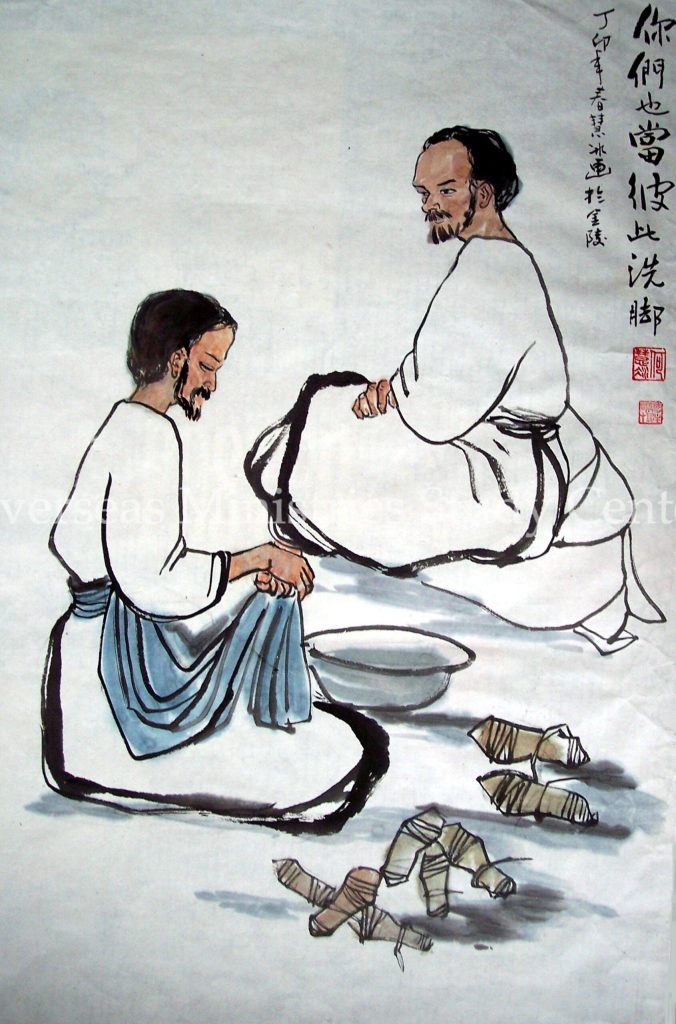
Wash Each Other's Feet

Painting by Huibing He (何慧冰), used with permission by the Overseas Ministries Study Center (OMSC) at Princeton Theological Seminary. You can purchase this and many other artworks by artists in residence at the OSMC in high resolution and without a watermark via the OSMC website .

“Dr. Huibing He, 2007-2008 OMSC artist in residence, encountered Christianity when the church was ‘reopened’ in China in 1980. She pursued her artistic education as well as her theological education in China in order to share her faith. Dr. He has embraced the challenge of a dual vocation as both artist and pastor. Her work has been exhibited in Nanjing, China, in Hong Kong, in Austria, and in the United States.

The story of her life is an amazing testimony to the faithfulness of God. She was born in Guangzhou, China, five years after the Communist takeover, and for much of her childhood her father was away at a concentration labor farm to which he had been sentenced because of his political views and alleged ‘capitalist’ sympathies. She became a Christian in her early twenties, just after churches in China were permitted to reopen. ‘I had always escaped into art for consolation, but I think I had always sought God without being aware of it,’ she says. Moved by the music at the first worship service she wandered into, Huibing asked to sing in the choir and before long was involved in many church activities, including Bible study and baptismal preparation. ‘The church was so full of warmth, love, and harmony. Something really captured my whole being. So I was compelled to stay.’

Although Huibing and her seven siblings grew up materially poor, her parents were enormously supportive and encouraged the children to be ‘spiritually free’ insofar as they were able. Huibing’s parents instilled in her from an early age the importance of honesty, integrity, and kindness, and on her father’s rare visits, he urged Huibing, ‘Don’t be destroyed by circumstance.’

Huibing took this lesson to heart. School was extremely difficult for her due to the stifling impositions of the Cultural Revolution; students had been encouraged to rebel against their teachers and inherited tradition, and until high school, Huibing endured daily bullying because of her father’s status. She was even barred from participating in school activities such as the art program. Nevertheless, the school made use of her talent by assigning her to decorate the building’s bulletin boards, an activity she loved.

Huibing attended Nanjing Theological Seminary because she wanted to be able to address the questions her friends often posed about her newfound faith. She was delighted to discover that she did not have to sacrifice her art in order to pursue ministry. She eventually came to Columbia Theological Seminary in Atlanta, where she earned a doctor of ministry degree focusing on the intersection between Gospel, culture, and pastoral care.

She studied oil painting with Master Li Jianheng, drawing and art theory with Master sculptor Tang Daxi, and Chinese painting with Master Zhu Gui in Guangzhou and Nanjing, China, from 1968 to 1978. She was an instructor in Fine Arts at the Guangzhou Commercial School from 1980 to 1982, an instructor in Applied Church Art at Nanjing Theological Seminary from 1985 to 1989, and an instructor in Christian Art History there from 1986 to 1992.

She is a member of three professional artist associations, and continues to work as an artist and an ordained minister in the United Methodist Church.” (Source ).

See also Jesus Washes His Disciples’ Feet.
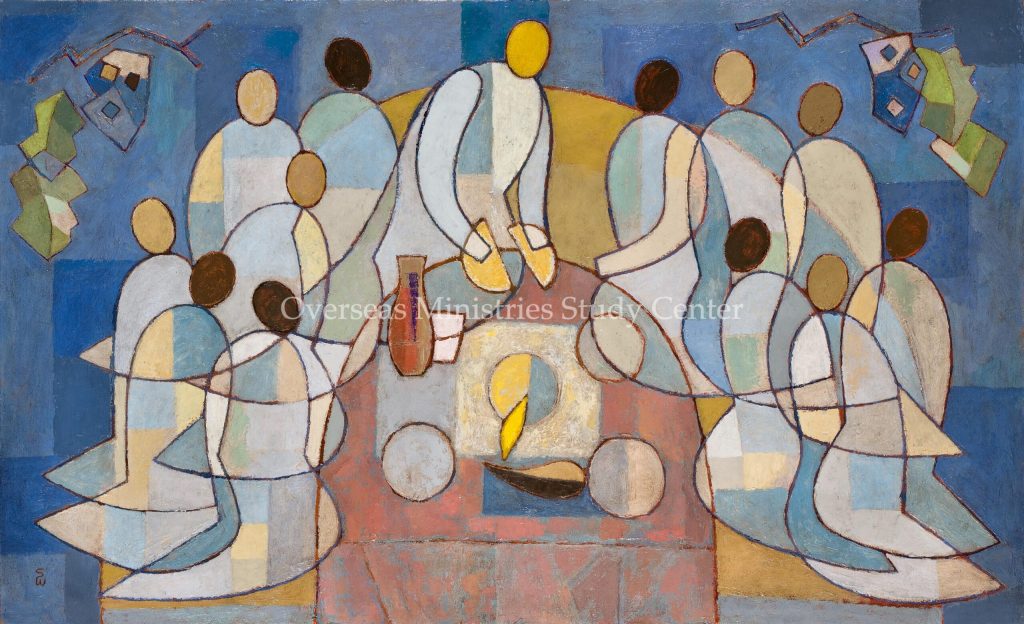
We All are One in Christ

Painting by Soichi Watanabe, used with permission by the Overseas Ministries Study Center (OMSC) at Princeton Theological Seminary. You can purchase this and many other artworks by artists in residence at the OSMC in high resolution and without a watermark via the OSMC website .

“A resident of Koshigaya City, Saitama, Japan, Soichi Watanabe was the 2008-09 OMSC artist in residence. Watanabe graduated in 1982 from the Ochanomizu Art School in Tokyo after having earned, a decade earlier, an economics degree from Tohoku Gakuin University in Sendai. He teaches at a private art school that he started in 1982. Following his 1982 graduation, Soichi founded a private art school where he and his wife work together to help others experience the joy of art.

“Soichi was drawn to God as an undergraduate student during a home Bible study when he encountered Mark 8:35: ‘Whoever wants to save his life will lose it, but whoever loses his life for me and for the gospel will save it.’ Further study of the New Testament led him to realize that he was both ‘stubborn and self-centered.’ He recalls that ‘the richness of the biblical world overwhelmed me and at the same time tortured me.’

“Shortly thereafter he chose to submit his life to God at an evening worship service. ‘I really heard a voice telling me to accept the salvation of Jesus on the cross and to follow him,’ remembers Soichi. From that point on he has been determined to serve God through his abilities. As a follower of Jesus, Soichi points to his faith as the foundation from which he works as an artist. In his art book Jesus Walking With Us (2004), he writes, ‘I realize that [my works] are my own humble responses to God’s calling in my life… . The images are often given to me through the words of God at worship services on Sundays and during my daily devotion. I have the earnest hope that I will go on painting to praise the Lord.'” (Source )

About this image, Watanabe says: “I have painted this subject twice. My first experience of this was being able to participate in the Nagel Institute Traveling Seminar in Indonesia, in June 2008, which had ‘Christianity, Contextualization, and the Visual Arts’ as its theme. I enjoyed fellowship there with Christian artists from different countries. My second experience was of being impressed with the Christian unity that exists in the OMSC community. In both cases, I experienced the unity that Christians have in Jesus.” (Source: OMSC 2010, p. 34)

Thomas Hastings, former director of the OMSC comments on this painting: “All One in Jesus. There are separate bodies, but they look so similar and they overlap. There are faces, and, differences exist between them, notably the faces are different colors, but they are also so similar in their lack of features.

“Counting the number of figures, it could be Jesus and the disciples. It could be the Last Supper and this could be Jesus. Looking at it that way we realize we all look like Jesus, or Jesus looks like each of us.

“One observation is that Watanabe minimized the particulars that can separate us from others to show we are all one people, regardless of where we come from. There is a sameness here, there is a union. We are one because all are all part of a common humanity. We are also one because we are at the table together, and the table encompasses us all. We are the body of Christ and members of one another.

“At the same time that we are one, there is also a differentiation. These are individual bodies, and faces. There is some specificity, not an undifferentiated mass. There is a spiritual reality here, of a one-ness that exists. There is a material specificity here, that individual bodies exist and the two can’t be separated.” (Source )

See other images of Soichi Watanabe.

the last supper (image).

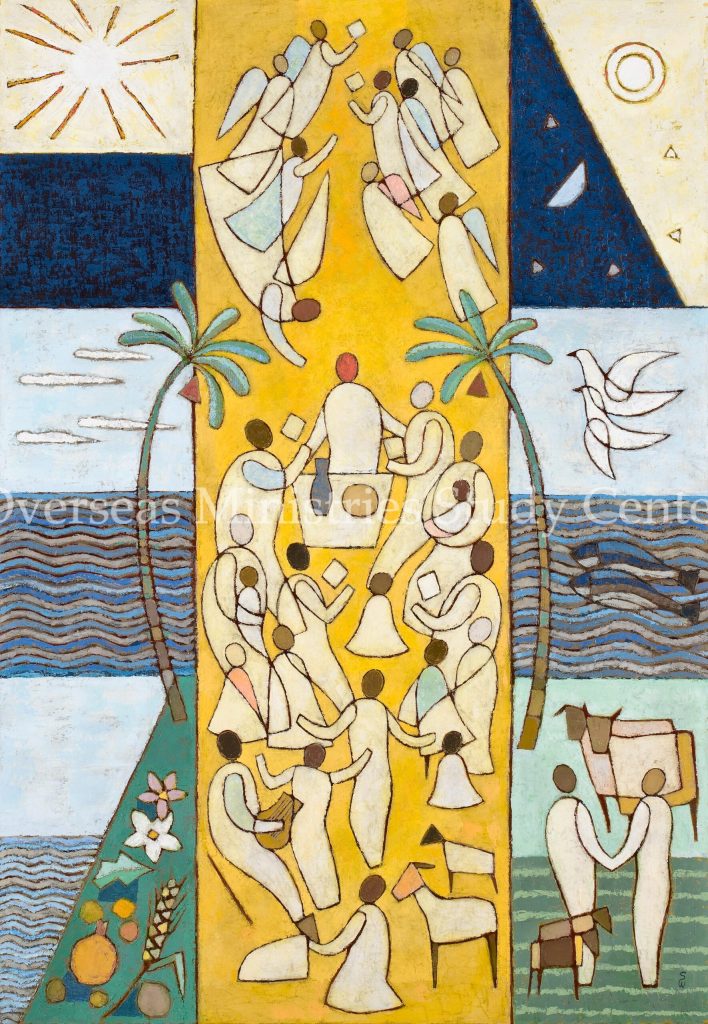
The Name of God and Salvation of Humanity

Painting by Soichi Watanabe, used with permission by the Overseas Ministries Study Center (OMSC) at Princeton Theological Seminary. You can purchase this and many other artworks by artists in residence at the OSMC in high resolution and without a watermark via the OSMC website .

“A resident of Koshigaya City, Saitama, Japan, Soichi Watanabe was the 2008-09 OMSC artist in residence. Watanabe graduated in 1982 from the Ochanomizu Art School in Tokyo after having earned, a decade earlier, an economics degree from Tohoku Gakuin University in Sendai. He teaches at a private art school that he started in 1982. Following his 1982 graduation, Soichi founded a private art school where he and his wife work together to help others experience the joy of art.

“Soichi was drawn to God as an undergraduate student during a home Bible study when he encountered Mark 8:35: ‘Whoever wants to save his life will lose it, but whoever loses his life for me and for the gospel will save it.’ Further study of the New Testament led him to realize that he was both ‘stubborn and self-centered.’ He recalls that ‘the richness of the biblical world overwhelmed me and at the same time tortured me.’

“Shortly thereafter he chose to submit his life to God at an evening worship service. ‘I really heard a voice telling me to accept the salvation of Jesus on the cross and to follow him,’ remembers Soichi. From that point on he has been determined to serve God through his abilities. As a follower of Jesus, Soichi points to his faith as the foundation from which he works as an artist. In his art book Jesus Walking With Us (2004), he writes, ‘I realize that [my works] are my own humble responses to God’s calling in my life… . The images are often given to me through the words of God at worship services on Sundays and during my daily devotion. I have the earnest hope that I will go on painting to praise the Lord.'” (Source )

About this image, Watanabe says: “The name of God, the ‘I AM’ or the ‘I AM WHO I WILL BE,’ can provide the context for our individual, human ‘I am.’ This is something that I learned from a book by Dr. Kenichi Kida. On this canvas I have expressed some of the salvation stories related to the name of God. The white squares symbolize the voice of God and the Ten Commandments. God freed the Israelites from slavery in Egypt, and after the Egyptian army sank into the sea, Miriam led the people in dancing and singing praise to God.” (Source: OMSC 2010, p. 16)

See other images of Soichi Watanabe.

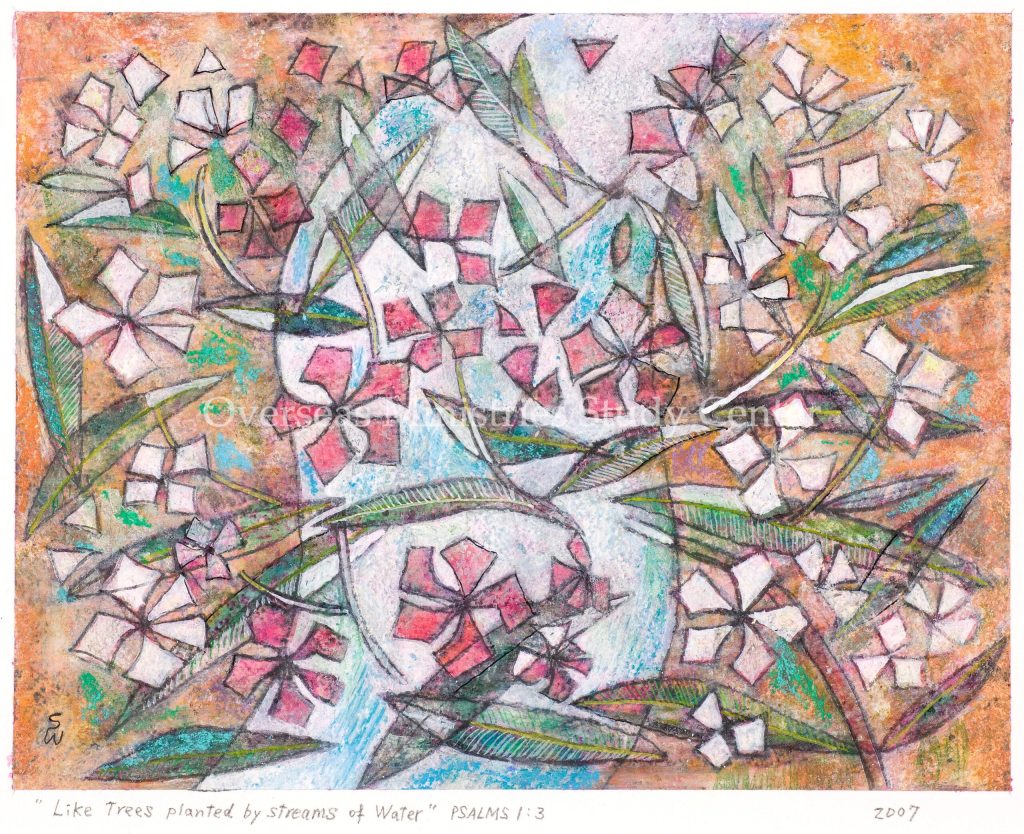
To God Be the Glory

Painting by Soichi Watanabe, used with permission by the Overseas Ministries Study Center (OMSC) at Princeton Theological Seminary. You can purchase this and many other artworks by artists in residence at the OSMC in high resolution and without a watermark via the OSMC website .

“A resident of Koshigaya City, Saitama, Japan, Soichi Watanabe was the 2008-09 OMSC artist in residence. Watanabe graduated in 1982 from the Ochanomizu Art School in Tokyo after having earned, a decade earlier, an economics degree from Tohoku Gakuin University in Sendai. He teaches at a private art school that he started in 1982. Following his 1982 graduation, Soichi founded a private art school where he and his wife work together to help others experience the joy of art.

“Soichi was drawn to God as an undergraduate student during a home Bible study when he encountered Mark 8:35: ‘Whoever wants to save his life will lose it, but whoever loses his life for me and for the gospel will save it.’ Further study of the New Testament led him to realize that he was both ‘stubborn and self-centered.’ He recalls that ‘the richness of the biblical world overwhelmed me and at the same time tortured me.’

“Shortly thereafter he chose to submit his life to God at an evening worship service. ‘I really heard a voice telling me to accept the salvation of Jesus on the cross and to follow him,’ remembers Soichi. From that point on he has been determined to serve God through his abilities. As a follower of Jesus, Soichi points to his faith as the foundation from which he works as an artist. In his art book Jesus Walking With Us (2004), he writes, ‘I realize that [my works] are my own humble responses to God’s calling in my life… . The images are often given to me through the words of God at worship services on Sundays and during my daily devotion. I have the earnest hope that I will go on painting to praise the Lord.'” (Source )

About this image, Watanabe says: “This passage in Exodus [and Deuteronomy] speaks of the six days God spent working on the creation. The daily work we do is to be done through God’s leading. The seventh day, the Sabbath day, is the day when we give thanks with joy and praise for the work of God and for what Jesus has done. This painting reflects some of the things I learned in seminars at OMSC, such as the worship dancing of African believers. It also reflects some of the worship experience I enjoyed with little children at the First Presbyterian Church in New Haven. (Source: OMSC 2010, p. 34)

See other images of Soichi Watanabe.

The Vine - Unity with Jesus

Painting by Soichi Watanabe, used with permission by the Overseas Ministries Study Center (OMSC) at Princeton Theological Seminary. You can purchase this and many other artworks by artists in residence at the OSMC in high resolution and without a watermark via the OSMC website .

“A resident of Koshigaya City, Saitama, Japan, Soichi Watanabe was the 2008-09 OMSC artist in residence. Watanabe graduated in 1982 from the Ochanomizu Art School in Tokyo after having earned, a decade earlier, an economics degree from Tohoku Gakuin University in Sendai. He teaches at a private art school that he started in 1982. Following his 1982 graduation, Soichi founded a private art school where he and his wife work together to help others experience the joy of art.

“Soichi was drawn to God as an undergraduate student during a home Bible study when he encountered Mark 8:35: ‘Whoever wants to save his life will lose it, but whoever loses his life for me and for the gospel will save it.’ Further study of the New Testament led him to realize that he was both ‘stubborn and self-centered.’ He recalls that ‘the richness of the biblical world overwhelmed me and at the same time tortured me.’

“Shortly thereafter he chose to submit his life to God at an evening worship service. ‘I really heard a voice telling me to accept the salvation of Jesus on the cross and to follow him,’ remembers Soichi. From that point on he has been determined to serve God through his abilities. As a follower of Jesus, Soichi points to his faith as the foundation from which he works as an artist. In his art book Jesus Walking With Us (2004), he writes, ‘I realize that [my works] are my own humble responses to God’s calling in my life… . The images are often given to me through the words of God at worship services on Sundays and during my daily devotion. I have the earnest hope that I will go on painting to praise the Lord.'” (Source )

About this image, Watanabe says: “In the OMSC community I felt directly that missionaries and others from all over the world were connected through their fellowship with Jesus, and much fruit was borne as we had fellowship together. As the OMSC artist in residence, I was impressed.” (Source: OMSC 2010, p. 76)

See other images of Soichi Watanabe.

Bamboo

Painting by Soichi Watanabe, used with permission by the Overseas Ministries Study Center (OMSC) at Princeton Theological Seminary. You can purchase this and many other artworks by artists in residence at the OSMC in high resolution and without a watermark via the OSMC website .

“A resident of Koshigaya City, Saitama, Japan, Soichi Watanabe was the 2008-09 OMSC artist in residence. Watanabe graduated in 1982 from the Ochanomizu Art School in Tokyo after having earned, a decade earlier, an economics degree from Tohoku Gakuin University in Sendai. He teaches at a private art school that he started in 1982. Following his 1982 graduation, Soichi founded a private art school where he and his wife work together to help others experience the joy of art.

“Soichi was drawn to God as an undergraduate student during a home Bible study when he encountered Mark 8:35: ‘Whoever wants to save his life will lose it, but whoever loses his life for me and for the gospel will save it.’ Further study of the New Testament led him to realize that he was both ‘stubborn and self-centered.’ He recalls that ‘the richness of the biblical world overwhelmed me and at the same time tortured me.’

“Shortly thereafter he chose to submit his life to God at an evening worship service. ‘I really heard a voice telling me to accept the salvation of Jesus on the cross and to follow him,’ remembers Soichi. From that point on he has been determined to serve God through his abilities. As a follower of Jesus, Soichi points to his faith as the foundation from which he works as an artist. In his art book Jesus Walking With Us (2004), he writes, ‘I realize that [my works] are my own humble responses to God’s calling in my life… . The images are often given to me through the words of God at worship services on Sundays and during my daily devotion. I have the earnest hope that I will go on painting to praise the Lord.'” (Source )

About this image, Watanabe says: “In his book When the Bamboo Bends, Dr. Masao Takenaka wrote about the relationship between Christianity and bamboo. The connection with bamboo is that it symbolizes unselfishness. It has an empty core, but it is flexible and strong, like faith. A fresh wind can blow through a grove of bamboo like the Holy Spirit. In November of 2008 I went to an exhibition of bamboo artwork by contemporary Japanese artists at the Japan Society, which is in front of the United Nations building in New York City. Former president of the Japan Society Richard Wood was a friend of Dr. Takenaka, and also supported the artist in residence program at OMSC. It was in America that I felt the beauty of bamboo and remembered Masao and his ‘bamboo theology.’” (Source: OMSC 2010, p. 34)

See other images of Soichi Watanabe.

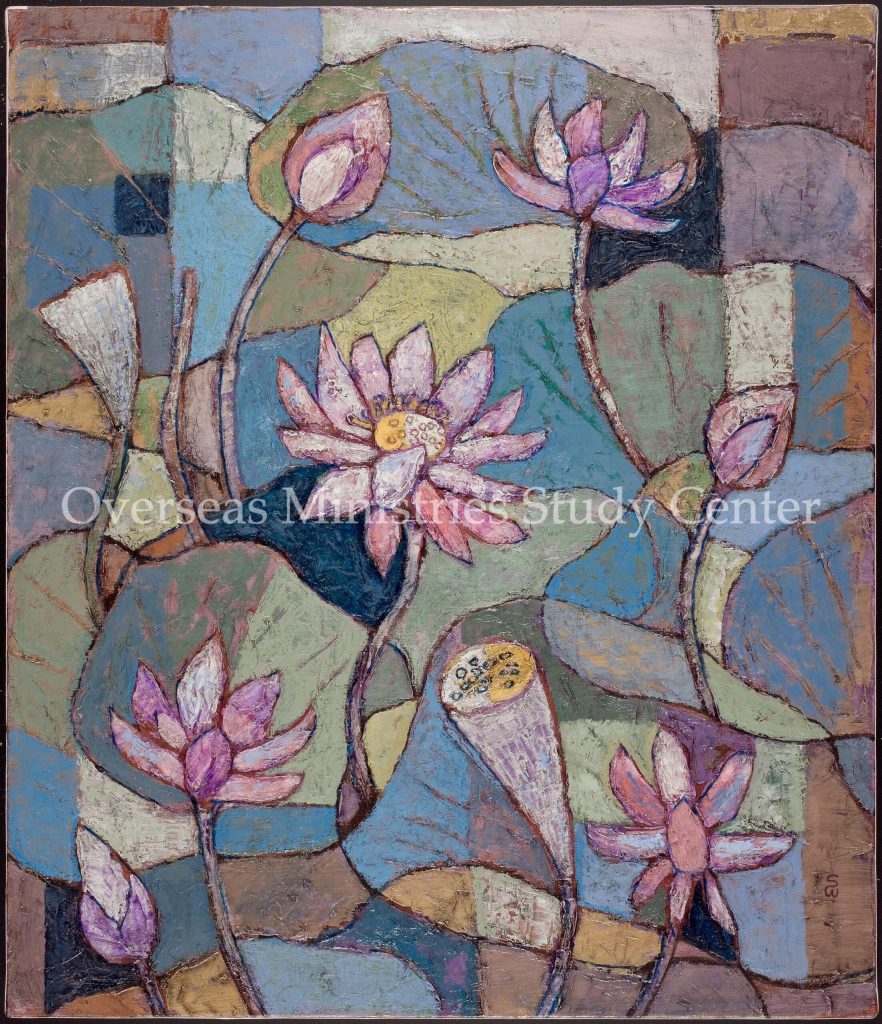
Lotus - the Grace of God

Painting by Soichi Watanabe, used with permission by the Overseas Ministries Study Center (OMSC) at Princeton Theological Seminary. You can purchase this and many other artworks by artists in residence at the OSMC in high resolution and without a watermark via the OSMC website .

“A resident of Koshigaya City, Saitama, Japan, Soichi Watanabe was the 2008-09 OMSC artist in residence. Watanabe graduated in 1982 from the Ochanomizu Art School in Tokyo after having earned, a decade earlier, an economics degree from Tohoku Gakuin University in Sendai. He teaches at a private art school that he started in 1982. Following his 1982 graduation, Soichi founded a private art school where he and his wife work together to help others experience the joy of art.

“Soichi was drawn to God as an undergraduate student during a home Bible study when he encountered Mark 8:35: ‘Whoever wants to save his life will lose it, but whoever loses his life for me and for the gospel will save it.’ Further study of the New Testament led him to realize that he was both ‘stubborn and self-centered.’ He recalls that ‘the richness of the biblical world overwhelmed me and at the same time tortured me.’

“Shortly thereafter he chose to submit his life to God at an evening worship service. ‘I really heard a voice telling me to accept the salvation of Jesus on the cross and to follow him,’ remembers Soichi. From that point on he has been determined to serve God through his abilities. As a follower of Jesus, Soichi points to his faith as the foundation from which he works as an artist. In his art book Jesus Walking With Us (2004), he writes, ‘I realize that [my works] are my own humble responses to God’s calling in my life… . The images are often given to me through the words of God at worship services on Sundays and during my daily devotion. I have the earnest hope that I will go on painting to praise the Lord.'” (Source )

About this image, Watanabe says: “Lotus icons are usually found in Buddhist temples. However, when I was making a sketch of a lotus flower in a pond, I became convinced that the flower was the ‘saint flower,’ because light shines out from the center of this flower. According to some books that have pictures of plants that are found in the Bible, the sculptures of lilies in Solomon’s temple were of water lilies [see Song of Songs 2:1], as the wild lotus plant can be found growing in Israel. I came to understand the deep biblical connection that exists with the lotus or the water lily.” (Source: OSMC 2010, p. 90)

See other images of Soichi Watanabe.