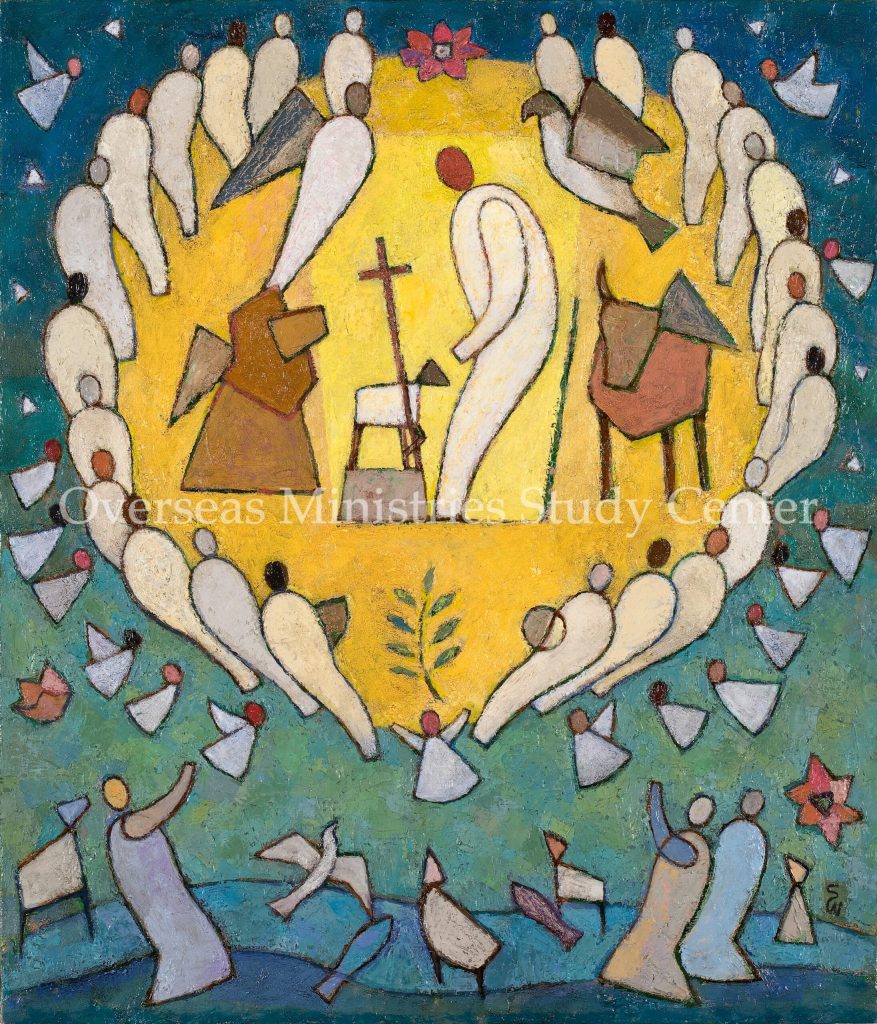
The Glory of the LORD in the Wilderness

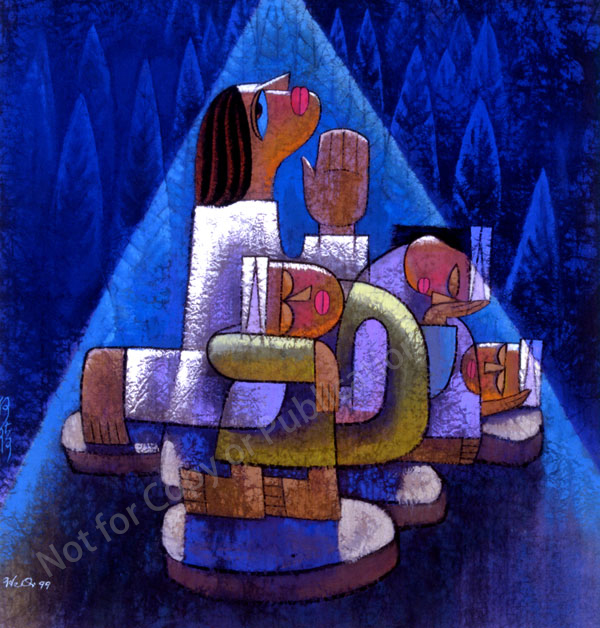
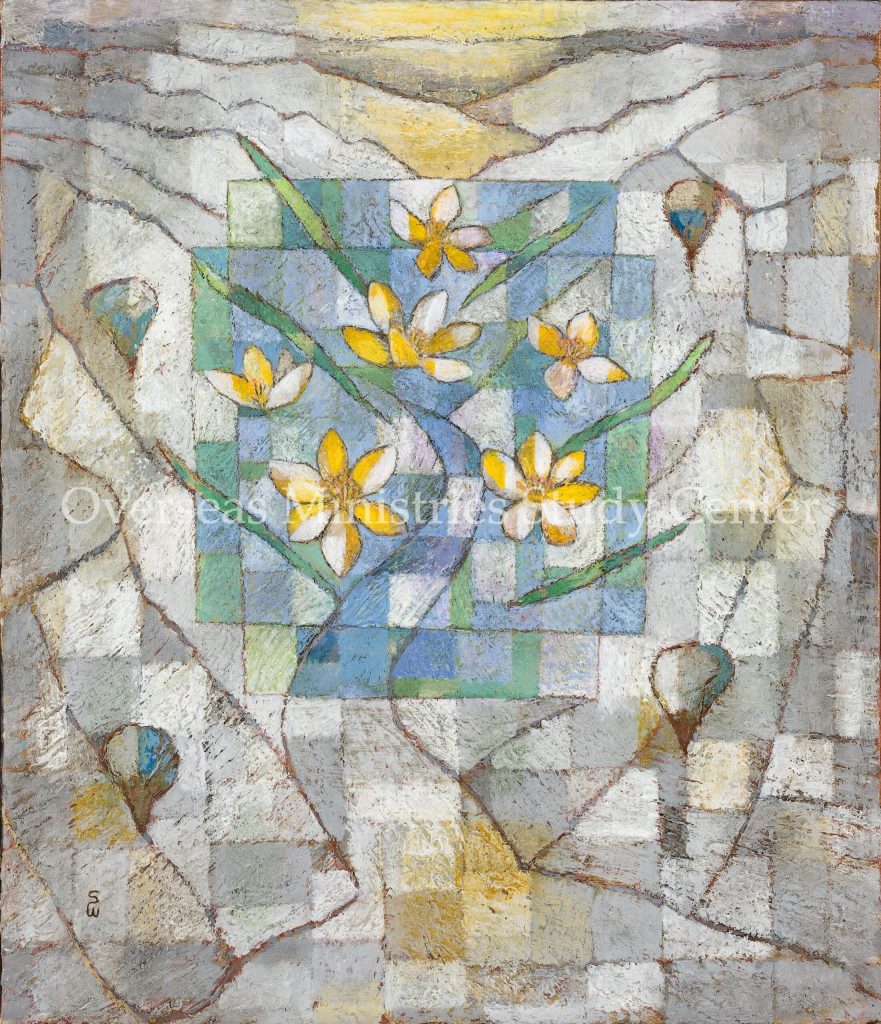
Painting by Soichi Watanabe, used with permission by the Overseas Ministries Study Center (OMSC) at Princeton Theological Seminary. You can purchase this and many other artworks by artists in residence at the OSMC in high resolution and without a watermark via the OSMC website .

“A resident of Koshigaya City, Saitama, Japan, Soichi Watanabe was the 2008-09 OMSC artist in residence. Watanabe graduated in 1982 from the Ochanomizu Art School in Tokyo after having earned, a decade earlier, an economics degree from Tohoku Gakuin University in Sendai. He teaches at a private art school that he started in 1982. Following his 1982 graduation, Soichi founded a private art school where he and his wife work together to help others experience the joy of art.

“Soichi was drawn to God as an undergraduate student during a home Bible study when he encountered Mark 8:35: ‘Whoever wants to save his life will lose it, but whoever loses his life for me and for the gospel will save it.’ Further study of the New Testament led him to realize that he was both ‘stubborn and self-centered.’ He recalls that ‘the richness of the biblical world overwhelmed me and at the same time tortured me.’

“Shortly thereafter he chose to submit his life to God at an evening worship service. ‘I really heard a voice telling me to accept the salvation of Jesus on the cross and to follow him,’ remembers Soichi. From that point on he has been determined to serve God through his abilities. As a follower of Jesus, Soichi points to his faith as the foundation from which he works as an artist. In his art book Jesus Walking With Us (2004), he writes, ‘I realize that [my works] are my own humble responses to God’s calling in my life… . The images are often given to me through the words of God at worship services on Sundays and during my daily devotion. I have the earnest hope that I will go on painting to praise the Lord.'” (Source )

About this image, Watanabe says: “The books of Dr. Kosuke Koyama inspired me to make this painting. Through his books and lectures, he taught us to pray and to act for the realization of peace and righteousness in this world. He also prayed for me and prompted me to make Christian art, emphasizing that I should bear witness to the Gospel through artwork, since the language of the Bible is so visually evocative.” (Source: OMSC 2010, p. 40)
See other images of Soichi Watanabe.

Doxology

Painting by Soichi Watanabe, used with permission by the Overseas Ministries Study Center (OMSC) at Princeton Theological Seminary. You can purchase this and many other artworks by artists in residence at the OSMC in high resolution and without a watermark via the OSMC website .

“A resident of Koshigaya City, Saitama, Japan, Soichi Watanabe was the 2008-09 OMSC artist in residence. Watanabe graduated in 1982 from the Ochanomizu Art School in Tokyo after having earned, a decade earlier, an economics degree from Tohoku Gakuin University in Sendai. He teaches at a private art school that he started in 1982. Following his 1982 graduation, Soichi founded a private art school where he and his wife work together to help others experience the joy of art.

“Soichi was drawn to God as an undergraduate student during a home Bible study when he encountered Mark 8:35: ‘Whoever wants to save his life will lose it, but whoever loses his life for me and for the gospel will save it.’ Further study of the New Testament led him to realize that he was both ‘stubborn and self-centered.’ He recalls that ‘the richness of the biblical world overwhelmed me and at the same time tortured me.’

“Shortly thereafter he chose to submit his life to God at an evening worship service. ‘I really heard a voice telling me to accept the salvation of Jesus on the cross and to follow him,’ remembers Soichi. From that point on he has been determined to serve God through his abilities. As a follower of Jesus, Soichi points to his faith as the foundation from which he works as an artist. In his art book Jesus Walking With Us (2004), he writes, ‘I realize that [my works] are my own humble responses to God’s calling in my life… . The images are often given to me through the words of God at worship services on Sundays and during my daily devotion. I have the earnest hope that I will go on painting to praise the Lord.'” (Source )

About this image, Soichi says: “When I tried to express this doxology, I remembered the vision in Revelation 5:13 in which the entire universe gives honor, praise, and glory to God: in heaven, on earth, under the earth, and in the sea. All living creatures in the universe sing together to God with full voices.” (Source: OMSC 2010, p. 62)

See other images of Soichi Watanabe.

Jesus calls his first disciples (image)

Kim Ki-chang (pen name: Unbo) (1913-2001) had been deaf and partially mute since the age of 7. He painted a series of 30 paintings for the “Life of Christ” cycle in 1952 during the Korean War. Kim portrayed Jesus as a seonbi / 선비, or a Joseon Period (1392-1910) gentleman scholar, wearing a gat / 갓 (hat) and dopo / 도포 (robe).

For other images of Kim Ki-chang art works in TIPs, see here.

Gethsemane

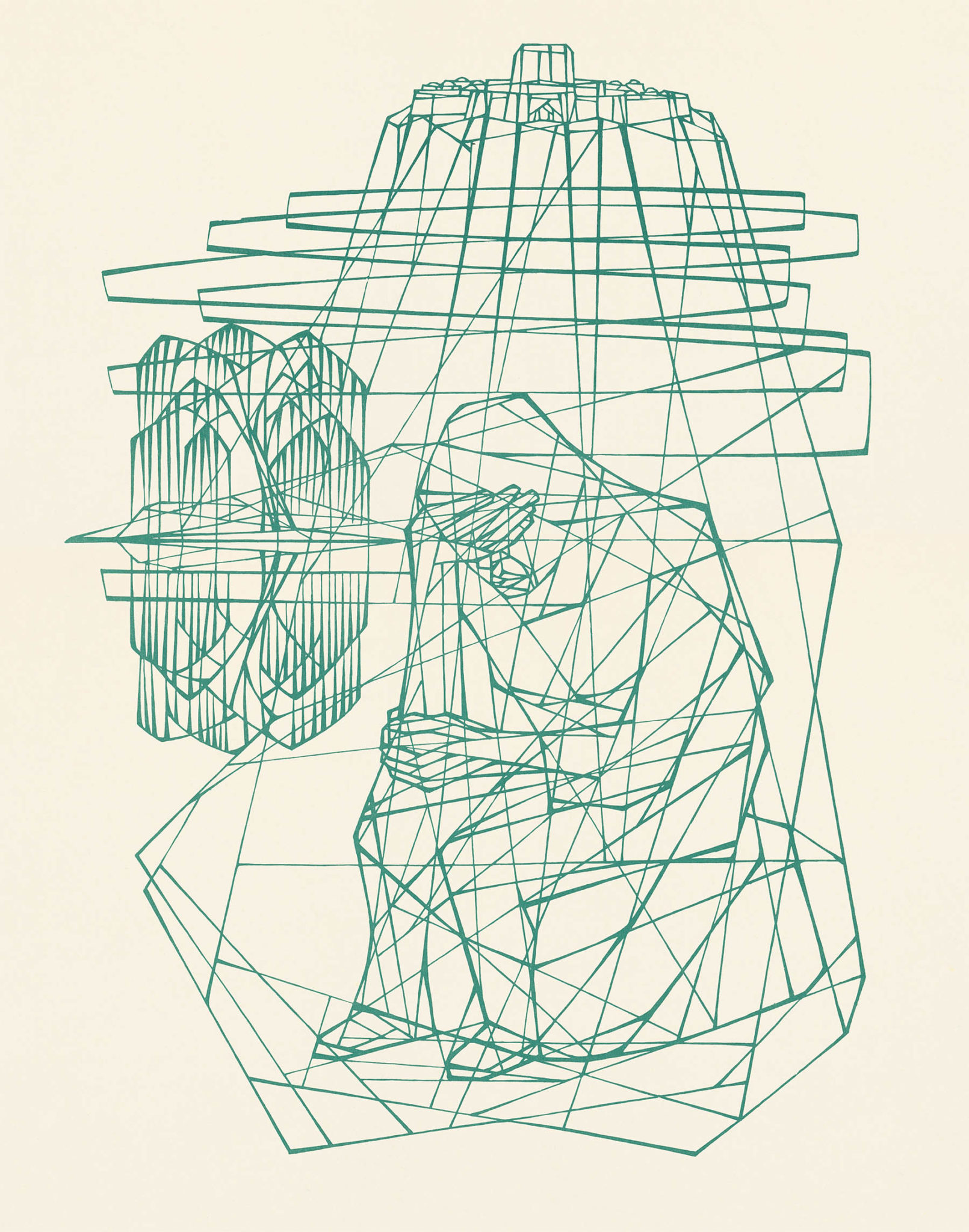
Hand colored stencil print on momigami by Sadao Watanabe (1962). Image taken with permission from the SadaoHanga Catalogue where you can find many more images and information about Sadao Watanabe. For other images of Sadao Watanabe art works in TIPs, see here.

Following is a painting (“Jesus’ agony in the garden of Gethsemane”) by Kim Ki-chang (1913-2001):

Kim Ki-chang (pen name: Unbo) had been deaf and partially mute since the age of 7. He painted a series of 30 paintings for the “Life of Christ” cycle in 1952 during the Korean War. Kim portrayed Jesus as a seonbi / 선비, or a Joseon Period (1392-1910) gentleman scholar, wearing a gat / 갓 (hat) and dopo / 도포 (robe). For other images of Kim Ki-chang art works in TIPs, see here.

Following is a painting (“Prayer at Gethsemane”) by He Qi:

He Qi © 2021 All Rights Reserved.

Image taken from He Qi Art . For purchasing prints of this and other artworks by He Qi go to heqiart.com . For other images of He Qi art works in TIPs, see here

Following is a painting in the Hamzanama style:

Prayer at Gethsemane, 2017-2018, Paul Abraham with Manish Soni, Opaque watercolour and natural pigments on hand-made paper, © Sarmaya Arts Foundation. (2018.33.12)

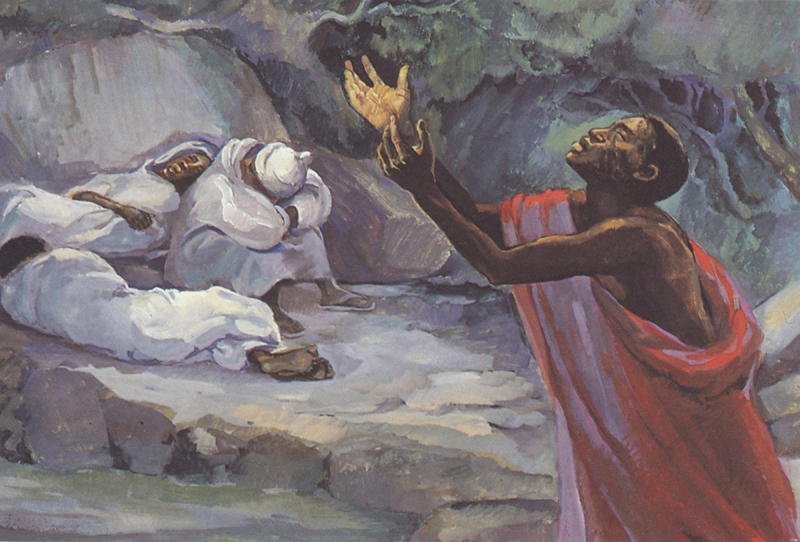
Following is a 1973 painting of the JESUS MAFA project, a response to New Testament readings from the Lectionary by a Christian community in Cameroon, Africa. Each of the readings was selected and adapted to dramatic interpretation by the community members. Photographs of their interpretations were made, and these were then transcribed to paintings:

From Art in the Christian Tradition , a project of the Vanderbilt Divinity Library, Nashville, TN. Image retrieved March 23, 2026. Original source: librairie-emmanuel.fr.

The following is a stained glass window from 1906 and made by R. T. Giles & Co. of Minneapolis for the First Presbyterian Church, Salt Lake City, Utah :

Photo by NateBergin, hosted by Wikimedia Commons under a Creative Commons Attribution 4.0 International license

Stained glass is not just highly decorative, it’s a medium which has been used to express important religious messages for centuries. Literacy was not widespread in the medieval and Renaissance periods and the Church used stained glass and other artworks to teach the central beliefs of Christianity. In Gothic churches, the windows were filled with extensive narrative scenes in stained glass — like huge and colorful picture storybooks — in which worshipers could ‘read’ the stories of Christ and the saints and learn what was required for their religious salvation. (Source: Victoria and Albert Museum )

As a youth he had wisdom that surpassed that of his elders (image)

“The elders are both religious and political as indicated by their clothing. Thai scripture is written on folded palm leaf manuscripts and raised on small tables. The object in the bowl is used for ceremonial purposes. The boy’s hair will be cut at age twelve when, according to Thai tradition, he becomes a complete person. This makes his young wisdom all the more amazing.”

Drawing by Sawai Chinnawong who employs northern and central Thailand’s popular distinctive artistic style originally used to depict Buddhist moral principles and other religious themes; explanation by Paul DeNeui. From That Man Who Came to Save Us by Sawai Chinnawong and Paul H. DeNeui, William Carey Library, 2010.

For more images by Sawai Chinnawong in TIPs see here.

Balaam and the angel

Hand colored stencil print on momigami by Sadao Watanabe (1972).

Image taken with permission from the SadaoHanga Catalogue where you can find many more images and information about Sadao Watanabe. For other images of Sadao Watanabe art works in TIPs, see here.

The following is a stained glass window in the Sacred Heart Cathedral in Chiang Mai, Thailand:

Photo by Jost Zetzsche

Stained glass is not just highly decorative, it’s a medium which has been used to express important religious messages for centuries. Literacy was not widespread in the medieval and Renaissance periods and the Church used stained glass and other artworks to teach the central beliefs of Christianity. In Gothic churches, the windows were filled with extensive narrative scenes in stained glass — like huge and colorful picture storybooks — in which worshipers could ‘read’ the stories of Christ and the saints and learn what was required for their religious salvation. (Source: Victoria and Albert Museum )