2“Speak to the Israelites, and get twelve staffs from them, one for each ancestral house, from all the leaders of their ancestral houses. Write each man’s name on his staff,
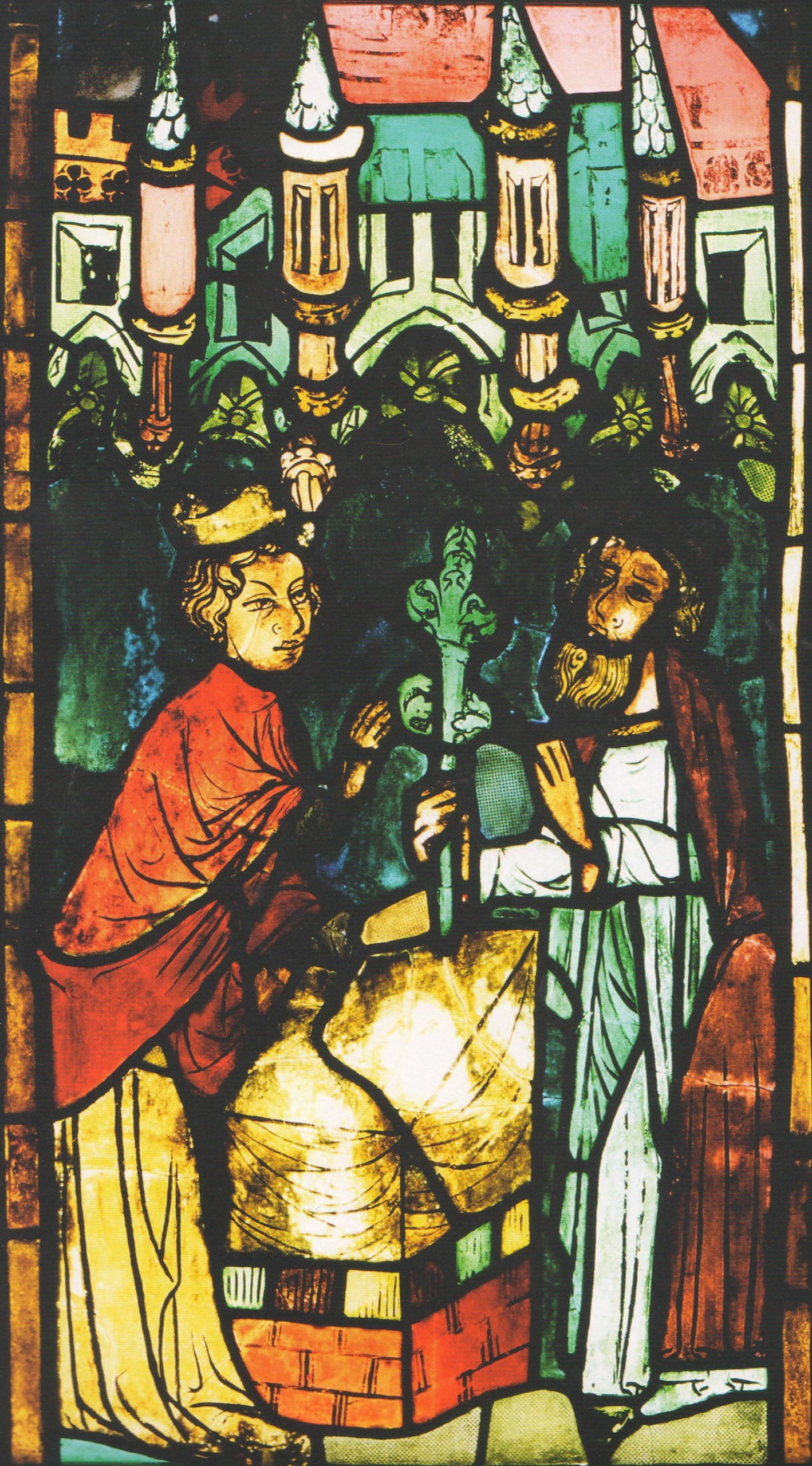
The following is a stained glass window from the Three choir windows in the Marienkirche, Frankfurt (Oder), Germany, of the 14th century, depicting the budding of Aaron’s rod:
Source: Der gläserne Schatz: Die Bilderbibel der St. Marienkirche in Frankfurt (Oder), Neuer Berlin Verlag, 2005, copyright for this image: Brandenburgisches Landesamt für Denkmalpflege und Archäologisches Landesmuseum
Stained glass is not just highly decorative, it’s a medium which has been used to express important religious messages for centuries. Literacy was not widespread in the medieval and Renaissance periods and the Church used stained glass and other artworks to teach the central beliefs of Christianity. In Gothic churches, the windows were filled with extensive narrative scenes in stained glass — like huge and colorful picture storybooks — in which worshipers could ‘read’ the stories of Christ and the saints and learn what was required for their religious salvation. (Source: Victoria and Albert Museum )
Following are a number of back-translations as well as a sample translation for translators of Numbers 17:2:
Kupsabiny: “‘Tell the people of Israel to give you twelve walking sticks. Each stick is to come from each clan leader of Israel. Write on each stick the name of the leader who has that stick.” (Source: Kupsabiny Back Translation)
Newari: “Speak with Israelites, take 12 sticks, one from the leader each tribe, and you are to write each person’s name on his own rod. ” (Source: Newari Back Translation)
Hiligaynon: “‘Tell the Israelinhon that each leader/[lit. head] of each tribe will-give to you (sing.) one staff/cane, and have- on it -write each their name. Twelve staffs/canes (in) all.” (Source: Hiligaynon Back Translation)
English: “‘Tell the Israeli people to bring to you twelve walking sticks. They should bring one from each of the leaders of the twelve tribes. You should carve each leader’s name on his stick.” (Source: Translation for Translators)
17.1 is numbered 17.16 in the Hebrew text, as noted in Revised Standard Version. According to the traditional chapter and verse numbering in the Hebrew text, chapter 17 already started at the verse that is numbered 16.36 in Revised Standard Version, Good News Translation, and many other translations.
The LORD said to Moses: See 1.1. God spoke to Moses again after he punished his people for rebelling. A transitional word or phrase may be needed for naturalness to begin this clause, for example, “Then” (New Living Translation) or “After that” (Chewa).
Speak to the people of Israel: See the comments on 15.38.
And get from them rods: The Hebrew word for rods refers to “walking sticks” (Good News Translation) in this context. The Hebrew noun rendered grain occurs frequently in the Old Testament. It has a wide range of meaning and may include beans and peas as well as crops like wheat and barley. The English word grain expresses the general, broad meaning of this Hebrew term. The word “corn” in the British edition of Good News Translation should not be used as a model since it may wrongly suggest only “maize.”
The first fruits of what they give to the LORD: The Hebrew word for first fruits (re’shit) is literally “first,” but in this context it refers to the “first produce” (Good News Translation), which is the best produce. Since the LORD is speaking here, Good News Translation refers to him in the first person by rendering what they give to the LORD as “which the Israelites give to me.”
I give to you: It may be better to place this verb phrase at the beginning of the sentence in verse 12 (so Good News Translation) rather than at the end (so Revised Standard Version). Revised Standard Version follows the Hebrew structure of verse 12 closely. Good News Translation reorders it for a natural structure in English, which other languages may find helpful. The Hebrew pronoun for you is singular, and so are the pronouns for yours and your in verse 13. These pronouns still refer to Aaron as the primary addressee, but the text also has his descendants in mind, as the final sentence in verse 13 indicates.
The first ripe fruits of all that is in their land, which they bring to the LORD, shall be yours: The Hebrew word rendered first ripe fruits (bikurim), which is literally “first ones” or “firstborn,” differs from the one translated first fruits, but they both refer to the first produce. The word ripe should be left implied here, so New Revised Standard Version omits it. This sentence summarizes the previous sentence and also seems to include other types of produce in addition to the olive oil, new wine, and grain. This nuance is missed in Good News Translation, which says simply “It all belongs to you.” A better model is “All the first crops [or, produce] of their land that the people present to me, the LORD, belongs to you” (similarly New Living Translation).
Every one who is clean in your house may eat of it: See verse 11.
Quoted with permission from de Regt, Lénart J. and Wendland, Ernst R. A Handbook on Numbers. (UBS Helps for Translators). Miami: UBS, 2016. For this and other handbooks for translators see here .


Leave a Reply
You must be logged in to post a comment.