
Jesus heals a boy

Image taken from the Wiedmann Bible. For more information about the images and ways to adopt them, see here .

For other images of Willy Wiedmann paintings in TIPs, see here.

Following is the 1973 painting “The Possessed” of the JESUS MAFA project, a response to New Testament readings from the Lectionary by a Christian community in Cameroon, Africa. Each of the readings was selected and adapted to dramatic interpretation by the community members. Photographs of their interpretations were made, and these were then transcribed to paintings:
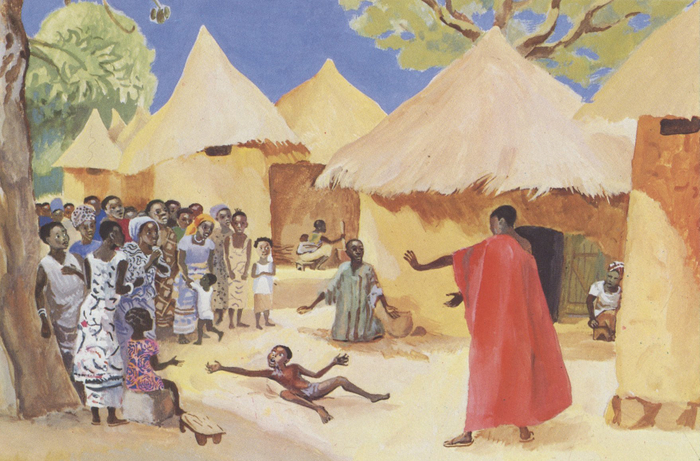
From Art in the Christian Tradition , a project of the Vanderbilt Divinity Library, Nashville, TN. Image retrieved March 23, 2026. Original source: librairie-emmanuel.fr.

request / beg (Japanese honorifics)

Click or tap here to see the rest of this insight.

Like a number of other East Asian languages, Japanese uses a complex system of honorifics, i.e. a system where a number of different levels of politeness are expressed in language via words, word forms or grammatical constructs. These can range from addressing someone or referring to someone with contempt (very informal) to expressing the highest level of reference (as used in addressing or referring to God) or any number of levels in-between.

One way to do this is through the usage (or a lack) of an honorific prefix as shown here in the widely-used Japanese Shinkaiyaku (新改訳) Bible of 2017. The concept of “requesting” is translated in the Shinkaiyaku Bible as o-negai (お願い), combining “request” (negai) with the respectful prefix o (お).

(Source: S. E. Doi, see also S. E. Doi in Journal of Translation, 18/2022, p. 37ff. )

Japanese benefactives (oidashite)

Click or tap here to see the rest of this insight.

Like a number of other East Asian languages, Japanese uses a complex system of honorifics, i.e. a system where a number of different levels of politeness are expressed in language via words, word forms or grammatical constructs. These can range from addressing someone or referring to someone with contempt (very informal) to expressing the highest level of reference (as used in addressing or referring to God) or any number of levels in-between. One way Japanese shows different degree of politeness is through the choice of a benefactive construction as shown here in the widely-used Japanese Shinkaiyaku (新改訳) Bible of 2017.

Here, oidashite (追い出して) or “chase out” is used in combination with kudasaru (くださる), a respectful form of the benefactive kureru (くれる). A benefactive reflects the good will of the giver or the gratitude of a recipient of the favor. To convey this connotation, English translation needs to employ a phrase such as “for me (my sake)” or “for you (your sake).” (Source: S. E. Doi, see also S. E. Doi in Journal of Translation, 18/2022, p. 37ff. )

Translation commentary on Mark 9:18

Exegesis:

hopou ean auton katalabē ‘wherever it seizes him,’ i.e. wherever the boy might be when the spirit seizes him.

hopou ean (hopou an 6.56) ‘wherever,’ ‘whatever place.’

katalambanō (only here in Mark) ‘take hold of’: with hostile intent, as here, ‘seize.’

rēssei auton kai aphrizei kai trizei tous odontas kai xērainetai ‘it throws him to the ground, and he foams at the mouth and grinds his teeth and grows rigid.’

rēssō (cf. rēgnumi 2.22) ‘throw down,’ ‘dash to the ground.’

aphrizō (9.20) ‘foam at the mouth.’

trizō (only here in the N. T.) ‘gnash,’ ‘grind,’ ‘grit.’

xērainō (cf. 3.1) ‘dry up,’ ‘wither,’ therefore (as in 3.1), ‘grow rigid,’ ‘become stiff’ (cf. Manson, Moffatt, Le Nouveau Testament. Version Synodale). This meaning of the word suits the context better than ‘waste away,’ ‘pine away’ (American Standard Version, Goodspeed, The Modern Speech New Testament, O Novo Testamento de Nosso Senhor Jesus Cristo. Revisdo Autorizada). Translator’s New Testament has ‘becomes parched.’

The other words have already been dealt with: hina ‘that’ of content, not of purpose, cf. 3.9; ekballō ‘cast out’ cf. 1.12, 34; ischuō ‘be strong,’ ‘be able’ cf. 2.17; 5.4.

Translation:

As in all expressions of demonic seizure (cf. Revised Standard Version seizes him), one must make certain of the way in which one can speak of such events in the receptor language (see 1.23). In some instances it may be necessary to speak of ‘entering into,’ ‘taking hold of him,’ or ‘being captured by.’

Dashes him down is equivalent in some languages to ‘causes him to fall down,’ especially if the demon is regarded as being within the person. However, whenever possible this strong figure should be used, but the idiom must be applicable to persons, and not exclusively to things (as has been the case in certain translations).

He may need to be changed to ‘the boy,’ since the pronominal reference may not clearly indicate the shift between the dumb spirit as the subject and the boy.

Foams may be easily translated in most languages by finding out how people describe the actions of demented persons, epileptics, or those suffering from rabies. In Southern Subanen one says literally ‘his mouth fills with bubbles.’

Becomes rigid is translatable as ‘his body becomes stiff’ (Southern Subanen) and ‘he becomes bone’ (Conob).

For cast it out see 1.34.

Were not able is translatable as ‘could not do so’ or ‘could not cast the demon out.’ In some languages one says ‘they did not have the strength to do so.’

Quoted with permission from Bratcher, Robert G. and Nida, Eugene A. A Handbook on the Gospel of Mark. (UBS Handbook Series). New York: UBS, 1961. For this and other handbooks for translators see here .

SIL Translator's Notes on Mark 9:18

9:18a

Whenever it seizes him: The verb that the Berean Standard Bible translates as seizes refers to the spirit suddenly and forcefully making the boy do things.

Here are some other ways to translate this:

Whenever the spirit grabs him
-or-
Whenever the spirit overcomes him
-or-
When the evil spirit takes control of him

9:18b

it throws him to the ground: The Greek word that the Berean Standard Bible translates as throws…to the ground means “cause to fall with violent shaking.” This action is similar to a seizure caused by epilepsy. The evil spirit caused the boy to fall to the ground with violent shaking. This expression does not refer to the demon physically throwing the boy. Another way to translate this is:

causes him to have seizures

9:18c

He foams at the mouth: Use the expression in your language that describes what happens when a person has an epileptic fit/seizure and white foam/bubbles come out of his mouth.

He: The pronoun He refers to the boy.

9:18d

gnashes his teeth: The word gnashes refers to forcefully grinding one’s teeth together. For example, the NET Bible has:

grinds his teeth

and becomes rigid: The Greek word that the Berean Standard Bible translates as becomes rigid is an idiom. In this context it indicates that the boy became stiff and could not move. For example, the Good News Bible has:

becomes stiff all over

9:18e

to drive it out: The Greek phrase that the Berean Standard Bible translates as to drive it out is literally “to cast/throw out the spirit.” To drive…out an evil spirit means to cause the evil spirit to stop controlling a person.

Jewish people often spoke of evil spirits as being in someone. Different cultures have different ways of speaking about people being controlled by evil spirits and being released from the control of evil spirits. Use a natural expression for this in your language.

Here are some other ways to translate this:

force the evil spirit out of the boy
-or-
cause the evil spirit to leave
-or-
exorcize the evil spirit
-or-
send the evil spirit away
-or-
free the boy from the control of the evil spirit

Similar phrases occur in 1:34b and 3:15.

9:18f

but they were unable: The Greek word that the Berean Standard Bible translates as were unable means not to “have power” or not to “be able.” The disciples were not able to drive out the evil spirit. The God’s Word shows another way to translate this clause:

but they didn’t have the power to do it

© 2008 by SIL International®

Made available under the terms of a Creative Commons Attribution-ShareAlike 4.0 License (CC BY-SA) creativecommons.org/licenses/by-sa/4.0

All Scripture quotations in this publication, unless otherwise indicated, are from The Holy Bible, Berean Standard Bible.
BSB is produced in cooperation with Bible Hub, Discovery Bible, OpenBible.com, and the Berean Bible Translation Committee.