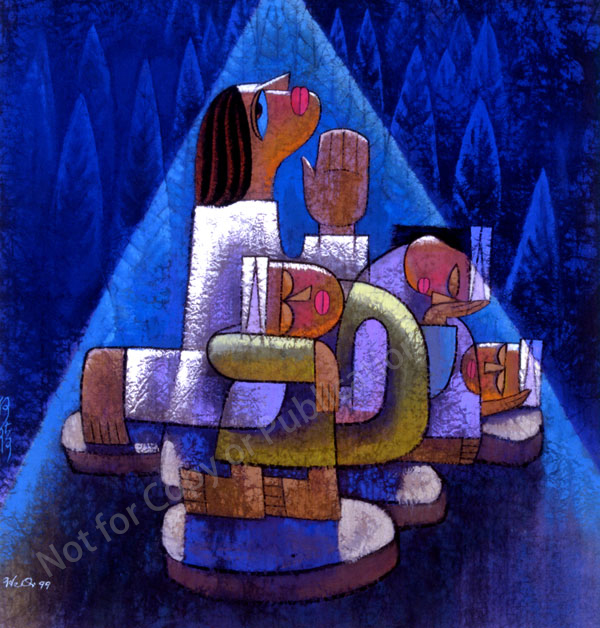
Hand colored stencil print on washi by Sadao Watanabe (1982).
Image taken with permission from the SadaoHanga Catalogue where you can find many more images and information about Sadao Watanabe. For other images of Sadao Watanabe art works in TIPs, see here.
Image taken from He Qi Art . For purchasing prints of this and other artworks by He Qi go to heqiart.com . For other images of He Qi art works in TIPs, see here.
The following is an artwork by Vinayak Shivaram Masoji (1897–1977):
“V.S. Masoji is a Bengali Indian artist who studied at Shantiniketan, an artist’s institution founded by the national poet of Bengal, Rabindranath Tagore.” (Source for this and the image: The Bible Through Asian Eyes by Masao Takenaka and Ron O’Grady 1991)
Following is a 1973 painting of the JESUS MAFA project, a response to New Testament readings from the Lectionary by a Christian community in Cameroon, Africa. Each of the readings was selected and adapted to dramatic interpretation by the community members. Photographs of their interpretations were made, and these were then transcribed to paintings:
Jesus sits in front of some religious leaders listening and asking questions as they listen to him, their astonishment evident in their facial expressions. In the background we see Mary and Joseph approaching, undoubtedly relieved to find their child safe and sound. We are reminded of Jesus’ humanity in this story. He was a child who did not fully consider the feelings of his parents and the consequences of his actions. He grew not only physically, but intellectually and emotionally as well. Through Jesus’ increase in wisdom, we are reminded that we too are called to grow into deeper understanding. And that requires that we ask questions whose answers may challenge our long-held beliefs and theologies.
From Art in the Christian Tradition, a project of the Vanderbilt Divinity Library, Nashville, TN. Image retrieved March 23, 2026. Original source: librairie-emmanuel.fr.
The following is a stained glass window from Mary Lowndes after William Holman Hunt, made by Lowndes and Drury, 1910. From St Martin & All Saints Church, Oxford:
Photo by the wub, hosted by Wikimedia Commons under a Creative Commons CC0 1.0 Universal Public Domain Dedication license
Stained glass is not just highly decorative, it’s a medium which has been used to express important religious messages for centuries. Literacy was not widespread in the medieval and Renaissance periods and the Church used stained glass and other artworks to teach the central beliefs of Christianity. In Gothic churches, the windows were filled with extensive narrative scenes in stained glass — like huge and colorful picture storybooks — in which worshipers could ‘read’ the stories of Christ and the saints and learn what was required for their religious salvation. (Source: Victoria and Albert Museum )
Following is a hand colored stencil print on washi of Daniel by Sadao Watanabe (1965):
Image taken with permission from the SadaoHanga Catalogue where you can find many more images and information about Sadao Watanabe. For other images of Sadao Watanabe art works in TIPs, see here.
The following artwork is part of a series of 56 paintings on biblical themes by Kazakh artist Nelly Bube (born 1949):
Hand colored stencil print on momigami by Sadao Watanabe (1962). Image taken with permission from the SadaoHanga Catalogue where you can find many more images and information about Sadao Watanabe. For other images of Sadao Watanabe art works in TIPs, see here.
Following is a painting (“Jesus’ agony in the garden of Gethsemane”) by Kim Ki-chang (1913-2001):
Kim Ki-chang (pen name: Unbo) had been deaf and partially mute since the age of 7. He painted a series of 30 paintings for the “Life of Christ” cycle in 1952 during the Korean War. Kim portrayed Jesus as a seonbi / 선비, or a Joseon Period (1392-1910) gentleman scholar, wearing a gat / 갓 (hat) and dopo / 도포 (robe). For other images of Kim Ki-chang art works in TIPs, see here.
Following is a painting (“Prayer at Gethsemane”) by He Qi:
Image taken from He Qi Art . For purchasing prints of this and other artworks by He Qi go to heqiart.com . For other images of He Qi art works in TIPs, see here
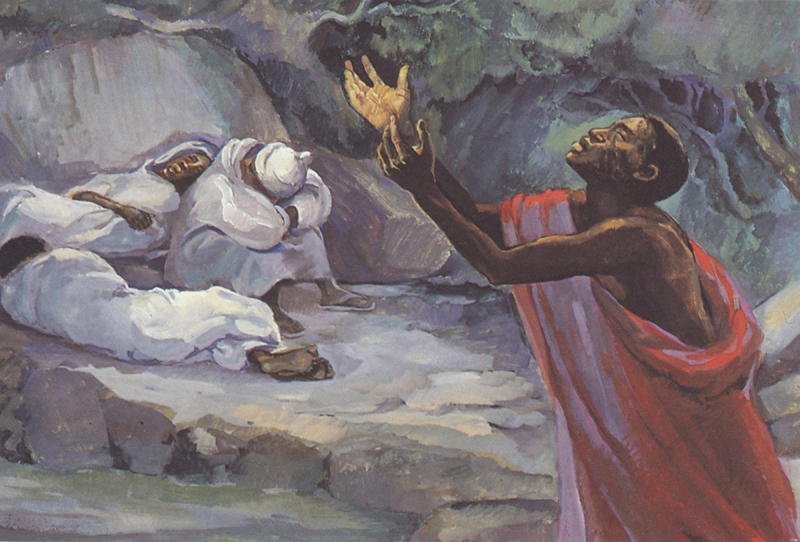
Following is a 1973 painting of the JESUS MAFA project, a response to New Testament readings from the Lectionary by a Christian community in Cameroon, Africa. Each of the readings was selected and adapted to dramatic interpretation by the community members. Photographs of their interpretations were made, and these were then transcribed to paintings:
From Art in the Christian Tradition, a project of the Vanderbilt Divinity Library, Nashville, TN. Image retrieved March 23, 2026. Original source: librairie-emmanuel.fr.
Photo by NateBergin, hosted by Wikimedia Commons under a Creative Commons Attribution 4.0 International license
Stained glass is not just highly decorative, it’s a medium which has been used to express important religious messages for centuries. Literacy was not widespread in the medieval and Renaissance periods and the Church used stained glass and other artworks to teach the central beliefs of Christianity. In Gothic churches, the windows were filled with extensive narrative scenes in stained glass — like huge and colorful picture storybooks — in which worshipers could ‘read’ the stories of Christ and the saints and learn what was required for their religious salvation. (Source: Victoria and Albert Museum )
Orthodox Icons are not drawings or creations of imagination. They are in fact writings of things not of this world. Icons can represent our Lord Jesus Christ, the Virgin Mary, and the Saints. They can also represent the Holy Trinity, Angels, the Heavenly hosts, and even events. Orthodox icons, unlike Western pictures, change the perspective and form of the image so that it is not naturalistic. This is done so that we can look beyond appearances of the world, and instead look to the spiritual truth of the holy person or event. (Source )
Following is a hand colored stencil print on momigami of Peter by Sadao Watanabe (1970):
Image taken with permission from the SadaoHanga Catalogue where you can find many more images and information about Sadao Watanabe. For other images of Sadao Watanabe art works in TIPs, see here.