Hand colored stencil print on washi by Sadao Watanabe (1979)
Image taken with permission from the SadaoHanga Catalogue where you can find many more images and information about Sadao Watanabe. For other images of Sadao Watanabe artworks in TIPs, see here.
Following is a painting by Chen Yuandu 陳緣督 (1902-1967):
Housed in the Société des Auxiliaires des Missions Collection – Whitworth University.
Image taken from Chinese Christian Posters . For more information on the “Ars Sacra Pekinensis” school of art, see this article , for other artworks of that school in TIPs, see here.
Batik dye artwork by Hanna-Cheriyan Varghese, used with permission by the Overseas Ministries Study Center (OMSC) at Princeton Theological Seminary. You can purchase this and many other artworks by artists in residence at the OSMC in high resolution and without a watermark via the OSMC website .
“Hanna-Cheriyan Varghese (1938 – 2009) of Selangor, Malaysia, was the artist in residence at OMSC for the 2006–2007 academic year. She was born to Christian parents, and she remembered her mother taking her to a different worship service every week: ‘My parents encouraged me to attend different churches so that my siblings and I would appreciate the liturgy and traditions of the Christian believers of different denominations. Christians are a minority in Malaysia so we continue to struggle for our identity in a Muslim society. There is no open conflict as such.’
“She always had a passion for painting and drawing. She worked in the mediums of acrylic paint and Batik dye, the latter medium being an ancient decorative craft that has come into use as a high art medium in the last 50 or 60 years. A Batik image is created as a pattern or picture dyed in fabric. Certain parts of the fabric are covered with a wax, which acts as a “resist” to the colorful dyes. Hanna Varghese mastered the medium, and the sacred art images she created with it are original, bold and graphic.
“‘All creative work, be it the spoken word, the written word or the sung word, are essentials in praise and worship, meditation, education, inculturation and evangelism. This also includes art and pictures, which is universal seeing.’ Hanna Varghese.” (Source )
Hand colored stencil print on momigami by Sadao Watanabe (1965).
Image taken with permission from the SadaoHanga Catalogue where you can find many more images and information about Sadao Watanabe. For other images of Sadao Watanabe art works in TIPs, see here.
Following is a painting by Xu Jihua 徐濟華 (1912-1937) (housed in the Société des Auxiliaires des Missions Collection – Whitworth University):
Image taken from Chinese Christian Posters . For more information on the “Ars Sacra Pekinensis” school of art, see this article , for other artworks of that school in TIPs, see here.
Hand colored stencil print on washi by Sadao Watanabe (1969).
Image taken with permission from the SadaoHanga Catalogue where you can find many more images and information about Sadao Watanabe. For other images of Sadao Watanabe art works in TIPs, see here.
The following is the image “Pentecost” by Sister Marie Claire , SMMI (1937–2018) from Bengaluru, India:
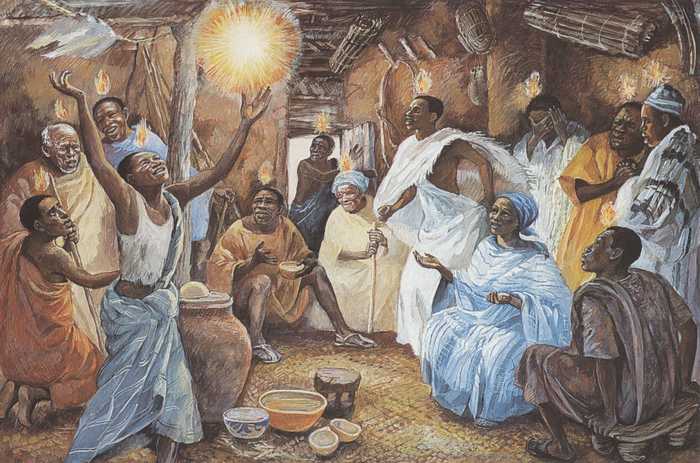
Following is a 1973 painting of the JESUS MAFA project, a response to New Testament readings from the Lectionary by a Christian community in Cameroon, Africa. Each of the readings was selected and adapted to dramatic interpretation by the community members. Photographs of their interpretations were made, and these were then transcribed to paintings:
The exuberant expression of joy in this depiction represents the Acts story, including Mary and the women mentioned in Acts, Chapter 1. Pentecost was originally an ancient Hebrew time of thanksgiving celebration for the first grain harvest, as recorded in Leviticus. The new significance given to this day by the gospel writers and early Christians extends that joyful expression to the new “filling up” by the Holy Spirit.
Source: Art in the Christian Tradition, a project of the Vanderbilt Divinity Library, Nashville, TN. Image retrieved March 23, 2026. Original source: librairie-emmanuel.fr.
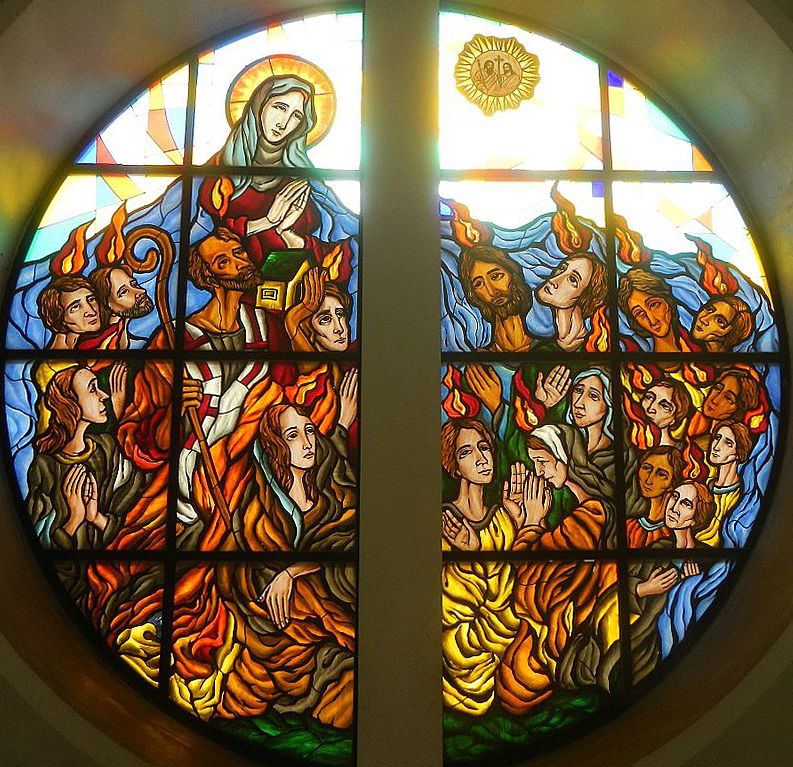
The following is a 2003 stained glass window by Ronald Kraut from the Our Lady Of Pentecost Church, Quezon City, Philippines:
Stained glass is not just highly decorative, it’s a medium which has been used to express important religious messages for centuries. Literacy was not widespread in the medieval and Renaissance periods and the Church used stained glass and other artworks to teach the central beliefs of Christianity. In Gothic churches, the windows were filled with extensive narrative scenes in stained glass — like huge and colorful picture storybooks — in which worshipers could ‘read’ the stories of Christ and the saints and learn what was required for their religious salvation. (Source: Victoria and Albert Museum )
Hand colored stencil print on washi by Sadao Watanabe (1979).
Image taken with permission from the SadaoHanga Catalogue where you can find many more images and information about Sadao Watanabe. For other images of Sadao Watanabe art works in TIPs, see here.
The following artwork is part of a series of 56 paintings on biblical themes by Kazakh artist Nelly Bube (born 1949):
The following is a stained glass window from the Three choir windows in the Marienkirche, Frankfurt (Oder), Germany, of the 14th century:
Source: Der gläserne Schatz: Die Bilderbibel der St. Marienkirche in Frankfurt (Oder), Neuer Berlin Verlag, 2005, copyright for this image: Brandenburgisches Landesamt für Denkmalpflege und Archäologisches Landesmuseum
Stained glass is not just highly decorative, it’s a medium which has been used to express important religious messages for centuries. Literacy was not widespread in the medieval and Renaissance periods and the Church used stained glass and other artworks to teach the central beliefs of Christianity. In Gothic churches, the windows were filled with extensive narrative scenes in stained glass — like huge and colorful picture storybooks — in which worshipers could ‘read’ the stories of Christ and the saints and learn what was required for their religious salvation. (Source: Victoria and Albert Museum )