Even the least significant members of society he embraced (image)

“Adult activities are only for adults and the activities of child are only for children. Usually only very elderly Thai adults will spend time with children, but here we see Jesus doing it. The shaved hairstyles are different for the different boys and girls. Those with two pony tails are actually boys with two crowns of hair indicative of either great intelligence or belligerence.”

Drawing by Sawai Chinnawong who employs northern and central Thailand’s popular distinctive artistic style originally used to depict Buddhist moral principles and other religious themes; explanation by Paul DeNeui. From That Man Who Came to Save Us by Sawai Chinnawong and Paul H. DeNeui, William Carey Library, 2010.

For more images by Sawai Chinnawong in TIPs see here.

He allowed people of bad reputation to touch him (image)

“Usually, Thai men spend their free time with other men. Women only enter to serve them food, but here a woman has entered into the male social space in a counter-cultural way Not only is she female, she is a lowly prostitute. Although a Thai woman may sometimes wash her husband’s feet, she will never use her hair to dry them The men observing her are shocked at it all.”

Drawing by Sawai Chinnawong who employs northern and central Thailand’s popular distinctive artistic style originally used to depict Buddhist moral principles and other religious themes; explanation by Paul DeNeui. From That Man Who Came to Save Us by Sawai Chinnawong and Paul H. DeNeui, William Carey Library, 2010.

For more images by Sawai Chinnawong in TIPs see here.

He deliberately took time to draw near to social outcasts (image)

“Jesus is dressed in a different style of clothing than the style of the woman who is shown as a Lanna Thai northerner. It is unusual for him to talk to a person from a different region, especially a woman. The clothes, the roof of the house in the background, and the dipper for water all indicate that this is in northern Thailand.”

Drawing by Sawai Chinnawong who employs northern and central Thailand’s popular distinctive artistic style originally used to depict Buddhist moral principles and other religious themes; explanation by Paul DeNeui. From That Man Who Came to Save Us by Sawai Chinnawong and Paul H. DeNeui, William Carey Library, 2010. . For more images by Sawai Chinnawong in TIPs see here.

See also The woman at the well (image).

Learn more on Bible Odyssey: Woman at the Well .

Religious leaders sought him out to find answers to life's deepest questions

“It is unusual for anyone to seek out another at night unless it is desired to be kept secret. Betel nut and condiments are laid out to welcome the guest even at the late hour. Nicodemus’s robe and bared shoulder show he is a religious devotee.”

Drawing by Sawai Chinnawong who employs northern and central Thailand’s popular distinctive artistic style originally used to depict Buddhist moral principles and other religious themes; explanation by Paul DeNeui. From That Man Who Came to Save Us by Sawai Chinnawong and Paul H. DeNeui, William Carey Library, 2010.

For more images by Sawai Chinnawong in TIPs see here.

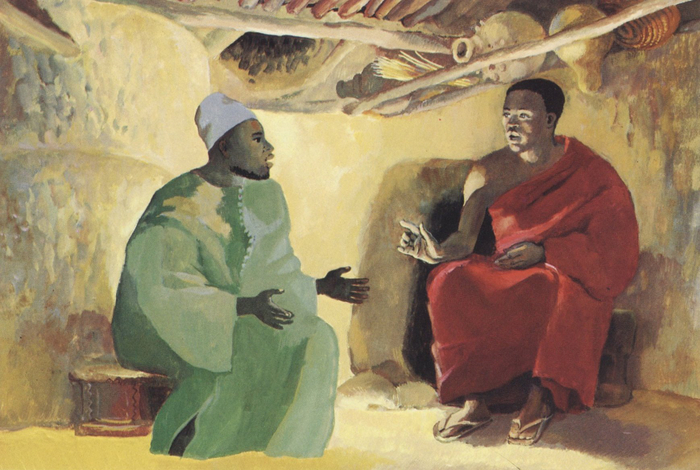
The following 1973 painting “Nicodemus” of the JESUS MAFA project is a response to New Testament readings from the Lectionary by a Christian community in Cameroon, Africa. Each of the readings was selected and adapted to dramatic interpretation by the community members. Photographs of their interpretations were made, and these were then transcribed to paintings:

Here we see Jesus patiently teaching about the kingdom of God to a perplexed Nicodemus, whose hands are in a gesture of questioning. Nicodemus has, like so many before and since, gotten caught up in the literal and limited understanding of the scriptures. Jesus attempted to explain the nature of reality in different terms that thereby he (and we) might be transformed. The boundaries we place on ourselves can be escaped if only we are brave enough to venture beyond them. Shall we remain in the cover of night with Nicodemus or step into the light that Jesus offers?

From Art in the Christian Tradition , a project of the Vanderbilt Divinity Library, Nashville, TN. Image retrieved March 23, 2026. Original source: librairie-emmanuel.fr.

Jesus Calls the Sons of Zebedee


“Fisherman spent their time finding fish to feed their family and sold what was left. It is not common for fishermen to be interested in or qualified for a study of the dharma but Jesus called them anyway.”

Drawing by Sawai Chinnawong who employs northern and central Thailand’s popular distinctive artistic style originally used to depict Buddhist moral principles and other religious themes; explanation by Paul DeNeui. From That Man Who Came to Save Us by Sawai Chinnawong and Paul H. DeNeui, William Carey Library, 2010.

For more images by Sawai Chinnawong in TIPs see here.

Following is a painting by Ketut Lasia (b. 1945):

Ketut Lasia is one of the last traditional Balinese painters in the Ubud style. As an adult, Lasia converted from Hinduism to Christianity, and he paints primarily biblical scenes. You can find artwork from Ketut Lasia in a variety of formats for sale at Fine Art America .

People from his home town rejected him because they could not accept who he claimed to be (image)

“Only qualified, trained leaders know the dharma (truth) yet Jesus made claims that threatened the establishment. He is being chased out of the temple because his people thought him merely a carpenter. They intended to throw him down the cliff but he just passed by.”

Drawing by Sawai Chinnawong who employs northern and central Thailand’s popular distinctive artistic style originally used to depict Buddhist moral principles and other religious themes; explanation by Paul DeNeui. From That Man Who Came to Save Us by Sawai Chinnawong and Paul H. DeNeui, William Carey Library, 2010.

For more images by Sawai Chinnawong in TIPs see here.

When he grew up he worked as a carpenter until the age of thirty (image)

“Carpenters are considered skilled craftsman who do detailed work. Here, Jesus is making a wooden spindle on which his mother will spin silk thread.”

Drawing by Sawai Chinnawong who employs northern and central Thailand’s popular distinctive artistic style originally used to depict Buddhist moral principles and other religious themes; explanation by Paul DeNeui. From That Man Who Came to Save Us by Sawai Chinnawong and Paul H. DeNeui, William Carey Library, 2010.

For more images by Sawai Chinnawong in TIPs see here.

Saved from first danger he developed in body and spirit - pleasing to God and people (image)

“The shaded area under the second floor of the house is where the activities of home take place. Here, the young child and his mother are modeling clay water buffalo.”

Drawing by Sawai Chinnawong who employs northern and central Thailand’s popular distinctive artistic style originally used to depict Buddhist moral principles and other religious themes; explanation by Paul DeNeui. From That Man Who Came to Save Us by Sawai Chinnawong and Paul H. DeNeui, William Carey Library, 2010.

For more images by Sawai Chinnawong in TIPs see here.