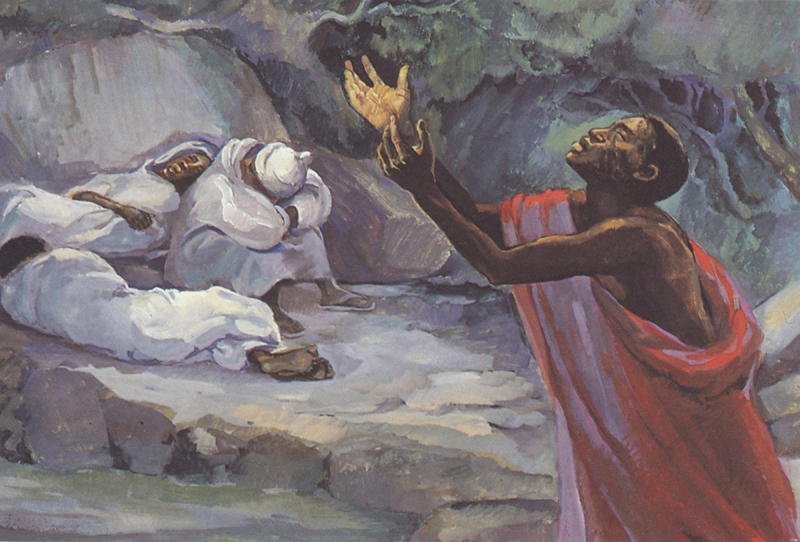
pray / prayer

The Hebrew, Aramaic, Latin, and Greek that is translated as “pray” (or “prayer”) in English is often translated as “talking with God” (Central Pame, Tzeltal, Chol, Chimborazo Highland Quichua, Shipibo-Conibo, Kaqchikel, Tepeuxila Cuicatec, Copainalá Zoque, Central Tarahumara).

Other solutions include:

  • “beg” or “ask,” (full expression: “ask with one’s heart coming out,” which leaves out selfish praying, for asking with the heart out leaves no place for self to hide) (Tzotzil)
  • “cause God to know” (Huichol)
  • “raise up one’s words to God” (implying an element of worship, as well as communication) (Miskito, Lacandon) (source of this and all above: Bratcher / Nida)
  • “speak to God” (Shilluk) (source: Nida 1964, p. 237)
  • “talk together with Great Above One (=God)” (Mairasi) (source: Enggavoter, 2004)
  • “call to one’s Father” (San Blas Kuna) (source: Claudio and Marvel Iglesias in The Bible Translator 1951, p. 85ff. )
  • “beg” (waan) (Ik). Terrill Schrock (in Wycliffe Bible Translators 2016, p. 93) explains (click or tap here to read more):

    What do begging and praying have to do with each other? Do you beg when you pray? Do I?

    “The Ik word for ‘visitor’ is waanam, which means ‘begging person.’ Do you beg when you go visiting? The Ik do. Maybe you don’t beg, but maybe when you visit someone, you are looking for something. Maybe it’s just a listening ear.

    When the Ik hear that [my wife] Amber and I are planning trip to this or that place for a certain amount of time, the letters and lists start coming. As the days dwindle before our departure, the little stack of guests grows. ‘Please, sir, remember me for the allowing: shoes, jacket (rainproof), watch, box, trousers, pens, and money for the children. Thank you, sir, for your assistance.’

    “A few people come by just to greet us or spend bit of time with us. Another precious few will occasionally confide in us about their problems without asking for anything more than a listening ear. I love that.

    “The other day I was in our spare bedroom praying my list of requests to God — a nice list covering most areas of my life, certainly all the points of anxiety. Then it hit me: Does God want my list, or does he want my relationship?

    “I decided to try something. Instead of reading off my list of requests to God, I just talk to him about my issues without any expectation of how he should respond. I make it more about our relationship than my list, because if our personhood is like God’s personhood, then maybe God prefers our confidence and time to our lists, letters, and enumerations.”

In Luang it is translated with different shades of meaning (click or tap here to read more):

  • For Acts 1:14, 20:36, 21:5: kola ttieru-yawur nehla — “hold the waist and hug the neck.” (“This is the more general term for prayer and often refers to worship in prayer as opposed to petition. The Luang people spend the majority of their prayers worshiping rather than petitioning, which explains why this term often is used generically for prayer.”)
  • For Acts 28:9: sumbiani — “pray.” (“This term is also used generically for ‘prayer’. When praying is referred to several times in close proximity, it serves as a variation for kola ttieru-yawur nehla, in keeping with Luang discourse style. It is also used when a prayer is made up of many requests.”)
  • For Acts 8:15, 12:5: polu-waka — “call-ask.” (“This is a term for petition that is used especially when the need is very intense.”)

Source: Kathy Taber in Notes on Translation 1/1999, p. 9-16.

See also Nehemiah’s prayer (image).

Translation commentary on Mark 14:38

Exegesis:

grēgoreite kai proseuchesthe hina ‘you (plural) must watch and pray that’: Revised Standard Version takes ‘that’ to refer to the content of the prayer (as in v. 35 and 13.38); if, however, both verbs be taken with hina, it could indicate purpose – ‘watch and pray, in order that…’ (so Translator’s New Testament; cf. Moffatt “so that”).

peirasmon (only here in Mark; cf. peirazō 1.13) ‘temptation’: the context seems to demand the meaning of ‘temptation’ leading to sin, and not merely the idea of ‘trial’ or ‘testing.’

pneuma (cf. 2.8) … sarx (cf. 10.8) ‘spirit … flesh’: here presented as distinct and antithetical elements of man’s nature. The contrast between the two, say Arndt & Gingrich, is between the will as opposed to inferior feelings such as fear, anxiety, etc. which are attributed to the ‘flesh.’

prothumon (only here in Mark) ‘ready,’ ‘willing,’ ‘eager.’

asthenēs (only here in Mark); cf. astheneō (6.56) ‘weak,’ ‘powerless.’

Translation:

Watch would seem to be best translated as ‘stay awake’ or ‘stay alert.’

Enter into temptation is an awkward idiom in most languages, for one does not literally ‘enter into’ such an experience. In Tzeltal this concept is expressed as ‘end by being tempted,’ and in Copainalá Zoque one must say ‘fall when Satan tries you.’ In Highland Puebla Nahuatl one may ‘enter into sin,’ but not ‘enter into temptation.’

The spirit … the flesh is a fundamental contrast, but one which is variously expressed in different languages. Often, however, spirit is equivalent to ‘heart’ (Eastern Highland Otomi, Loma (Liberia), Guerrero Amuzgo, Highland Puebla Nahuatl ), and flesh may be rendered as ‘body’ (Guerrero Amuzgo, Highland Puebla Nahuatl , Tzeltal), ‘you yourself’ (Central Tarahumara). The following translations are illustrative of the contrastive expressions: ‘your hearts are ready but your bodies are weak’ (Highland Puebla Nahuatl ), ‘your heart is strong but you yourselves are not strong’ (Central Tarahumara), ‘your heart has strength, but your body does not have strength’ (Tzeltal), ‘your heart desires to do good, but your heart is weak,’ in which ‘heart’ must be used in both clauses since it not only stands for the center of the personality, but is also the symbol of typical human nature (Loma (Liberia)).

Quoted with permission from Bratcher, Robert G. and Nida, Eugene A. A Handbook on the Gospel of Mark. (UBS Handbook Series). New York: UBS, 1961. For this and other handbooks for translators see here .

SIL Translator's Notes on Mark 14:38

14:38a

Watch and pray so that you will not enter into temptation: The clause so that you will not enter into temptation is closely related to the words Watch and pray. Scholars interpret this relationship in two different ways:

(1) The clause tells the purpose for which the disciples should watch and pray. For example:

Watch and pray so that you will not enter into temptation. (Berean Standard Bible)
-or-
Keep alert and pray. Otherwise temptation will overpower you. (New Living Translation, 1996 edition)

(Berean Standard Bible, New International Version, King James Version, New Living Translation, 1996 edition)

(2) The clause tells what the disciples should pray. For example, the Good News Bible says:

pray that you will not fall into temptation

(Good News Bible, New Jerusalem Bible, New Century Version)

The word “that” with certain speech verbs can introduce either the purpose or content of the speech, so some English versions are ambiguous. It is recommended that you follow interpretation (1). This seems to fit both the Greek grammar and the context better. However, both interpretations are valid.

Watch and pray: The verbs Watch and pray are plural forms in Greek. This indicates that Jesus was speaking here to all three disciples. They were to continue to stay awake and continue to pray. See the comments on these verbs in 14:34b.

pray: The Greek word that the Berean Standard Bible translates as pray means “speak to God.” Some languages use different words to refer to specific kinds of prayer, such as requests, thanks, or praise. Here you should use a general term that means “speak” or “talk.”

Avoid a term that may imply magical or meaningless words.

enter into temptation: The Greek phrase that the Berean Standard Bible translates as enter into temptation is literally “come into temptation.” The phrase is a figure of speech. It means “yield to temptation.” It implies that when a person is tempted to do something sinful, he agrees to do it.

Here are some other ways to translate this:

so that you will be able to resist temptation
-or-
so that you do not agree to sin when you are tempted

Notice that the second example uses a passive verb. In some languages it may be necessary to use an active verb and make the subject explicit. If that is true in your language, you may supply “Satan” or use an indefinite subject. For example:

so that if Satan tempts you,(plur) you(plur) will not yield

It may also be necessary to indicate what Satan was tempting the disciples to do. For example:

so that you(plur) will not sin when Satan tempts you(plur) to stop trusting me

temptation: The Greek word that the Berean Standard Bible translates as temptation here refers to an enticement to sin. A temptation is anything that makes a person consider sinning in order to avoid difficulty or receive some benefit.

See how you translated “tempted” at 1:13a. In some languages there may be an idiom to express the idea.

14:38b

For the spirit is willing, but the body is weak: This statement expresses a contrast: a person wants to do what is right but he is not able to do it without God’s help.

Here are some other ways to translate this contrast:

I know that you(plur) want to do what is right, but you(plur) are unable to do it in/by your(plur) own strength.
-or-
Your(plur) heart/mind wants to do something good, but your(plur) body lacks strength.

the spirit…the body: Jesus was referring mainly to the disciples when he talked about the spirit and the body. However, Jesus expressed his statement in a general way that could also apply to other people who try to resist temptation. You may translate either way. Here is one way to refer to people in general:

A person’s spirit is willing, but his body is weak.

the spirit is willing: Jesus did not say what the disciples were willing to do. There are three possibilities:

(1) They were willing to do the right thing.

(2) They were willing to resist sin / temptation.

(3) They were willing to watch.

The Greek text and English versions are ambiguous about this issue. If you are able to translate ambiguously in your language, it is recommended that you do so. If you need to specify what they were willing to do, it is recommended that you follow interpretation (1).

the spirit: In this context the phrase the spirit refers to the part of a person that thinks and feels and determines his character. It represents the person himself and his own will. In some languages, this may be expressed as:

You(plur)
-or-
People

In some languages speakers use a certain part of a person, such as “heart,” “liver,” or “thoughts,” to express this. If that is true in your language, consider whether you could use that expression here.

but: The connector that the Berean Standard Bible translates as but indicates a contrast. It shows that a person wants to do right, but is not able to resist temptation without God’s help. Express the contrast in a natural way in your language.

the body is weak: The Greek word that the Berean Standard Bible translates as the body is literally “the flesh” (Revised Standard Version). In this context it represents human ability or human strength in general. It includes the physical body and also human self-control. Here it does not represent sinful human nature that is opposed to God.

In some languages a word like body may not be used in such a general way. If that is true in your language, here are some other ways to express the meaning of the phrase the body is weak:

your/their strength is lacking
-or-
they/you are weak
-or-
they/you are unable to do so

Paragraph 14:39–40

© 2008 by SIL International®

Made available under the terms of a Creative Commons Attribution-ShareAlike 4.0 License (CC BY-SA) creativecommons.org/licenses/by-sa/4.0

All Scripture quotations in this publication, unless otherwise indicated, are from The Holy Bible, Berean Standard Bible.
BSB is produced in cooperation with Bible Hub, Discovery Bible, OpenBible.com, and the Berean Bible Translation Committee.