
The Hebrew in Isaiah 32:18 that is translated in English as “my people” or similar is translated in Klao as “you” since they are directly addressed. (Source: Don Slager)
The Glory of the LORD in the Wilderness
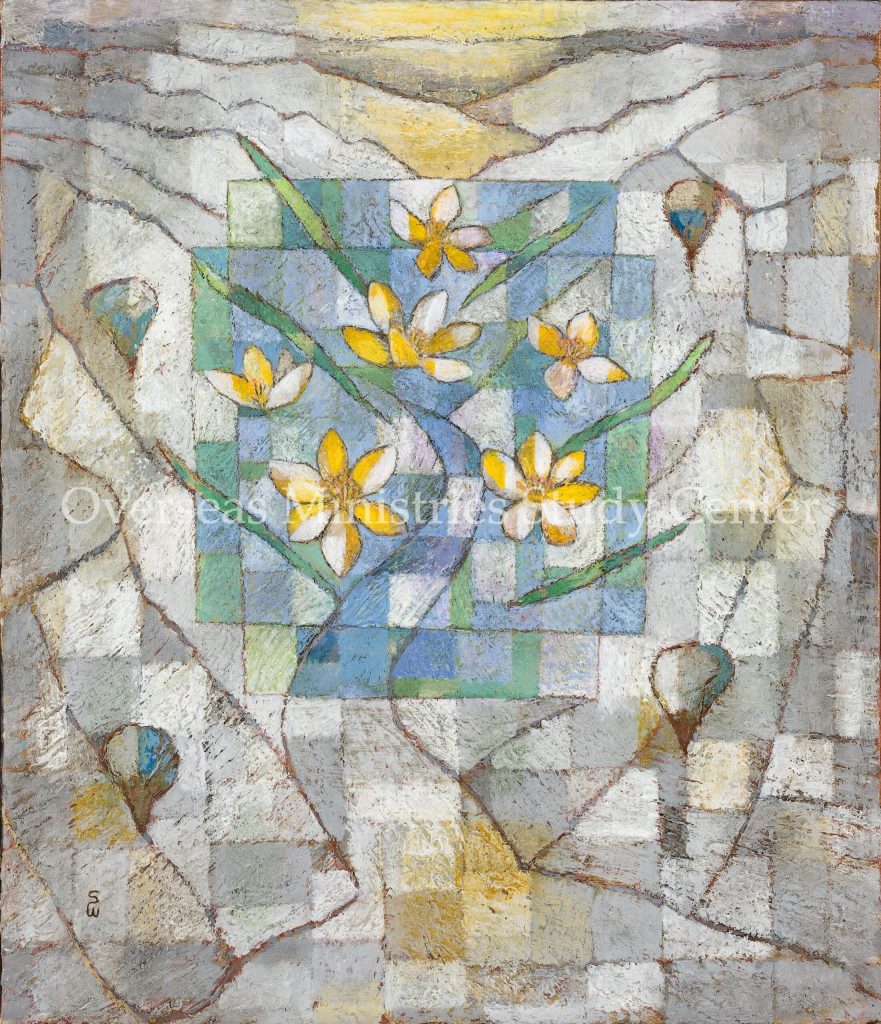
Painting by Soichi Watanabe, used with permission by the Overseas Ministries Study Center (OMSC) at Princeton Theological Seminary. You can purchase this and many other artworks by artists in residence at the OSMC in high resolution and without a watermark via the OSMC website .
“A resident of Koshigaya City, Saitama, Japan, Soichi Watanabe was the 2008-09 OMSC artist in residence. Watanabe graduated in 1982 from the Ochanomizu Art School in Tokyo after having earned, a decade earlier, an economics degree from Tohoku Gakuin University in Sendai. He teaches at a private art school that he started in 1982. Following his 1982 graduation, Soichi founded a private art school where he and his wife work together to help others experience the joy of art.
“Soichi was drawn to God as an undergraduate student during a home Bible study when he encountered Mark 8:35: ‘Whoever wants to save his life will lose it, but whoever loses his life for me and for the gospel will save it.’ Further study of the New Testament led him to realize that he was both ‘stubborn and self-centered.’ He recalls that ‘the richness of the biblical world overwhelmed me and at the same time tortured me.’
“Shortly thereafter he chose to submit his life to God at an evening worship service. ‘I really heard a voice telling me to accept the salvation of Jesus on the cross and to follow him,’ remembers Soichi. From that point on he has been determined to serve God through his abilities. As a follower of Jesus, Soichi points to his faith as the foundation from which he works as an artist. In his art book Jesus Walking With Us (2004), he writes, ‘I realize that [my works] are my own humble responses to God’s calling in my life… . The images are often given to me through the words of God at worship services on Sundays and during my daily devotion. I have the earnest hope that I will go on painting to praise the Lord.'” (Source )
About this image, Watanabe says: “The books of Dr. Kosuke Koyama inspired me to make this painting. Through his books and lectures, he taught us to pray and to act for the realization of peace and righteousness in this world. He also prayed for me and prompted me to make Christian art, emphasizing that I should bear witness to the Gospel through artwork, since the language of the Bible is so visually evocative.” (Source: OMSC 2010, p. 40)
complete verse (Isaiah 32:18)
Following are a number of back-translations as well as a sample translation for translators of Isaiah 32:18:
- Kupsabiny: “The people of God shall live in
a peaceful country.
They shall live in prosperous homes
and be with peace.” (Source: Kupsabiny Back Translation) - Newari: “As for my people, [they] will be in a peaceful place,
[in] secure houses,
and in a quiet [lit.: not having shouting] place to take rest” (Source: Newari Back Translation) - Hiligaynon: “You (plur.) people-groups of God will-live/dwell in peaceful dwelling-places, with no disaster. And no one will-trouble/disturb you (plur.).” (Source: Hiligaynon Back Translation)
Translation commentary on Isaiah 32:18
My people will abide …: As in verse 13, the prophet refers to the people of Judah as My people since they are his fellow citizens. He continues to build the picture of peace and harmony for his people by using three parallel phrases: in a peaceful habitation, in secure dwellings, and in quiet resting places. It is typical of his style to use three or four synonymous phrases to emphasize a point.
In a peaceful habitation: The word peaceful renders the Hebrew term for “peace” (shalom), so it provides a link to the previous verse. The Hebrew noun for habitation generally refers to a pastoral place rather than a building. For this reason Revised English Bible renders a peaceful habitation as “tranquil country,” while New American Bible suggests “peaceful country.” Translators may also use a more generic expression, such as “a peaceful place.” Good News Translation omits habitation, which is acceptable in this context.
In secure dwellings: The Hebrew term for secure comes from the same root as the word for trust in the previous verse (see the comments there) and the adjective for “complacent” in verses 9-10. The Hebrew word rendered dwellings often refers to the Tabernacle, but here it has the sense of “homes.” It comes from the same root as the verb for “dwell” in verse 16.
In quiet resting places: The Hebrew word for quiet comes from the same root as the adjective rendered who are at ease in verses 9 and 11 (see the comments there).
Translation examples for this verse are:
• My people will live in a peaceful place,
in homes that are secure,
in restful and comfortable places….
• My people will live in a land of harmony,
in homes that offer security,
in places of rest and comfort….
Quoted with permission from Ogden, Graham S. and Sterk, Jan. A Handbook on Isaiah. (UBS Helps for Translators). New York: UBS, 2011. For this and other handbooks for translators see here .
Leave a Reply
You must be logged in to post a comment.