(Pioneer Bible Translators and The Word for the World use the following introduction in many of their translation projects around the world.)
The book of Hebrews is an encouraging letter which shows how Jesus fulfilled several Old Testament prophecies. It was written like a sermon. There are over 60 references to the Old Testament in Hebrews which clearly show how Jesus fulfilled prophecy and the duties of the Jewish High Priest. For this reason the book was meant to be encouraging to Jewish Christians. Hebrews shows how Jesus completed the Law so that priests won’t have to offer sacrifices ever again. Jesus was the sacrifice for all sins, once and for all time. Christians in our time can also find encouragement in the letter to the Hebrews to keep following Jesus Christ as the one who makes it possible for us to trust in God, and also to keep on trusting in him (12:2).
No one knows who wrote Hebrews, but scholars have made suggestions such as the Apostle Paul, Luke, or Barnabas. The date of writing is also not known but most believe it was written before 70 years after the birth of Christ. Jerusalem was destroyed in 70, but the writer of this letter talks about Jerusalem like it was not yet destroyed. Hebrews was written in the city of Rome (13:24) and was probably circulated among several churches.
Outline:
1. The writer shows that Jesus is superior to God’s prophets and angels (1:1-4:13).
2. Then he goes on to show that Jesus is superior to the priests who minister in the temple of God in Jerusalem (4:14-7:28).
3. Also Jesus’ ministry is superior to the old agreement which God made with his people through the law that he gave to Moses (8:1-10:31).
4. After explaining that Jesus is superior in every way, the author gives several practical instructions (10:32-13:17).
5. Lastly the writer finishes the letter with some encouragements and greetings (13:18-25).
Le livre aux Hébreux est une lettre encourageante qui montre comment Jésus a accompli plusieurs prophéties de l’Ancien Testament. Elle a été écrite comme un sermon. Il y a dans Hébreux plus de 60 références à l’Ancien Testament ce qui montre clairement comment Jésus a accompli la prophétie et les devoirs du souverain grand-prêtre juif. Pour cette raison le livre est destiné à encourager les chrétiens juifs. Hébreux montre comment Jésus a accompli la loi afin que les prêtres ne doivent jamais plus offrir des sacrifices. Jésus a été le sacrifice pour tous les péchés, une fois pour toutes. Les chrétiens de notre époque peuvent aussi trouver des encouragements dans la lettre aux Hébreux pour continuer à suivre Jésus-Christ comme celui qui a rendu possible que nous ayons confiance en Dieu et aussi de continuer à nous confier en lui (12 :2).
Personne ne sait qui a écrit les Hébreux, mais des experts ont fait des suggestions comme l’apôtre Paul, Luc ou Barnabas. La date de rédaction n’est pas connue non plus mais plusieurs pensent que la lettre a été écrite avant 70 ans après la naissance de Christ. Jérusalem a été détruite en l’an 70, mais l’auteur de cette lettre parle de Jérusalem comme si elle n’a pas encore été détruite. La lettre aux Hébreux a été écrite dans la ville de Rome (13 :24) et elle a probablement été circulée parmi plusieurs églises.
Résumé
1. L’auteur montre que Jésus est supérieur aux prophètes de Dieu et aux anges (1 :1-4 :13).
2. Il continue à montrer que Jésus est supérieur aux grands-prêtres qui officient dans le temple de Dieu à Jérusalem (4 :14-7 :28).
3. Le ministère de Jésus est aussi supérieur à l’ancienne alliance que Dieu avait conclue avec son peuple au travers de la loi qu’il avait donnée à Moïse (8 :1-10 :31).
4. Après avoir expliqué que Jésus est supérieur de toute manière, l’auteur donne plusieurs instructions pratiques (10 :32-13 :17).
5. Finalement l’auteur termine la lettre avec quelques encouragements et des salutations (13 :18-25).
Translation: Swahili
Utangulizi wa kitabu cha Waebrania
Kitabu cha Waebrania ni barua inayotia moyo ambayo inaonyesha jinsi Yesu alivyotimiza Maandiko kadhaa ya unabii wa Agano la Kale. Barua ya Waebrania imeandikwa kama hotuba ya mahubiri. Ndani ya barua ya Waebrania kuna nukuu zaidi ya 60 kutoka katika Agano la Kale zinazoonyesha wazi jinsi Yesu alivyotimiza unabii wote na majukumu ya Kuhani Mkuu. Kwa sababu hii, kitabu hiki kilikusudiwa kiwe chenye kutia moyo kwa Wakristo waliokuwa na asili ya Kiyahudi. Barua ya Waebrania inaonyesha jinsi Yesu alivyoikamilisha Torati ili sasa makuhani wasiwe tena na sababu ya kutoa sadaka zenye maana ya tambiko. Yesu alikuwa tambiko lililoondoa dhambi zote, tangu wakati huo alipokufa kifo cha msalaba na hata milele. Wakristo wanaoishi katika siku zetu hizi za leo wanaweza pia kutiwa moyo na barua ya Waebrania ili waendelee kumfuata Yesu Kristo kwa kuwa ndiye pekee anayetuwezesha sisi tumtumainie Mungu, na pia kuendelea kumtumainia (12:2).
Hakuna ajuaye ni nani hasa kwa hakika aliyeiandika barua kwa Waebrania, lakini wasomi wa mambo ya kibiblia wamewahi kupendekeza kwamba ni mmoja kati ya watatu hawa: yaani Mtume Paulo, Luka au Barnaba. Tarehe ya kuandikwa barua hii pia haijulikani, lakini wengi wanaamini iliandikwa kabla ya mwaka 70 baada ya kuzaliwa Yesu Kristo. Mji wa Yerusalemu uliharibiwa katika mwaka wa 70 baada ya kuzaliwa Yesu Kristo, lakini mwandishi wa barua hii anauzungumzia mji wa Yerusalemu kama kwamba ulikuwa bado haujaharibiwa. Barua kwa Waebrania iliandikwa katika mji wa Roma (13:24) na yawezekana kwamba ilizungushwa ili isomwe katika makanisa kadhaa.
Muhtasari:
1. Mwandishi anamwonyesha Yesu Kristo kuwa bora na mkuu zaidi ya manabii na malaika wa Mungu (1:1-4:13).
2. Kisha anaendelea kuonyesha kwamba Yesu ni bora na mkuu kuliko makuhani wanaohudumu ndani ya hekalu la Yerusalemu (4:14-7:28).
3. Pia anaonyesha kwamba huduma ya Yesu ni bora na yenye ukuu kuliko ile Torati ambayo Mungu alimpa Musa (8:1-10:31).
4. Baada ya kufafanua kwamba Yesu ni bora na mkuu katika namna zote, sasa mwandishi anaendelea kutoa maagizo yanayohitaji kutendewa kazi kwa vitendo (10:32-13:17).
5. Mwisho mwandishi anamaliza uandishi wa barua yake kwa kutoa hamasa na salamu (13:18-25).
(The Catholic Christian Community Bible [first English edition 1997, other translations into Indonesian, Chinese, Cebuano, Chavacano, French, Ilonggo, Korean, Quechuan, Spanish, and Tagalog] “for the Christian Communities of the Third World” uses the following introduction.)
“Hebrews” was the name given to the Jews who lived in Palestine, unlike the majority who had emigrated to other countries. This letter is addressed to the first Christian communities of Palestine, formed by Jews — by race –- who had been persecuted and punished and whose possessions had even been confiscated, all because they had become followers of Christ. They no longer had anything in this world and they had to encourage one another with the assurance that, at the conclusion of their exile, they would find the true Home where Jesus went after his suffering. In this way they were like their Hebrew ancestors who had lived in the desert, hoping and searching for the Promised Land.
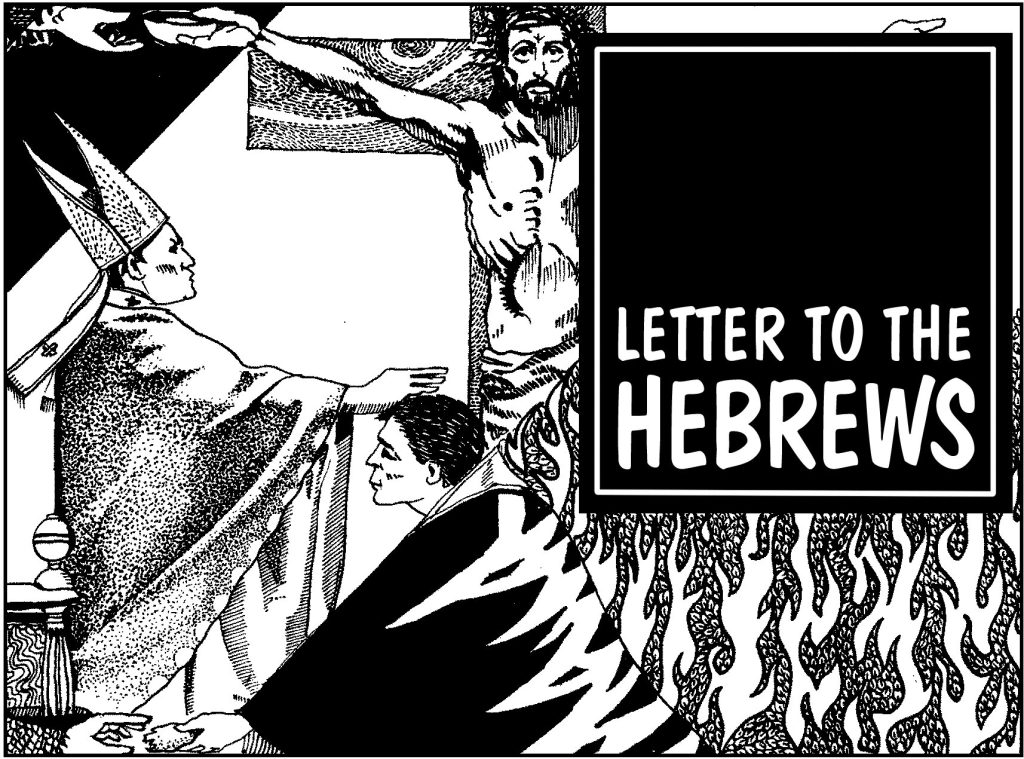
It is helpful to know that this letter is addressed to people familiar with the Old Testament: they may well have been Jewish priests who had believed in Jesus and now were going through a serious crisis. Indeed, up until then the Temple had been their whole lives, since they were priests: they would offer sacrifices and would receive part of the sacrificed animals in payment. Now, not only had they been excluded and removed from the temple by the Jews, but Christ had replaced them. For he had come as the New Temple and the perfect victim pleasing to God, as the only Priest capable of putting people in touch with God.
He had relegated the Temple of Jerusalem and its cult to the rank of the out-moded. He, a layman had organized his Church, disregarding the priesthood of the “sons of Aaron,” the Jewish priests. The priest, he who is the link between humans and the all-holy God, was he and he alone.
So Christ had taken their work away from them, as well as their reason for being. At times, these men who had known Jesus, the man, had their doubts: was it certain that everything had changed because of him?
To confirm their faith, this letter shows them that the Jewish religion with its imposing ceremonies in the Temple of Jerusalem, was but the image of something greater. The pardon of sin and the spirit of religion – the aspiration of the entire Old Testament – was to be the work of the authentic priest of all humanity, Jesus, the Son of God. There is now no other sacrifice but his, which begins on the cross and ends in glory.
Are there not many “Hebrews” in today’s world? The sick who no longer have hope, the persecuted Christians, the people who do not accept the injustice and mediocrity of the society in which we live. Although many of them may not understand all the premises and biblical quotations in this letter, they will feel encouraged in the faith.
Besides, the word “priest” has become so important in the Church that it is useful to find here the biblical text which has gone deeper into the meaning of priesthood and its reorientation through the very fact of the sacrifice of Jesus.
This letter was written in Rome, perhaps in the year 66, when the war in which Jerusalem was destroyed was approaching. These were the last months of Paul’s life; he was imprisoned in Rome for the second time. This letter reflects Paul’s thoughts, but he did not write it. It is quite possible that the author is Apollos, mentioned in Acts 18:24-28, “a man well-versed in Scriptures” and who “proved from the Scriptures (the Old Testament) that Jesus is the Messiah.”
Down below are the introductions in the Mandarin Chinese, Tagalog, Cebuano, and Spanish editions.
“Hebreo” ang pangalang ikinapit sa mga Judio na nanirahan sa Palestina, di tulad ng marami sa kanila na nandayuhan sa mga ibang bansa. Ang sulat na ito ay iniukol sa mga unang pamayanang Kristiyano sa Palestina na binuo ng mga Judio -- ayon sa lahi -- na pinag-usig at pinarusahan na. ang mga ari-arian ay sinamsam pa, at ang lahat ng ito ay dahil naging tagasunod sila ni Kristo. Wala nang nalabi pasa kanila samundong ito, at sila-sila angnagpapalakassa loob ng isa’t isa, lakip ang paniniyak na sa wakas ng pagkatapon sa kanila ay matatagpuan nila ang tunay na Tahanan na tinunguhan ni Jesus pagkatapos ng Pasyon nito. Sa ganitong paraan ay gaya sila ng kanilang mga ninunong Hebreo na nanirahan sa ilang sa pag-asa at sa paghahanap sa Lupang Pangako.
Makatutulong na malaman na ang sulat na ito ay iniuukol sa mga taong kilala ang Matandang Tipan: maaaring sila ang mga paring Judio na sumampalataya kay Kristo at dahil dito ay nagdaraan sa isang matinding pagsubok. Talaga nga, na noon, ang Templo ang kanilang buong buhay sapagkat sila ay mga pari: naghandog sila ng mga sakripisyo at tumatanggap sila ng bahagi ng mga hayop na ginawang handog bilang kabayaran sa kanila. Gayunman, ngayon ay hindi lamang sila inalis at hindi na tinatanggap sa templo ng mga Judio. kundi pinalitan na rin sila ni Kristo. Sapagkat dumating siya bilang ang Bagong Templo at ang ganap na biktima. bilang tanging Pari na may kakayahang ilapit ang tao sa Diyos.
Sa gayon ay kinuha ni Kristo sa kanila ang kanilang gawain, pati ang tanging bokasyon nila. Kung minsan, ang mga lalaking ito na nakakilala kay Jesus ay nag-aalinlangan: nagbago na nga kaya ang lahat-lahat dahil sa kanya?
Upang patunayan ang kanilang pananampalataya, ipinakikita ng sulat na ito na ang relihiyong Judio, kasama ang maluningning na mga paghahandog sa Templo ng Jerusalem ay sagisag lamang ng isang higit na dakilang bagay: ang totoong Pari sa buong sangkatauhan ay si Jesus, ang Anak ng Diyos, at ngayon. ang nariyan ay ang kanyang pagpapakasakit na lamang, na nagsimula sa krus at nagwakas sa Luwalhati ng Langit.
Hindi ba marami ring “Hebreo” sa kasalukuyang daigdig? Ang mga maysakit na wala nang pag-asa, ang mga pinag-uusig na Kristiyano. ang mga taong hindi tinatanggap ang kawalang- katarungan at ang kababaang-uri ng lipunang ginagalawan natin. Bagamat hindi nila na- uunawaan ang lahat ng batayan at pagsipi ng mga kasabihang biblikal ng sulat na ito, mapalalakas naman ang loob ng mga taong ito sa kanilang pananampalataya.
Sa Roma sinulat ang liham na ito. Marahil ay noong taong 66, nang palapit na ang pakikidigma ng Jerusalem na nagwasak dito. Noon ang mga huling buwan ng buhay ni Pablo; nabilanggo siya sa Roma sa ikalawang pagkakataon. Masasalamin sa sulat na ito ang mga kaisipan ni Pablo, bagamat hindi niya isinulat. Malaki ang posibilidad na ang awtor ay si Apollos, na binabanggit sa Gawa 18:24-28, “isang lalaking malaki ang kaalaman sa Banal na Kasulatan” at “nakapagpatunay mula sa Kasulatan (Matandang Tipan) na si Jesus ang Mesiyas.”
Translation: Cebuano
“Hebreo” ang mga Judio nga nagpabilin sa Palestina, sukwahi sa kadaghanan nga milangyaw sa ubang nasod. Kining sulata gitumong sa unang mga Kristohanong Katilingban sa Palestina. Mga Judio sila nga nag-umol ining mga katilingbana. Gipanglutos sila, gisilotan ug gani gisakmitan sa kabtangan, kay nasumosunod sila ni Cristo. Namakaluluoy ug hininginlan sila; walay gahom gawas sa panaghiusa, ug sa pagsalig nga makaplagan ra ang matuod nga Pinuy-anan diin tua si Jesus human sa pag-antos. Ining paagiha, nahisama sila sa katigulangang mga Hebreo nga nagpuyo sa kamingawan, puno sa paglaom nga nangita sa Yuta sa Saad.
Angayng masayran nga gipahinungod ni sa may kasinatian sa Daang Kasabotan; mapari sila sa mga Judio nga nakabig kang Cristo ug nagsagubang og grabing kalisdanan. Kay mga pari, nakaapektar og dako ang Templo sa ilang kinabuhi; didto, maghalad silag mga sakripisyo ug makadawat og pahat sa gisakripisyong hayop isip bayad. Karon, dili lang kay gisalikway sila sa mga Judio ug gipalagpot sa Templo, si Cristo mismo ang mipuli. Ang Bag-o siyang Templo, ang hingpit nga biktima nga makapahimuot sa Diyos; ang bugtong Pari nga makapasig-uli sa tawo ngadto sa Diyos.
Busa, gipulihan ni Cristo ang ilang mga buluhaton ug tinoohan. Apan may mga higayon nga tungod sa ilang pag-ila ni Jesus nga tawo magduhaduha sila: tinuod kaha nga nakapausab si Jesus ining tanan?
Aron paglig-on sa pagtoo, gipakita ining sulata nga ang tinoohan sa mga Judio, uban sa mabulokang mga seremonyas sa Templo sa Jerusalem, pasiuna lang sa mas labawng kamatuoran: ang lunsay nga Pari sa tanang katawhan mao si Jesus, ang Anak sa Diyos; gihimo niya ang usa ra ka sakripisyo nga nagsugod sa krus ug natapos sa Himaya sa Langit.
Daghan ba ang mga “Hebreo” sa kalibotan karon? Ang mga masakiton nga nawad-ag paglaom, ang gilutos nga kristyanos, ang dili makadawat sa mga inhustisya ug sa tipo sa sosyedad karon. Bisag daghan nila dili makatugkad sa gipamahayag ining sulata, malig-on sila ini sa pagtoo.
Gisulat ni sa Roma, lagmit sa tuig 66, sa nagsingabot na ang dakong gubot kanus-a lumpagon ang Jerusalem. Mao ni ang kataposang mga bulan sa kinabuhi ni Pablo; ang ikaduha niyang pagkabilanggo sa Roma. Dili ni sinulat ni Pablo, apan nagpadayag sa iyang mga hunahuna. Dako ang purohan nga gisulat ni ni Apolo nga gihisgotan sa mga Buhat 18:24-28; naila nga “maayong mosulti ug batid sa Kasulatan ug nagmatuod gikan sa Kasulatan nga si Jesus ang Mesiyas.”
Translation: Spanish
En tiempos de los apóstoles se calificaba de Hebreos a los judíos que vivían en Palestina, a diferencia de esa mayoría de su pueblo que había emigrado a diversos países, por todo el Imperio Romano. Esta carta está dirigida a las comunidades cristianas de Palestina que se habían formado con judíos de raza después de Pentecostés.
Como discípulos de Cristo habían sido perseguidos, y a algunos les habían sido confiscados los bienes. Ya no tenían nada en el mundo y debían darse ánimo unos a otros con la convicción de que, al fin de su exilio, encontrarían la verdadera patria a donde Jesús se había ido después de sus sufrimientos. Volvían así a encontrarse en la situación de sus antepasados hebreos que habían vivido en el desierto, aguardando y buscando una tierra prometida.
No será difícil ver que esta carta se dirige a personas familiarizadas con el Antiguo Testamento; podría tratarse de sacerdotes judíos que habían reconocido a Jesús como el Cristo y que pasaban entonces por una crisis.
Siendo sacerdotes, el Templo había sido toda su vida hasta ese momento; ofrecían sacrificios y recibían en paga una parte de los animales ofrecidos. Pero ahora, no solamente habían sido excluidos y expulsados del Templo por los judíos, sino que de cualquier modo Cristo los había reemplazado.
Creer en Cristo significaba reconocerlo como el nuevo Templo, del que el edificio sagrado de Jerusalén no era más que figura. Él, laico, había organizado su Iglesia sin tomar en cuenta el sacerdocio de los «hijos de Aarón», los sacerdotes judíos, pues él y sólo él es el sacerdote, el que pone a los hombres en contacto con el Dios santísimo.
De ese modo Cristo les había quitado tanto su trabajo como su razón de ser. Por eso a veces esos hombres, que habían conocido a Jesús en su existencia humana, habrán sentido la duda: ¿acaso todo ha cambiado a causa de él?
Para confirmar su fe, esta carta les muestra que la religión judía, con sus ceremonias grandiosas en el Templo de Jerusalén, no era más que la imagen de algo más grande. El perdón de los pecados y la religión en espíritu, aspiración de todo el Antiguo Testamento, debían ser la obra del sacerdote auténtico de toda la humanidad, Jesús, el Hijo de Dios. Ya no hay otro sacrificio fuera del suyo, sacrificio que comienza en la cruz y termina en la gloria.
¿No hay también muchos Hebreos, o personas desarraigadas en el mundo de hoy? Los enfermos que no tienen esperanza, los cristianos perseguidos, los que no aceptan la injusticia ni la mediocridad de la sociedad. Aunque muchos de ellos no comprendan todos los argumentos o las citas bíblicas que llenan estas páginas, esta carta los animará en su fe.
Por otro lado, la palabra sacerdote ha tomado una importancia tal en la Iglesia que no está de más examinar aquí el texto bíblico que ha profundizado más el sentido del sacerdocio y su reorientación por el hecho mismo del sacrificio de Cristo.
Esta carta fue escrita desde Roma, tal vez hacia el año 66, cuando se anunciaba la guerra en la que iba a ser destruida Jerusalén. Eran también los últimos meses de la vida de Pablo; él estaba prisionero en Roma por segunda vez. Esta carta no es extraña al pensamiento de Pablo, pero él no la escribió. Es muy posible que su autor haya sido Apolo, mencionado en Hechos 18,24-28, «hombre muy versado en las Escrituras y que demostraba por las Escrituras que Jesús es el Mesías».

Leave a Reply
You must be logged in to post a comment.