Hand colored stencil print on washi by Sadao Watanabe (1994).
Image taken with permission from the SadaoHanga Catalogue where you can find many more images and information about Sadao Watanabe. For other images of Sadao Watanabe art works in TIPs, see here.
Following is a painting by He Qi (“Adoration of the Magi”):
Image taken from He Qi Art . For purchasing prints of this and other artworks by He Qi go to heqiart.com . For other images of He Qi art works in TIPs, see here.
Following is a painting by Kim Ki-chang (1913-2001):
Kim Ki-chang (pen name: Unbo) had been deaf and partially mute since the age of 7. He painted a series of 30 paintings for the “Life of Christ” cycle in 1952 during the Korean War. Kim portrayed Jesus as a seonbi / 선비, or a Joseon Period (1392-1910) gentleman scholar, wearing a gat / 갓 (hat) and dopo / 도포 (robe). For other images of Kim Ki-chang art works in TIPs, see here.
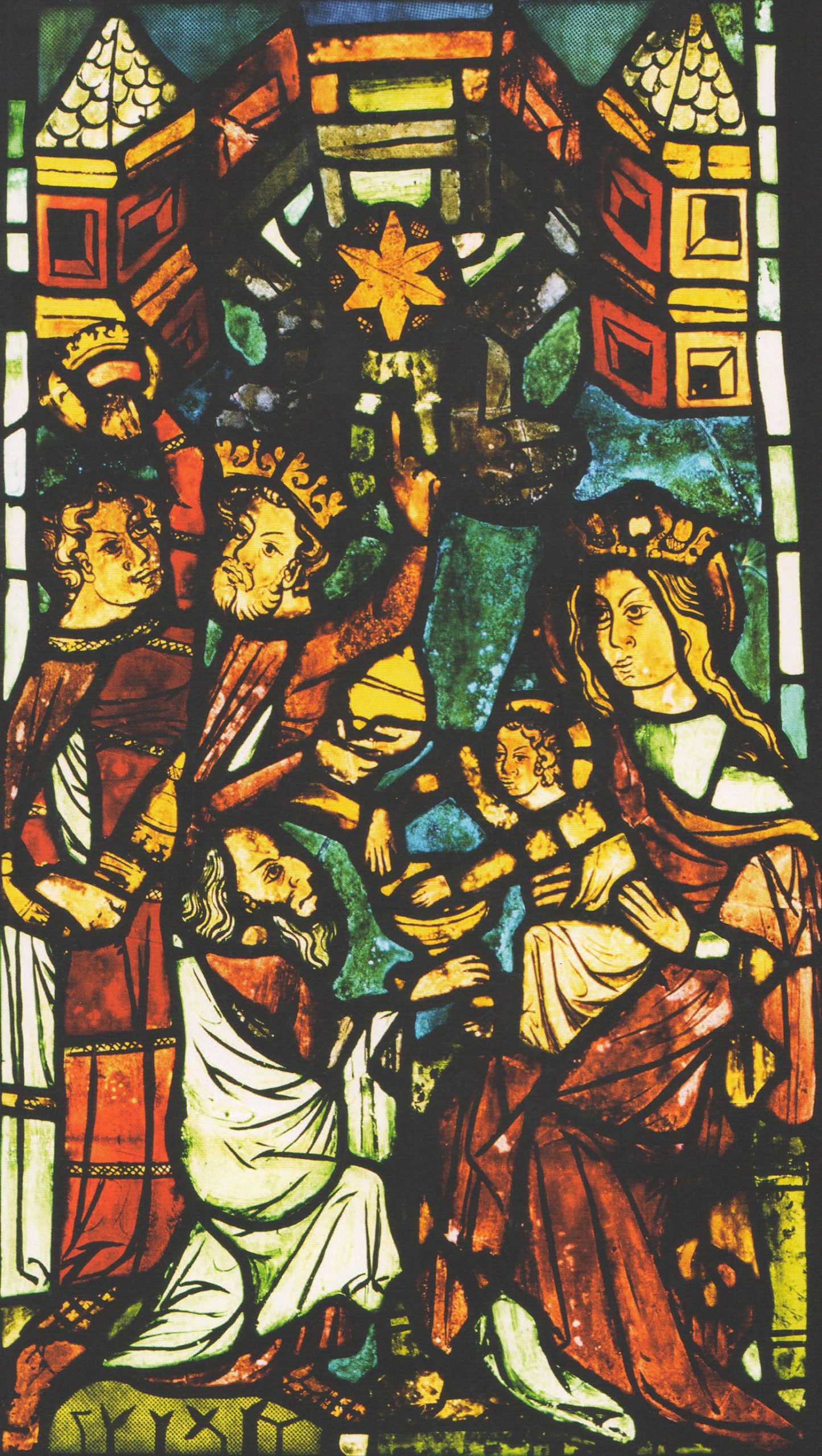
The following is a stained glass window from the Three choir windows in the Marienkirche, Frankfurt (Oder), Germany, of the 14th century, depicting God calling out to Adam who is hiding:
Source: Der gläserne Schatz: Die Bilderbibel der St. Marienkirche in Frankfurt (Oder), Neuer Berlin Verlag, 2005, copyright for this image: Brandenburgisches Landesamt für Denkmalpflege und Archäologisches Landesmuseum
Stained glass is not just highly decorative, it’s a medium which has been used to express important religious messages for centuries. Literacy was not widespread in the medieval and Renaissance periods and the Church used stained glass and other artworks to teach the central beliefs of Christianity. In Gothic churches, the windows were filled with extensive narrative scenes in stained glass — like huge and colorful picture storybooks — in which worshipers could ‘read’ the stories of Christ and the saints and learn what was required for their religious salvation. (Source: Victoria and Albert Museum )
Hand colored stencil print on washi by Sadao Watanabe (1977).
Image taken with permission from the SadaoHanga Catalogue where you can find many more images and information about Sadao Watanabe. For other images of Sadao Watanabe art works in TIPs, see here.
The following is a stained glass window depicting Elijah by Endre Odon Hevezi and Gyula Bajo from 1965 for the Debre Libanos Monastery, Oromia, Ethiopia:
Photo by Timothy A. Gonsalves, hosted by Wikimedia Commons under a Creative Commons Attribution-Share Alike 4.0 International license
Stained glass is not just highly decorative, it’s a medium which has been used to express important religious messages for centuries. Literacy was not widespread in the medieval and Renaissance periods and the Church used stained glass and other artworks to teach the central beliefs of Christianity. In Gothic churches, the windows were filled with extensive narrative scenes in stained glass — like huge and colorful picture storybooks — in which worshipers could ‘read’ the stories of Christ and the saints and learn what was required for their religious salvation. (Source: Victoria and Albert Museum )
This is a contemporary tempera/gouache on leather painting by an unknown Ethiopian artist. Source: Sacred Art Pilgrim website .
“Miriam-Rose Ungunmerr-Baumann (born 1950) was a member of the Daly River Mission church in Australia’s Northern Territory. When it was being redecorated in 1974 she was invited to paint a series of Stations of the Cross. It is unusual for an Aboriginal woman to paint since this is usually the task of the men, but she accepted the challenge and produced a remarkable series of paintings which, like other Aboriginal art, uses symbols to go beyond external shapes to inner meanings and emotions. The Stations of the Cross were painted in acrylic paint on burnie board.
“Ungunmerr-Baumann explains the symbolism of the Stations of the Cross: ‘The third stop shows Jesus falling for the first time (below). In Jesus’ weakened state the weight of the cross forces him to fall. The patterns on his body show the physical stress he is under. The circles on his head indicate the pain and sorrow locked up inside him. The patterns on the cross show the increasing weight on his shoulders. In the Fifth Station, Simon of Cyrene helps Jesus carry the cross (opposite). When Simon takes hold of the cross, his body merges with that of Jesus. The pattern on Jesus’ head is open: he is giving grace to Simon to strengthen him. When Simon took hold of the cross, something happened inside him: the sun rose inside his head, his mind burst with a new belief, he became a new man. The resurrection had already begun.’ She prays: ‘Jesus you take your heavy cross, It gives you pain. Help all who suffer. Forgive us for the pain we give you and others.'” (Source for this and the image: The Bible Through Asian Eyes by Masao Takenaka and Ron O’Grady 1991)
This is a contemporary tempera/gouache on leather painting by an unknown Ethiopian artist. Source: Sacred Art Pilgrim website .
The following is a stained glass window in the Sacred Heart Cathedral in Chiang Mai, Thailand, depicting Adam and Eve being banished from Eden:
Photo by Jost Zetzsche
Stained glass is not just highly decorative, it’s a medium which has been used to express important religious messages for centuries. Literacy was not widespread in the medieval and Renaissance periods and the Church used stained glass and other artworks to teach the central beliefs of Christianity. In Gothic churches, the windows were filled with extensive narrative scenes in stained glass — like huge and colorful picture storybooks — in which worshipers could ‘read’ the stories of Christ and the saints and learn what was required for their religious salvation. (Source: Victoria and Albert Museum )
The Hebrew and Greek that is translated as “thresh” in English is illustrated for use in Bible translations in East Africa by Pioneer Bible Translators like this:
Image owned by PBT and Jonathan McDaniel and licensed with the Creative Commons Attribution 3.0 Unported License.
The Hebrew and Greek that is translated as “sandal” in English is illustrated for use in Bible translations in East Africa by Pioneer Bible Translators like this:
Image owned by PBT and Jonathan McDaniel and licensed with the Creative Commons Attribution 3.0 Unported License.
The Hebrew that is translated as “bronze altar” in English is illustrated for use in Bible translations in East Africa by Pioneer Bible Translators like this:
Image owned by PBT and Jonathan McDaniel and licensed with the Creative Commons Attribution 3.0 Unported License.