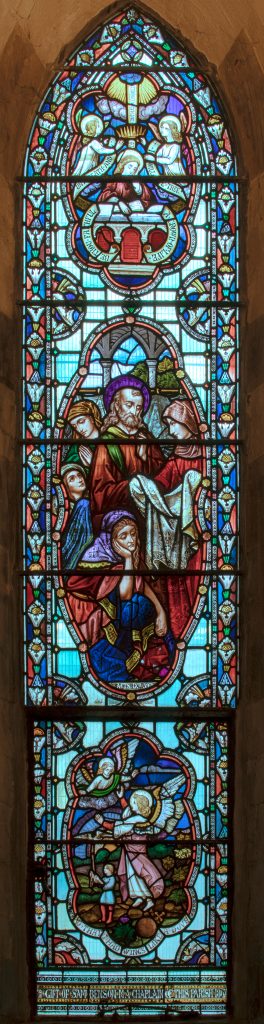
The top scene bears the inscription ‘Be thou faithful unto death and I will give thee a crown of life’; below St Peter is shown healing Tabitha at Joppa, and below again is the inscription ‘O that I had wings like a dove’ (Psalm 55) with a small boy and his kite. (Source: Southwark Cathedral website )
Stained glass is not just highly decorative, it’s a medium which has been used to express important religious messages for centuries. Literacy was not widespread in the medieval and Renaissance periods and the Church used stained glass and other artworks to teach the central beliefs of Christianity. In Gothic churches, the windows were filled with extensive narrative scenes in stained glass — like huge and colorful picture storybooks — in which worshipers could ‘read’ the stories of Christ and the saints and learn what was required for their religious salvation. (Source: Victoria and Albert Museum )
Stained glass is not just highly decorative, it’s a medium which has been used to express important religious messages for centuries. Literacy was not widespread in the medieval and Renaissance periods and the Church used stained glass and other artworks to teach the central beliefs of Christianity. In Gothic churches, the windows were filled with extensive narrative scenes in stained glass — like huge and colorful picture storybooks — in which worshipers could ‘read’ the stories of Christ and the saints and learn what was required for their religious salvation. (Source: Victoria and Albert Museum )
The following is a stained glass window from 1855 by artist H. Beiler over the altar of the Evangelische Stadtkirche Bad Rappenau, Bad Rappenau, Germany:
Photo by Llez, hosted by Wikimedia Commons under a Creative Commons Attribution-Share Alike 3.0 Unported license
Stained glass is not just highly decorative, it’s a medium which has been used to express important religious messages for centuries. Literacy was not widespread in the medieval and Renaissance periods and the Church used stained glass and other artworks to teach the central beliefs of Christianity. In Gothic churches, the windows were filled with extensive narrative scenes in stained glass — like huge and colorful picture storybooks — in which worshipers could ‘read’ the stories of Christ and the saints and learn what was required for their religious salvation. (Source: Victoria and Albert Museum )
This is a contemporary tempera/gouache on leather painting by an unknown Ethiopian artist. Source: Sacred Art Pilgrim website .
Following is a painting by Chen Yuandu 陳緣督 (1902–1967):
Housed in the Société des Auxiliaires des Missions Collection – Whitworth University.
Image taken from Chinese Christian Posters . For more information on the “Ars Sacra Pekinensis” school of art, see this article , for other artworks of that school in TIPs, see here.
The following is a stained glass window from the Three choir windows in the Marienkirche, Frankfurt (Oder), Germany, of the 14th century:
Source: Der gläserne Schatz: Die Bilderbibel der St. Marienkirche in Frankfurt (Oder), Neuer Berlin Verlag, 2005, copyright for this image: Brandenburgisches Landesamt für Denkmalpflege und Archäologisches Landesmuseum
Stained glass is not just highly decorative, it’s a medium which has been used to express important religious messages for centuries. Literacy was not widespread in the medieval and Renaissance periods and the Church used stained glass and other artworks to teach the central beliefs of Christianity. In Gothic churches, the windows were filled with extensive narrative scenes in stained glass — like huge and colorful picture storybooks — in which worshipers could ‘read’ the stories of Christ and the saints and learn what was required for their religious salvation. (Source: Victoria and Albert Museum )