Oral translation of 1 Samuel 3:1-18 in Mam (Todos Santos)

Following is the oral translation of 1 Samuel 3:1-18 in Mam (spoken in the municipality of Todos Santos Cuchumatán ) followed by a back translation into English:

When our Father God called Samuel, Samuel was serving our Father God under Eli’s care. In those days, our Father God did not speak much, nor did He appear to speak in dreams. On this day, Eli was asleep in his bed; his eyes were weak, and he was nearly blind. The lamp of our Father God had not been extinguished. The young Samuel was also sleeping in the house of our Father God, near the ark of our Father God. God spoke to the young Samuel. He replied, “Here I am,” and ran to where Eli was sleeping. “Did you call me?” “Here I am,” Eli replied. “I did not call you; go back to sleep.” Samuel returned to sleep. Our Father God spoke again. Samuel stood up and went back to where Eli was. “Here I am. Why did you call me?” Eli replied, “Son, I did not call you; Go back to sleep.” Samuel had not recognized the tone of our Father God’s voice; this was the first time our Father God had called out to him. The third time, our Father God spoke: “Samuel, Samuel!” Samuel stood up and went to where Eli was and said, “Here I am. Why did you call me?” That is how it was. Eli understood; our Father God was calling him. He said to him, “Go back to sleep, but if you hear him calling you, you shall answer, ‘Speak, our Father God, for your servant is listening.’” So Samuel went back to sleep. Our Father God stood beside him and called him as before: “Samuel, Samuel!” But he answered, “Here I am; speak, our Father God, for I am your servant.” “I am listening,” our Father God said to him. “I am going to bring great evil upon Israel. When the people hear it, they will tremble with fear. My word that I spoke concerning the sons of Eli will come to pass. He knows his sons; they have done me wrong, and he did not rebuke them. Therefore, I will bring suffering upon his sons; nothing and no one will save them. Truly I tell you, no offering will be sufficient for me to forgive the sin of the family (Eli’s sin). Samuel went to sleep; when morning came, he got up and opened the door of the house of our Father God. Fear came upon him to tell Eli what Father God had said to him. Eli called out to him and said, “Samuel, my son.” Samuel answered, “Here I am.” Eli asked, “What did our Father God say to you? Tell me everything. God will bring suffering upon you if you do not tell me.” Samuel said everything and hid nothing. Eli said, “Our Father God is the Lord, and He is the one who commands.” We hear this story in the First Book of Samuel, chapter 3, verses 1 through 18.

Source: Sociedad Bíblica de Guatemala , Fausto Liriano

Oral translation of 1 Samuel 3:1-18 in Sipakapense

Following is the oral translation of 1 Samuel 3:1-18 in Sipakapense followed by a back translation into English:

They called him Samuel. The young Samuel served God the father. The Lord stopped appearing to Eli. In those days, the voice of the Lord was not heard; there was no one to whom the Lord revealed Himself or appeared. Eli slept in his usual place, but his eyes were failing, and he could no longer see. It was as if the light of the Lord had gone out. Samuel also slept in the house of the Lord, where the keeper of the Lord God called out to Samuel, he answered, “Here I am.” He quickly went to where Eli was sleeping. “Are you calling me? I’m here,” Eli replied. “I’m not calling you. Turn around and go to sleep.” Samuel turned around and slept. The Lord called him again: “Samuel!” Samuel got up and went again to where Eli was. “Where is Eli?” he asked. “Why are you calling me? I’m here.” Eli answered, “I’m not calling you, my son. Go to sleep again.” Samuel did not recognize the voice of the Lord until then; hearing the voice of God the Father for the first time. God the Father called him three times: “Samuel, Samuel.” Samuel got up and went to where Eli was. He said, “Why are you calling me? Here I am.” At that moment, it occurred to Eli that God the Father was calling the boy, and he said, “Go back to sleep. If you hear him calling you again, you’re going to answer like this: ‘Speak, Lord my God; your servant is listening.’” Samuel went back to sleep. God the Father stood beside him and called just as the first time: “Samuel! Samuel!” He answered, “Speak, Lord God; your servant is listening.” God said, “I am going to bring a great terror upon Israel; when the people hear it, they will be terrified by this great terror and tremble with fear. I will carry out everything I have spoken against Eli’s family. He knows that his sons have caused me great pain, yet he did nothing to make amends. Therefore, I will bring pain upon his family—nothing and no one will be able to remove it—for that reason I offer no gift that will take away the guilt of Eli’s family. Samuel went back to sleep; when dawn broke, he got up and opened what had been closed—the house of God the Father—but he didn’t dare tell Eli what had been said to him. But Eli called out and said, “Samuel, my son.” Samuel replied, “Here I am.” Eli asked, “What did God the Father say? Tell me everything.” God the Father will bring sorrow upon you if you do not tell me.” Samuel told him everything; he hid nothing. Eli said, “Let God the Father do whatever He wants, for He is in charge.” This event is found in 1 Samuel 3:1–18

Source: Sociedad Bíblica de Guatemala , Fausto Liriano

Oral translation of 1 Samuel 3:1-18 in Ixil (Cotzal)

Following is the oral translation of 1 Samuel 3:1-18 in Ixil (spoken in San Juan Cotzal ) followed by a back translation into English:

So when God, our Lord, called Samuel, the young man Samuel was working for God, our Lord, and his boss was Eli. In those days, God, our Lord, no longer spoke; He no longer sent anyone to deliver a message, nor did He reveal anything to anyone. On that day, Eli was sleeping in his house; his eyes were failing, and he was going blind. Yet the light from God had not yet gone out, and Samuel was sleeping in the house of our Lord God as well, where the place of God’s covenant was. Then our Lord God called Samuel, and Samuel answered, “Here I am,” and he ran to where Eli was and said to him, “Did you call me?” “Here I am,” and Eli answered him, “I didn’t call you; go back to sleep.” So Samuel went back to sleep, and God our Lord called Samuel again. Then Samuel got up and went straight to where Eli was and said, “Ah, yes, here I am. What are you going to tell me? You called me?” And Eli answered him, “No, I didn’t call you, my little son; go back to sleep.” For Samuel did not yet know the voice of the Lord, because the Lord had not yet spoken to him. So the Lord called him a third time, “Samuel, Samuel!” And Samuel got up and went to where Eli was and said, “Here I am; what do you want to tell me? You called me.” So, as soon as Eli made it clear that the Lord God had called the little boy, he said, “Go back to sleep, and if you hear him call you again, answer, ‘Speak, Lord God, for your servant is listening.’” Then Samuel went back to sleep. So the Lord God stood there and called again, just as he had the first times: “Samuel! Samuel!” And Samuel answered, Samuel: “Thus says my God, my Lord, for I am your servant and I listen to you.” Then our God, the Lord, said to him: “I am going to do something in Israel that will strike great fear into the hearts of the people, so that they will tremble with fear. For when they come to know it, I will finish doing everything I have already said I will do to Eli, his sons, and all his brothers’ sons—because Eli knows his sons well; they used to beat me severely in their work, yet he did nothing to put it right. And that is why I will punish Eli and his sons and their brothers, and nothing and no one will be able to take them out of my hand, for I have already said, ‘Even if they do anything, I will not forgive the sins of Eli’s sons.’ So Samuel went back to sleep. When morning came, he got up, then opened the doors of the house of God, and he could not bear to tell Eli the things he saw and heard. But Eli called him and said, “Samuel, my little son,” and Samuel answered, “Here I am.” Then Eli asked him, “So, what did God say to you? Tell me everything; if you don’t tell me, God will punish you.” So Samuel did not hide his face from Eli and told him everything. Then Eli said, “Let the thought of the Lord our God be done, for it is He who spoke.” And all these things that happened are recorded in the first book of Samuel, chapter three; the account begins in verse one and ends in verse 18.”

Source: Sociedad Bíblica de Guatemala , Fausto Liriano
Psalm 2 in Koti

Following is a translation of Psalm 2 into song in Koti, by Tarikhi Ya Haakhi. The Koti text is translated into English within the video.

Following is another rendition only verses 1 and 2 by the same team in the same language:

℗ 2025 Wycliffe Bible Translators South Africa NPC. Used with permission. Part of the Psalms that Sing project.

Jesus is Tempted

Following is a 1973 painting of the JESUS MAFA project, a response to New Testament readings from the Lectionary by a Christian community in Cameroon, Africa. Each of the readings was selected and adapted to dramatic interpretation by the community members. Photographs of their interpretations were made, and these were then transcribed to paintings:

In this painting, Jesus has been taken to the top of a mountain in the final temptation where the devil whispers in his ear the promise of all the kingdoms of the world. Jesus is confronted with the temptation to seize power—to live by the rule(s) of the world. We know from this one gospel story that he refuses every temptation, but we know from the remaining narrative that the temptation to be the messiah people expected must have haunted him to his death on the cross. Jesus instead is a new kind of messiah, one who exemplifies non-violent resistance, trusting in the love he embodies.

From Art in the Christian Tradition , a project of the Vanderbilt Divinity Library, Nashville, TN. Image retrieved March 23, 2026. Original source: librairie-emmanuel.fr.

Christ Appears to Mary

Following is a 1973 painting of the JESUS MAFA project, a response to New Testament readings from the Lectionary by a Christian community in Cameroon, Africa. Each of the readings was selected and adapted to dramatic interpretation by the community members. Photographs of their interpretations were made, and these were then transcribed to paintings:

Dramatically picturesque, this painting of John’s resurrection narrative captures the moment when Mary recognizes Jesus outside the tomb where he was meant to be lying. She has fallen to her knees in joy and worship as she reaches out to touch him. Jesus holds his arm to himself as he commands her not to hold onto him for he “has not yet ascended to the father.” Mary’s happiness is infectious and stirs in the viewer a similar delight in believing that death does not have the final word.

From Art in the Christian Tradition , a project of the Vanderbilt Divinity Library, Nashville, TN. Image retrieved March 23, 2026. Original source: librairie-emmanuel.fr.

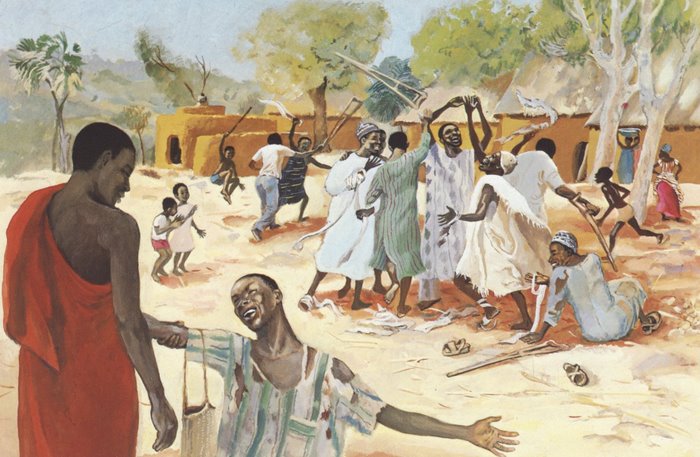
Healing of the Ten Lepers

Following is a 1973 painting of the JESUS MAFA project, a response to New Testament readings from the Lectionary by a Christian community in Cameroon, Africa. Each of the readings was selected and adapted to dramatic interpretation by the community members. Photographs of their interpretations were made, and these were then transcribed to paintings:

This beautiful rendering of the healing of the ten lepers sets the tone as one of joyous celebration. Jesus has just restored the health of ten people and only one has returned in thanksgiving, but this fact from the story does not impact the painting negatively. The one has knelt before Jesus to offer his gratitude while the other nine rejoice in the background. The piece is dynamic as we see arms thrown in the air in elation while onlookers are also rejoicing at this miracle. The smiling faces in this painting are contagious as the viewer can join in applause and praise of God for such wonderful works.

From Art in the Christian Tradition , a project of the Vanderbilt Divinity Library, Nashville, TN. Image retrieved March 23, 2026. Original source: librairie-emmanuel.fr.

Jesus as a Child in Nazareth

Following is a 1973 painting of the JESUS MAFA project, a response to New Testament readings from the Lectionary by a Christian community in Cameroon, Africa. Each of the readings was selected and adapted to dramatic interpretation by the community members. Photographs of their interpretations were made, and these were then transcribed to paintings:

From Art in the Christian Tradition , a project of the Vanderbilt Divinity Library, Nashville, TN. Image retrieved March 23, 2026. Original source: librairie-emmanuel.fr.