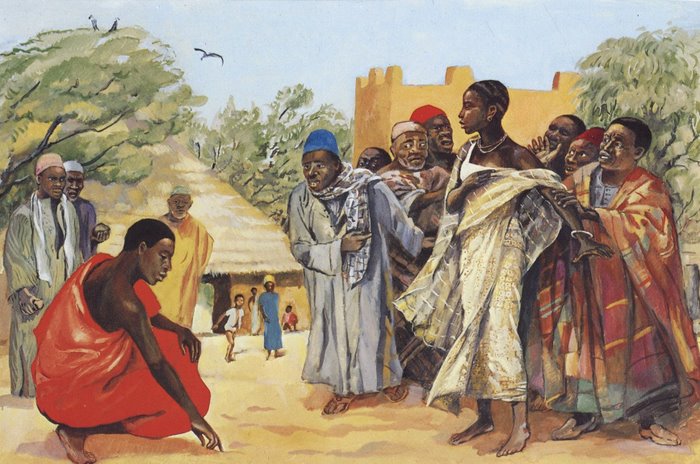
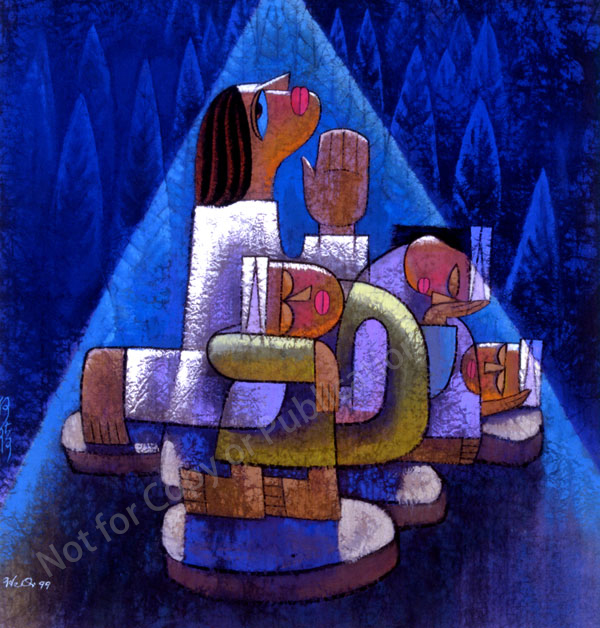
Image taken from He Qi Art . For purchasing prints of this and other artworks by He Qi go to heqiart.com . For other images of He Qi art works in TIPs, see here.
Following is a painting by Kim Ki-chang (1913-2001):
Kim Ki-chang (pen name: Unbo) had been deaf and partially mute since the age of 7. He painted a series of 30 paintings for the “Life of Christ” cycle in 1952 during the Korean War. Kim portrayed Jesus as a seonbi / 선비, or a Joseon Period (1392-1910) gentleman scholar, wearing a gat / 갓 (hat) and dopo / 도포 (robe). For other images of Kim Ki-chang art works in TIPs, see here.
Following is a 1973 painting of the JESUS MAFA project, a response to New Testament readings from the Lectionary by a Christian community in Cameroon, Africa. Each of the readings was selected and adapted to dramatic interpretation by the community members. Photographs of their interpretations were made, and these were then transcribed to paintings:
From Art in the Christian Tradition, a project of the Vanderbilt Divinity Library, Nashville, TN. Image retrieved March 23, 2026. Original source: librairie-emmanuel.fr.
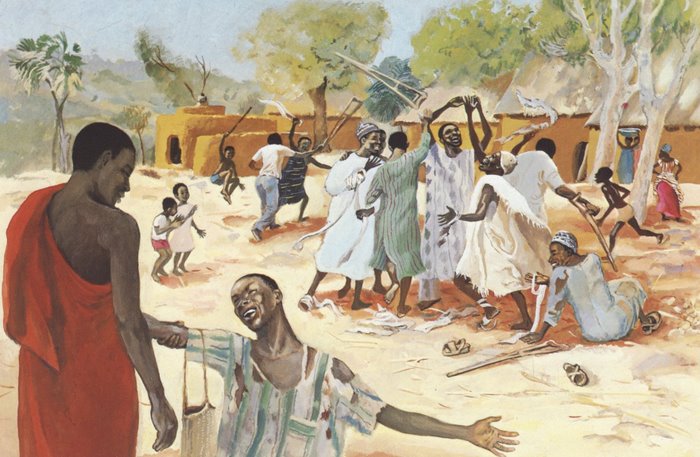
Following is a 1973 painting of the JESUS MAFA project, a response to New Testament readings from the Lectionary by a Christian community in Cameroon, Africa. Each of the readings was selected and adapted to dramatic interpretation by the community members. Photographs of their interpretations were made, and these were then transcribed to paintings:
This beautiful rendering of the healing of the ten lepers sets the tone as one of joyous celebration. Jesus has just restored the health of ten people and only one has returned in thanksgiving, but this fact from the story does not impact the painting negatively. The one has knelt before Jesus to offer his gratitude while the other nine rejoice in the background. The piece is dynamic as we see arms thrown in the air in elation while onlookers are also rejoicing at this miracle. The smiling faces in this painting are contagious as the viewer can join in applause and praise of God for such wonderful works.
From Art in the Christian Tradition, a project of the Vanderbilt Divinity Library, Nashville, TN. Image retrieved March 23, 2026. Original source: librairie-emmanuel.fr.
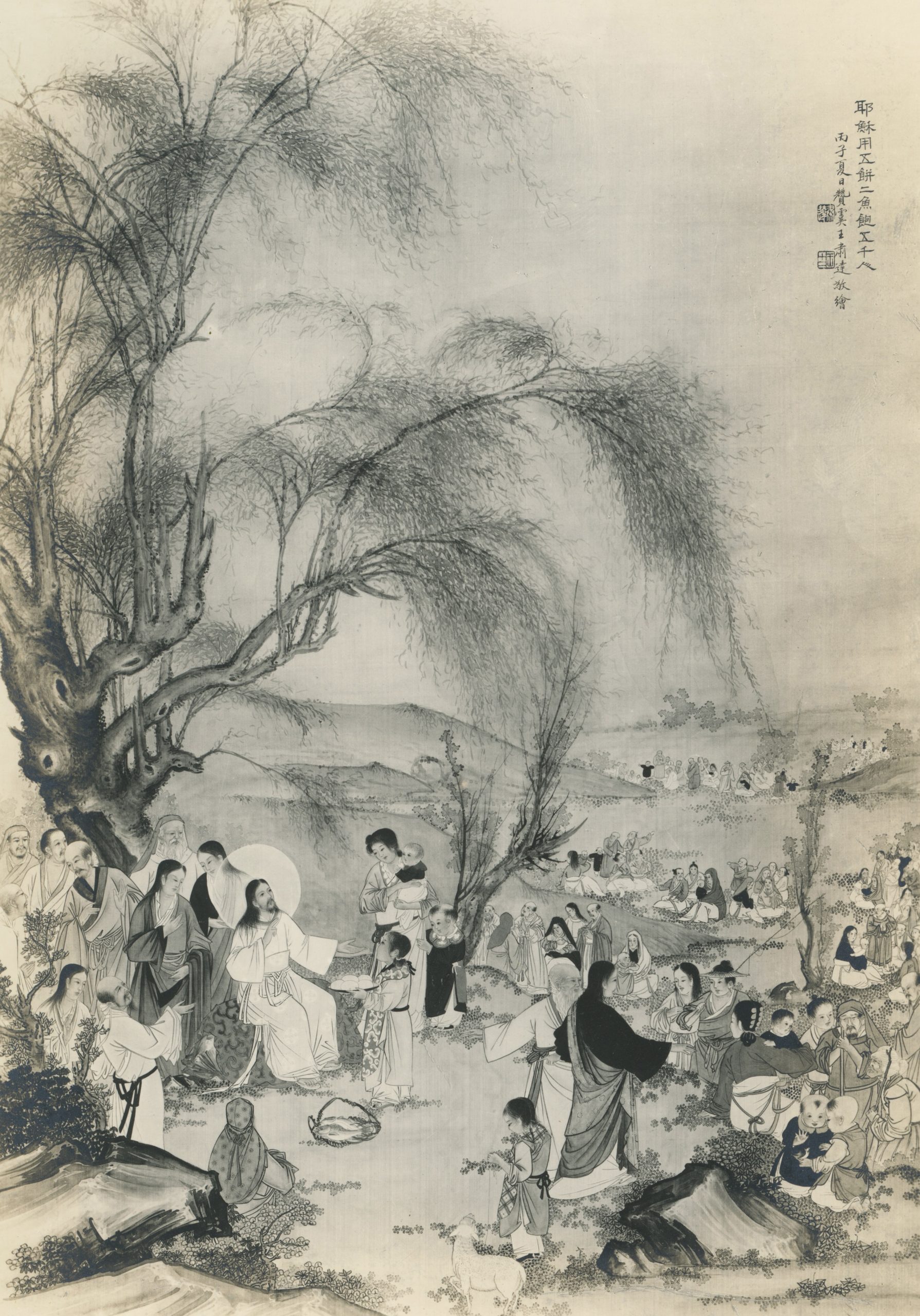
1936 painting by Wang Suda 王肅達 (1910-1963),
Housed in the Société des Auxiliaires des Missions Collection – Whitworth University
(click image to enlarge)
Image taken from Chinese Christian Posters . For more information on the “Ars Sacra Pekinensis” school of art, see this article , for other artworks of that school in TIPs, see here.
Following is a 1973 painting of the JESUS MAFA project, a response to New Testament readings from the Lectionary by a Christian community in Cameroon, Africa. Each of the readings was selected and adapted to dramatic interpretation by the community members. Photographs of their interpretations were made, and these were then transcribed to paintings:
Jesus stands in the center inspecting the baskets of leftover food the disciples are bringing to him. All around him are content crowds of people who have just been fed. The miracle of this story rests in Jesus’ taking the resources people shared and breaking (read dividing) them among all in attendance that day. Christians are called to live and follow Christ in his example—this means sharing what we have with those around us, especially those in need. In this world, there is plenty to go around. Rather than projecting a gospel of prosperity, we should radiate a gospel of giving.
From Art in the Christian Tradition, a project of the Vanderbilt Divinity Library, Nashville, TN. Image retrieved March 23, 2026. Original source: librairie-emmanuel.fr.
Following is a 1973 painting of the JESUS MAFA project, a response to New Testament readings from the Lectionary by a Christian community in Cameroon, Africa. Each of the readings was selected and adapted to dramatic interpretation by the community members. Photographs of their interpretations were made, and these were then transcribed to paintings:
From Art in the Christian Tradition, a project of the Vanderbilt Divinity Library, Nashville, TN. Image retrieved March 23, 2026. Original source: librairie-emmanuel.fr.
Image taken from the Wiedmann Bible. For more information about the images and ways to adopt them, see here .
For other images of Willy Wiedmann paintings in TIPs, see here.
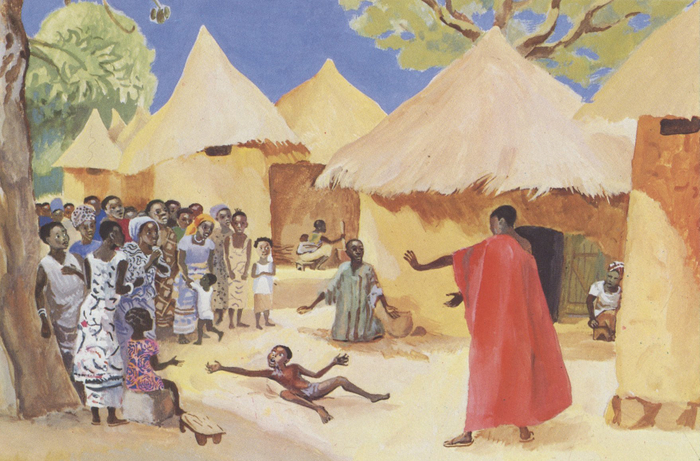
Following is the 1973 painting “The Possessed” of the JESUS MAFA project, a response to New Testament readings from the Lectionary by a Christian community in Cameroon, Africa. Each of the readings was selected and adapted to dramatic interpretation by the community members. Photographs of their interpretations were made, and these were then transcribed to paintings:
From Art in the Christian Tradition, a project of the Vanderbilt Divinity Library, Nashville, TN. Image retrieved March 23, 2026. Original source: librairie-emmanuel.fr.
Following is a 1973 painting of the JESUS MAFA project, a response to New Testament readings from the Lectionary by a Christian community in Cameroon, Africa. Each of the readings was selected and adapted to dramatic interpretation by the community members. Photographs of their interpretations were made, and these were then transcribed to paintings:
In this painting, Jesus has been taken to the top of a mountain in the final temptation where the devil whispers in his ear the promise of all the kingdoms of the world. Jesus is confronted with the temptation to seize power—to live by the rule(s) of the world. We know from this one gospel story that he refuses every temptation, but we know from the remaining narrative that the temptation to be the messiah people expected must have haunted him to his death on the cross. Jesus instead is a new kind of messiah, one who exemplifies non-violent resistance, trusting in the love he embodies.
From Art in the Christian Tradition, a project of the Vanderbilt Divinity Library, Nashville, TN. Image retrieved March 23, 2026. Original source: librairie-emmanuel.fr.
Following is a 1973 painting of the JESUS MAFA project, a response to New Testament readings from the Lectionary by a Christian community in Cameroon, Africa. Each of the readings was selected and adapted to dramatic interpretation by the community members. Photographs of their interpretations were made, and these were then transcribed to paintings:
From Art in the Christian Tradition, a project of the Vanderbilt Divinity Library, Nashville, TN. Image retrieved March 23, 2026. Original source: librairie-emmanuel.fr.
Hand colored stencil print on momigami by Sadao Watanabe (1962). Image taken with permission from the SadaoHanga Catalogue where you can find many more images and information about Sadao Watanabe. For other images of Sadao Watanabe art works in TIPs, see here.
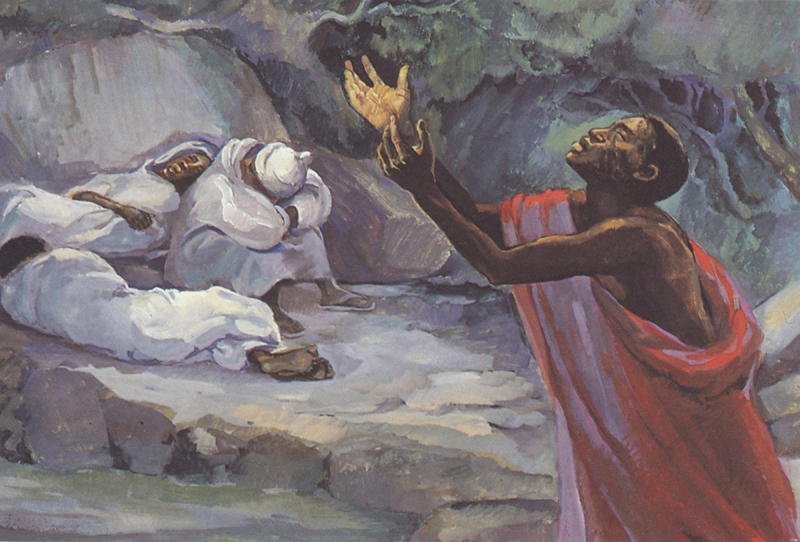
Following is a painting (“Jesus’ agony in the garden of Gethsemane”) by Kim Ki-chang (1913-2001):
Kim Ki-chang (pen name: Unbo) had been deaf and partially mute since the age of 7. He painted a series of 30 paintings for the “Life of Christ” cycle in 1952 during the Korean War. Kim portrayed Jesus as a seonbi / 선비, or a Joseon Period (1392-1910) gentleman scholar, wearing a gat / 갓 (hat) and dopo / 도포 (robe). For other images of Kim Ki-chang art works in TIPs, see here.
Following is a painting (“Prayer at Gethsemane”) by He Qi:
Image taken from He Qi Art . For purchasing prints of this and other artworks by He Qi go to heqiart.com . For other images of He Qi art works in TIPs, see here
Following is a 1973 painting of the JESUS MAFA project, a response to New Testament readings from the Lectionary by a Christian community in Cameroon, Africa. Each of the readings was selected and adapted to dramatic interpretation by the community members. Photographs of their interpretations were made, and these were then transcribed to paintings:
From Art in the Christian Tradition, a project of the Vanderbilt Divinity Library, Nashville, TN. Image retrieved March 23, 2026. Original source: librairie-emmanuel.fr.
Photo by NateBergin, hosted by Wikimedia Commons under a Creative Commons Attribution 4.0 International license
Stained glass is not just highly decorative, it’s a medium which has been used to express important religious messages for centuries. Literacy was not widespread in the medieval and Renaissance periods and the Church used stained glass and other artworks to teach the central beliefs of Christianity. In Gothic churches, the windows were filled with extensive narrative scenes in stained glass — like huge and colorful picture storybooks — in which worshipers could ‘read’ the stories of Christ and the saints and learn what was required for their religious salvation. (Source: Victoria and Albert Museum )