Following is a 1973 painting of the JESUS MAFA project, a response to New Testament readings from the Lectionary by a Christian community in Cameroon, Africa. Each of the readings was selected and adapted to dramatic interpretation by the community members. Photographs of their interpretations were made, and these were then transcribed to paintings:
From Art in the Christian Tradition, a project of the Vanderbilt Divinity Library, Nashville, TN. Image retrieved March 23, 2026. Original source: librairie-emmanuel.fr.
Image taken from He Qi Art . For purchasing prints of this and other artworks by He Qi go to heqiart.com . For other images of He Qi art works in TIPs, see here.
Painting by Nalini Jayasuriya (1927 – 2014), used with permission by the Overseas Ministries Study Center (OMSC) at Princeton Theological Seminary. You can purchase this and many other artworks by artists in residence at the OSMC in high resolution and without a watermark via the OSMC website .
“Nalini M. Jayasuriya was an internationally known artist from Sri Lanka, who exhibited her soul-stirring paintings in Manila, London, Bangkok, Paris, Toronto, Tokyo, Jerusalem and New York. (…) While growing up in Sri Lanka, Nalini never took an art course. As an eight-year old assigned to draw a still life in drawing class, she ended up erasing a hole in her paper, and was told to take her books and leave. She spent the rest of the year’s drawing class time in the library. Her real talent was music; from about age four, she could play almost any piece of music that she heard. At about age fifteen, she wrote a number of poems that were published, and later wrote a secondary-level reader consisting of letters from her cat, Ingy.
“The direction of Nalini’s life changed when, as a young ESL teacher, she was offered an unsolicited British Council grant to study in England. She saw this as one of the many miracles in her life. For three years in London, she experienced a whole new world. She added evening classes to her schedule, including coursework in stained glass and enamel on metal, thinking that she would never again have such an opportunity. Later, she received seven scholarships and fellowships, (none of which she applied for) and she went on to live in thirty-six different countries.
“’I come from a land of rich, ancient, and diverse cultures and traditions. While I carry the enriching influences of both West and East, I express myself through an Asian and Christian consciousness with respect for all confessions of religious faith.’ Nalini Jayasuriya).” (Source )
About this image, Jayasuriya says: “To me, the Great Commission is much more than the words that Jesus spoke to the twelve. So, I have tried to suggest the Power that had to sweep through humanity and through Time, transcending all thought and illumining all experience. So, Christ makes a Statement and an Offering; a Statement of the Abiding Holy Spirit in the form of a Dove, and the Offering of his Life in the symbol of the Cup. This is not a portrait of the young vibrant giver of the Gospels, but an almost elusive vision of a spiritual Presence — a Presence eternally renewing.” (Source : OMSC 2010, p. 34)
Following is a 1973 painting of the JESUS MAFA project, a response to New Testament readings from the Lectionary by a Christian community in Cameroon, Africa. Each of the readings was selected and adapted to dramatic interpretation by the community members. Photographs of their interpretations were made, and these were then transcribed to paintings:
In The Mission to the World, Jesus stands atop a hill proclaiming to his disciples their authority to baptize and teach all that Jesus commanded. His arms are outstretched in a posture of blessing and exhortation. Some disciples remain before him while others are setting out on their journey to complete the task Jesus has set before them. Those departing go in separate directions to spread the gospel to all nations. This scene is a reminder that all Christians are called to spread Jesus’ message of love and justice throughout the world.
From Art in the Christian Tradition, a project of the Vanderbilt Divinity Library, Nashville, TN. Image retrieved March 23, 2026. Original source: librairie-emmanuel.fr.
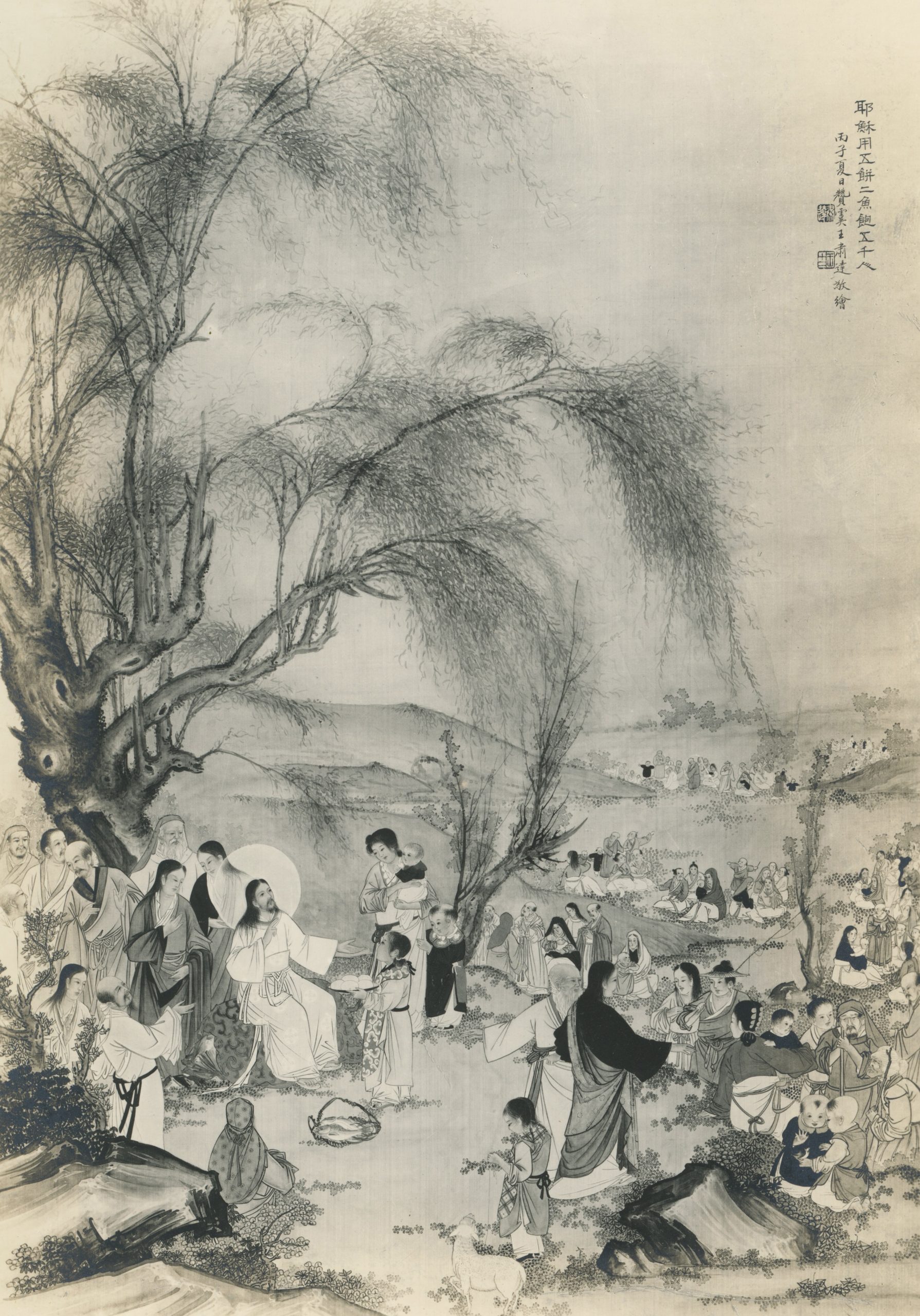
1936 painting by Wang Suda 王肅達 (1910-1963),
Housed in the Société des Auxiliaires des Missions Collection – Whitworth University
(click image to enlarge)
Image taken from Chinese Christian Posters . For more information on the “Ars Sacra Pekinensis” school of art, see this article , for other artworks of that school in TIPs, see here.
Following is a 1973 painting of the JESUS MAFA project, a response to New Testament readings from the Lectionary by a Christian community in Cameroon, Africa. Each of the readings was selected and adapted to dramatic interpretation by the community members. Photographs of their interpretations were made, and these were then transcribed to paintings:
Jesus stands in the center inspecting the baskets of leftover food the disciples are bringing to him. All around him are content crowds of people who have just been fed. The miracle of this story rests in Jesus’ taking the resources people shared and breaking (read dividing) them among all in attendance that day. Christians are called to live and follow Christ in his example—this means sharing what we have with those around us, especially those in need. In this world, there is plenty to go around. Rather than projecting a gospel of prosperity, we should radiate a gospel of giving.
From Art in the Christian Tradition, a project of the Vanderbilt Divinity Library, Nashville, TN. Image retrieved March 23, 2026. Original source: librairie-emmanuel.fr.
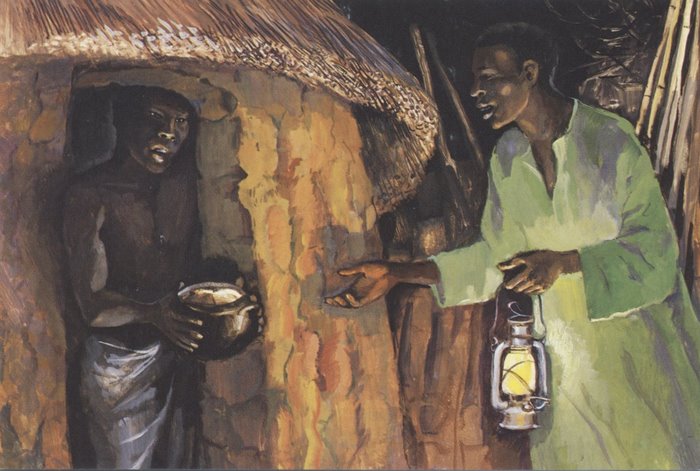
“It is unusual for anyone to seek out another at night unless it is desired to be kept secret. Betel nut and condiments are laid out to welcome the guest even at the late hour. Nicodemus’s robe and bared shoulder show he is a religious devotee.”
For more images by Sawai Chinnawong in TIPs see here.
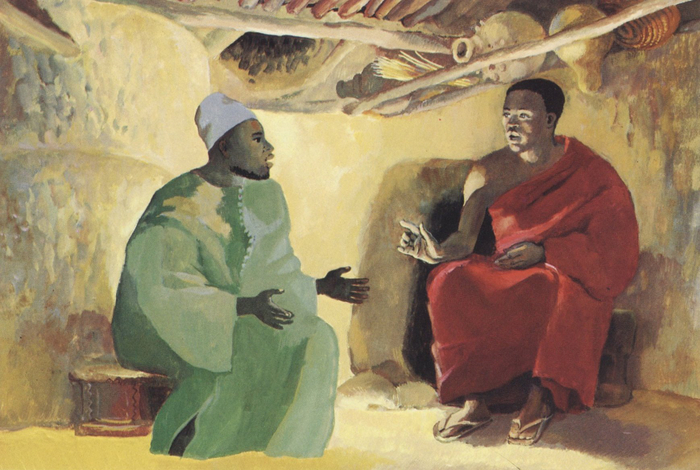
The following 1973 painting “Nicodemus” of the JESUS MAFA project is a response to New Testament readings from the Lectionary by a Christian community in Cameroon, Africa. Each of the readings was selected and adapted to dramatic interpretation by the community members. Photographs of their interpretations were made, and these were then transcribed to paintings:
Here we see Jesus patiently teaching about the kingdom of God to a perplexed Nicodemus, whose hands are in a gesture of questioning. Nicodemus has, like so many before and since, gotten caught up in the literal and limited understanding of the scriptures. Jesus attempted to explain the nature of reality in different terms that thereby he (and we) might be transformed. The boundaries we place on ourselves can be escaped if only we are brave enough to venture beyond them. Shall we remain in the cover of night with Nicodemus or step into the light that Jesus offers?
From Art in the Christian Tradition, a project of the Vanderbilt Divinity Library, Nashville, TN. Image retrieved March 23, 2026. Original source: librairie-emmanuel.fr.
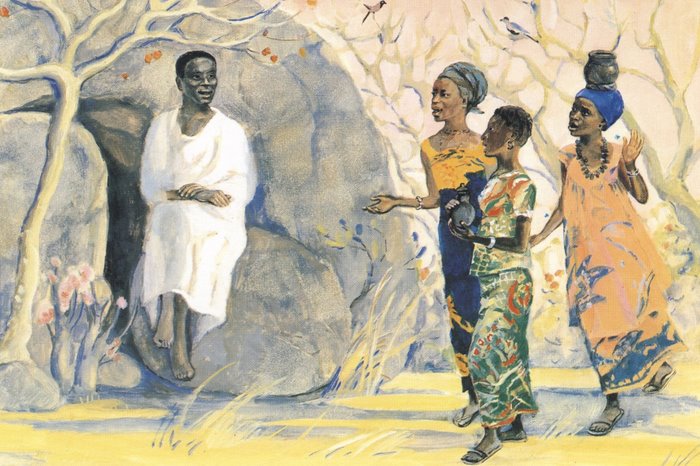
Following is a 1973 painting of the JESUS MAFA project, a response to New Testament readings from the Lectionary by a Christian community in Cameroon, Africa. Each of the readings was selected and adapted to dramatic interpretation by the community members. Photographs of their interpretations were made, and these were then transcribed to paintings:
From Art in the Christian Tradition, a project of the Vanderbilt Divinity Library, Nashville, TN. Image retrieved March 23, 2026. Original source: librairie-emmanuel.fr.
The following is a stained glass window depicting The Parable of the Rich Fool by Arthur J. Dix, 1898. From St John’s church, Bowness-on-Windermere, England:
Hosted by Wikimedia Commons under a Creative Commons CC0 1.0 Universal Public Domain Dedication
Stained glass is not just highly decorative, it’s a medium which has been used to express important religious messages for centuries. Literacy was not widespread in the medieval and Renaissance periods and the Church used stained glass and other artworks to teach the central beliefs of Christianity. In Gothic churches, the windows were filled with extensive narrative scenes in stained glass — like huge and colorful picture storybooks — in which worshipers could ‘read’ the stories of Christ and the saints and learn what was required for their religious salvation. (Source: Victoria and Albert Museum )
Following is a 1973 painting of the JESUS MAFA project, a response to New Testament readings from the Lectionary by a Christian community in Cameroon, Africa. Each of the readings was selected and adapted to dramatic interpretation by the community members. Photographs of their interpretations were made, and these were then transcribed to paintings:
From Art in the Christian Tradition, a project of the Vanderbilt Divinity Library, Nashville, TN. Image retrieved March 23, 2026. Original source: librairie-emmanuel.fr.
Following is a 1973 painting of the JESUS MAFA project, a response to New Testament readings from the Lectionary by a Christian community in Cameroon, Africa. Each of the readings was selected and adapted to dramatic interpretation by the community members. Photographs of their interpretations were made, and these were then transcribed to paintings:
From Art in the Christian Tradition, a project of the Vanderbilt Divinity Library, Nashville, TN. Image retrieved March 23, 2026. Original source: librairie-emmanuel.fr.
Following is a 1973 painting of the JESUS MAFA project, a response to New Testament readings from the Lectionary by a Christian community in Cameroon, Africa. Each of the readings was selected and adapted to dramatic interpretation by the community members. Photographs of their interpretations were made, and these were then transcribed to paintings:
From Art in the Christian Tradition, a project of the Vanderbilt Divinity Library, Nashville, TN. Image retrieved March 23, 2026. Original source: librairie-emmanuel.fr.