
Translation commentary on 2 Thessalonians 3:13

Paul turns away from the group which is refusing to work and addresses the rest of the Christian community. He also turns from a specific order to a general instruction. The transition is marked in Good News Translation as in Greek by an emphatic but you, brothers, which Revised Standard Version, usually so close to the form of the Greek, does not reproduce in its “brethren.” New English Bible similarly has simply “my friends.” Phillips has “and the rest of you, my brothers,” Perhaps verse 15 is intended to correct this emphasis by stating that even those who do not work are still to be counted among the Christian “brothers.”

The abrupt appositional expression, you, brothers, may seem particularly awkward in this context. Perhaps one can use an expression such as “you, my fellow believers,” but it is also possible to say “but, my fellow believers, you must not become tired of doing good.”

Some translations (including Moffatt Phillips New English Bible Jerusalem Bible Bijbel in Gewone Taal Bible en français courant Biblia Dios Habla Hoy La Sainte Bible: Nouvelle version Segond révisée Bible de Jérusalem Traduction œcuménique de la Bible) also mark the transition by beginning a new paragraph with this verse. Revised Standard Version and Luther 1984 make this verse the end of a paragraph. This is less satisfactory, since verse 13 is closely linked to the more specific instructions of verses 14-15.

There is a danger that some may wrongly interpret must not become tired of doing good. This expression could be interpreted to mean that the believers should refrain from doing good so that they would not become tired. The meaning is, of course, that the believers should keep on doing good, even though they might be tired. The correct meaning is more appropriately expressed in some languages as “you must never give up doing good.”

Quoted with permission from Ellingworth, Paul and Nida, Eugene A. A Handbook on Paul’s Second Letter to the Thessalonians. (UBS Handbook Series). New York: UBS, 1976. For this and other handbooks for translators see here .
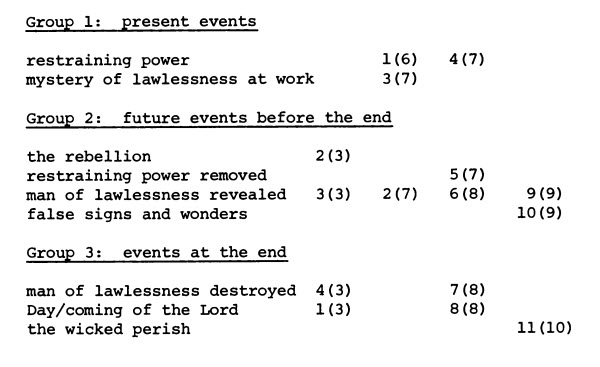
Translation commentary on 2 Thessalonians 2:9

Here as in verse 8, Good News Translation changes the noun “coming” into an active verb come. But here it is not the Lord Jesus but the Wicked One who comes. Good News Bible and some other translations mark this change by a new sentence.

The grammatical structure of the Greek is not clear. The Wicked One will come may be linked with (1) “by the activity of Satan,” (2) “with all power…,” or (3) “for (the destruction of) those who will perish.” The third possibility is remote. “By the activity of Satan” comes first in the Greek, and it seems more natural to understand it as the basis of the signs and wonders, rather than simply as an aside. This is the view taken by most translators (e.g. New English Bible “the coming of that wicked man is the work of Satan,” cf. Moffatt Phillips Jerusalem Bible Barclay Translator’s New Testament; Revised Standard Version “the coming of the lawless one by the activity of Satan will be with all power….”)

Will come reflects a present tense in Greek (see the notes on vv. 9-12). Translators must avoid making nonsense of the passage by suggesting that the Wicked One had already come. Yet there is a serious problem involved in the future form of the verb will come since it repeats the beginning of verse 8 and so seems to contradict what has been said in the latter part of that same verse. It may be necessary, therefore, to refer to the coming of the Wicked One as a temporal setting for the kinds of miracles, signs, and wonders which he will perform, for example, “when the Wicked One comes with the power of Satan, he will perform all kinds of miracles….”

On the power of Satan, see verse 7. Satan should be carefully distinguished in translation from his servant the Wicked One. A literal rendering of with the power of Satan might suggest that the Wicked One was merely carrying along Satan’s power. It may be necessary to introduce this phrase as a parenthetical and explanatory statement, for example, “Satan himself will give the Wicked One his power,” or “he will have Satan’s power.”

All kinds of false miracles raises two separate questions, one about all, and the other about miracles. (1) All may mean (a) all kinds of (Good News Translation cf. Jerusalem Bible Barclay New English Bible Translator’s New Testament), as in Matthew 4.23 (Good News Translation “every kind of disease”), or (b) “to the highest degree,” as in Philippians 1.20 (Good News Translation “full of courage,” literally “with all courage”). Moffatt (“the full power”) and Phillips (“all the force”) choose this second meaning of all. (2) When the Greek word dunamis “power” is used in the plural, it often means miracles. But in this verse, dunamis is in the singular, and Moffatt Revised Standard Version Phillips New English Bible Barclay accordingly translate it as “power.” Combining these two choices, the translator has in practice two possibilities: (1) “all kinds of power” (New English Bible Barclay); (2) “power in the highest degree” (Moffatt Phillips).

Good News Translation, however, combines the expression of power (so frequently used to refer to supernatural force) with the following two Greek terms, generally translated as “signs and wonders.” The resulting coalesced expression is perhaps the closest natural equivalent of a rather unusual Greek phrase.

It is also possible to translate “power in the highest degree,” leaving the false miracles and wonders to be understood as examples of this power. However, all kinds of fits in better with every kind of wicked deceit in verse 10, so “all kinds of power” is perhaps to be preferred. It may be necessary to translate as “he will demonstrate all kinds of power,” or “he will show that he has all kinds of power,” and then to bring in the false miracles in an added phrase, for example, “by causing people to see false miracles.”

“Signs and wonders” are often linked together, especially by Luke in Acts, in speaking of the miracles performed by the apostles. “Signs” indicates the significance of the event: God is active in a special way, the time of his final victory is near. “Wonders” stresses the astonishment of those who see these events. The combination of the two is so common in principle it would be possible to link them in translation as “miraculous signs” or “amazing and significant happenings.”

False miracles and wonders may mean (1) apparent signs and wonders which are really fakes (Knox uses the word “counterfeit,” cf. Revised Standard Version “pretended”); (2) signs and wonders which come from a false source (Moffatt “the full power, the miracles and portents, of falsehood,” cf. New English Bible); or (3) signs and wonders “calculated to deceive” (Barclay). It is difficult to find any parallel to (1) false miracles and wonders in the New Testament, for the New Testament normally takes seriously even those miracles which are performed by evil powers. (2) fits in well with the reference to Satan as the ultimate cause of these events. (3) fits in well with the more detailed description of those who will perish, especially in verse 11, and is perhaps slightly preferable. Accordingly, false miracles and wonders may be rendered as “signs and wonders which deceive people,” or “… which cause them to turn the wrong way” (using an idiom which refers to general behavior). It may be possible to combine miracles and wonders as “wonderful events” or “very astonishing happenings.”

Quoted with permission from Ellingworth, Paul and Nida, Eugene A. A Handbook on Paul’s Second Letter to the Thessalonians. (UBS Handbook Series). New York: UBS, 1976. For this and other handbooks for translators see here .

Translation commentary on 2 Thessalonians 3:3

The play on words mentioned above is reproduced in many English translations (from King James Version to Translator’s New Testament) and by some translations in other languages (e. g. Biblia Dios Habla Hoy). There are, however, two reasons for avoiding it in English, and one or both of them may apply in other languages also. (1) It may be good to follow Good News Translation in replacing “faith” in verse 2 by a related verb like “believe,” in order to show that Paul is speaking of an event. (2) Faithful is gradually falling out of nonliterary English, except in a number of set phrases, most of which refer to an inferior’s relationship with his superior (“faithful servant,” “faithful dog,” though not “faithful husband/wife”). This term is therefore not very appropriate in speaking of God’s relationship with men. Phillips “the Lord is utterly to be depended upon” brings out the meaning well, at a slightly higher language level (cf. Barclay “you can rely on the Lord to strengthen you”). In addition to these two factors, the ability to reproduce plays on words in translation depends entirely on the resources of the receptor language, and meaning must have priority over formal and stylistic features.

Most translations, both traditional and modern, translate the Greek conjunction de here as “but,” since there is a clear contrast between the faithlessness of the wicked men in verse 2 and the faithfulness of Christ or God. If the play on words is not retained, there is a rather less specific contrast between the wicked men and God. In order to point up the contrast, it may be possible to restructure but the Lord is faithful by rendering this expression as “but you can trust the Lord completely.” Here, however, the contrast must be between not everyone and you. It is not between the message and the Lord. In some languages the Lord is faithful must be semantically restructured, since in reality the Lord is the goal of the process of trusting, and people are the ones who trust. In many languages expressions for trust or dependence are quite idiomatic in form, for example, “you may lean on the Lord,” “you may put your hand on the Lord,” or “the Lord will always hold you up.”

A literal rendering of he will strengthen you might suggests mere physical strength. It is better in some instances to render this as “he will cause your hearts to be strong,” or “he will strengthen your wills.” The strength here is obviously not physical, but psychological and spiritual. On strengthen see 1 Thess. 3.2.

Here as in verse 2 (rescue), the translator must avoid the suggestion that Christ will make it possible for the Thessalonians to avoid persecution completely. Paul knows that persecution is already going on and cannot be avoided, but he is confident that Christ will keep both him and the Thessalonian Christians safe in the midst of these attacks. The expression keep you safe from the Evil One must be inverted in a number of languages, for example, “prevent the Evil One from harming you,” or “cause that the Evil One will not harm you,” or “… make you suffer.”

The last words may mean either the Evil One or “evil.” (The same ambiguity is found in Matthew 5.37, and in the Lord’s Prayer, Matthew 6.13.) Translations are divided: Moffatt New English Bible Jerusalem Bible Barclay cf. Bijbel in Gewone Taal (“the devil”) Bible en français courant La Sainte Bible: Nouvelle version Segond révisée Le Nouveau Testament. Version Synodale Bible de Jérusalem Traduction œcuménique de la Bible agree with Good News Translation, while King James Version Knox Revised Standard Version Phillips Translator’s New Testament cf. Biblia Dios Habla Hoy have “evil.” (German translations, like the original, can have both meanings. Revised Standard Version Translator’s New Testament Jerusalem Bible La Sainte Bible: Nouvelle version Segond révisée Bible de Jérusalem Traduction œcuménique de la Bible give the other possible translation in a note.) The arguments for each translation are rather evenly balanced. It is at least clear that the idea of a completely impersonal power of evil is foreign to Paul’s thought. The wider context, especially 2.6-9, refers to the Wicked One in clearly personal terms. The narrower context, on the other hand, which has just mentioned wicked men, would support a more general translation “evil,” thus covering attacks from either human or supernatural powers. Ancient Jewish writings speak of an “evil impulse.” This idea is relevant if Paul is now thinking, not of attacks from outside the Christian community (as in v. 2), nor even of disturbances within it (as in vv. 6 ff.), but of attacks from within the individual. “Evil” therefore seems slightly preferable to the Evil One (cf. Knox “he will strengthen you, and keep you from all harm”).

Quoted with permission from Ellingworth, Paul and Nida, Eugene A. A Handbook on Paul’s Second Letter to the Thessalonians. (UBS Handbook Series). New York: UBS, 1976. For this and other handbooks for translators see here .

Translation commentary on 2 Thessalonians 1:11

That is why indicates a very general connection between the previous verses and the aim of Paul’s prayer, which he is about to state in a little more detail. The Greek contains an additional word, “also,” which does not here imply any kind of contrast, but indicates that Paul is about to make another statement about what he and his colleagues do. Most translations omit it.

In a number of languages it may be necessary to specify what that refers to in the phrase that is why. The content of the following two verses would seem to point clearly to the special glory which the believers are to render to the Lord on that special Day. Certainly that is not a reference to possible punishment. In some instances one may be able to use a very general connective such as “therefore,” but where something more specify is required, it may be necessary to say “because of the honor which you are going to give to the Lord, we always pray for you.”

We ask our God to make you worthy is literally “that our God may make you worthy.” Good News Translation begins a new sentence by repeating in other words the end of the previous sentence. Paul probably means, not “we pray in order that God may make you worthy”, but “the subject of our prayer is that God will make you worthy.” In a number of languages it is necessary to introduce direct discourse with any expression of asking favors of God or praying to God. For example, it may be necessary to say “We pray to our God, Make the believers in Thessalonica worthy of the life you called them to live.”

Make you worthy usually means “consider you worthy,” but Good News Translation‘s translation is justified by the context; the rest of the verse clearly shows that a new kind of conduct is involved. (A similar difficulty was noted in 2 Thess. 1.5). It is difficult in some languages to find an expression which fully translates the term worthy. In some instances the equivalent may be “make you the kind of people who deserve the life.” It may even be necessary to use an expression equivalent to “make you good enough to live the life.” This is not directly a petition for sanctification; it is a request that the lives of the Thessalonians will come up to the standard expected of those who have been called of God to live in a very special way.

The life he has called you to live is literally “the calling,” but this means, not only the act by which God first called the Thessalonians, but the life which he intended they should follow. There are problems involved in the expression the life he has called you to live. It is impossible in some languages to speak of “living a life.” However, one can say “worthy of the way in which he has called you to live.” But then, there are often difficulties involved in the word called. This must not be rendered in such a way as to suggest “calling to” or “shouting at.” The closest equivalent in some languages is an expression relating to the process of inviting or even summoning.

All your desire for goodness is the most probable way of understanding the next words (cf. Barclay “that [God] may turn all your good intentions into actions”). Paul is speaking of an activity of God which, he prays, will bring to good effect the Thessalonians’ own desire for good. The La Sainte Bible: Nouvelle version Segond révisée text understands Paul to mean that the good desires are also God’s, and translates “that [God] may accomplish in you … all the benevolent designs of his goodness.” This translation is less probable (cf. the footnote to the La Sainte Bible: Nouvelle version Segond révisée text). Traduction œcuménique de la Bible leaves the matter open, producing the vague translation: “that [God] may grant you to accomplish all the good desired.”

The request implied in may he, by his power, fulfill all your desire must be introduced in some languages by an expression of prayer or requesting, for example, “we pray to God that he will fulfill.”

Fulfill all your desire for goodness may be expressed in some languages as “make it possible for you to do all the good which you want to do,” or “… to be good to others in all the ways that you desire to do so.”

In the Greek of by his power, the possessive his is understood. Some versions translate by his power as “powerfully.” By his power comes at the end of the verse in the original, so it is not quite certain whether this phrase refers only to complete your work of faith or to fulfill all your desire for goodness also. The two phrases introduced by complete and fulfill (one word in Greek) are so similar in meaning and so closely linked that it is best to take by his power as referring to them both. Barclay chooses “that he may turn all your good intentions into actions, and powerfully help you to live the life that faith demands.” In some languages it is extremely difficult to speak of power as a means by which something is accomplished. Since power is essentially a quality of God himself, and not an instrument, it must be expressed in some languages as cause, for example, “because he is so powerful,” or “because he has the power to do so.”

The last part of Barclay‘s translation (“the life that faith demands”) corresponds to Good News Translation‘s more literal your work of faith. Your is only implied in the Greek, but many translations add it, and rightly so. Complete your work of faith may mean either (1) “make perfect the activity of your faith” (Bible en français courant), or (2) “complete the things you do because you believe” (cf. Jerusalem Bible “complete all that you have been doing through faith”). The difference in meaning is slight, since a purely inward activity of faith would be difficult to imagine, and it is certainly not intended in 1 Thess. 1.3, where a very similar phrase is used. The second alternative would produce a clearer translation.

Quoted with permission from Ellingworth, Paul and Nida, Eugene A. A Handbook on Paul’s Second Letter to the Thessalonians. (UBS Handbook Series). New York: UBS, 1976. For this and other handbooks for translators see here .

Translation commentary on 2 Thessalonians 3:14

This is not be first time Paul discusses the need to work, and in verses 14-15 he turns to the problem of what should be done if this repeated order is not obeyed. Good News Translation makes explicit the fact that Paul is referring, not to earlier teaching, but to the teaching contained in this letter. A possible, but much less natural, alternative translation would be “but if someone does not obey our message (contained in) the (earlier) letter.” Good News Bible‘s more probable interpretation involves changing the present “obey” into the future will … obey, inserting a present verb we send, and inserting this before letter. Similar procedures may be necessary in other languages (cf. Die Bibel im heutigen Deutsch “but if someone does not want to follow the instructions in this letter”).

In 1 Thess. 2.13, “word” (Good News Translation message) clearly referred to a spoken word (cf. 1 Thess. 1.5, 8), but the present context makes no contrast between “word” and letter, and a general term such as message or even “teaching” should be chosen in translation. The translator should avoid any term which would suggest a single word rather than a message consisting of a number of words. Greek-speaking Jews, following Exodus 34.28, referred to the Ten Commandments as the “Ten Words” of the covenant, and the meaning is similar here. For once, Paul’s message is not (at least not directly) “good news” in the form of a narrative about Jesus, but instructions intended to correct an error.

The possibility suggested by it may be that someone there may be made a conditional clause, for example, “if there is anyone.” Will not obey may be more precisely described in some languages as “refuse to do” or “refuse to conform to.”

Take note of him is so rendered by Jerusalem Bible and Translator’s New Testament. Moffatt has “mark him” Knox “he is to be a marked man,” New English Bible Barclay “mark him well” (cf. Die Bibel im heutigen Deutsch). Bijbel in Gewone Taal has “hold him in view.” A simple equivalent may be “name him” or “recognize who he is.”

Have nothing to do with him is, more literally, “do not mix with him.” The meaning of this verb is similar to that translated keep away from in verse 6. The same verb is used in 1 Corinthians 5.9, 11.

The problem of deciding how the Thessalonians were to have nothing to do with the disobedient member and still treat him as a brother (v. 15) involves both translation and exegesis. The translator should avoid expressions which suggest (like Bible en français courant) that the Thessalonians were to have no contact with the disobedient brother. Barclay has “refuse to associate with him” (cf. Best). La Sainte Bible: Nouvelle version Segond révisée and Le Nouveau Testament. Version Synodale “have no relationship (relation) with him.” Traduction œcuménique de la Bible has rapport. Bijbel in Gewone Taal has “do not go around with him.” In some instances this may be expressed as “treat him as though he didn’t exist”—which is almost equivalent to “make his a nonperson!” In other cases an equivalent may be “do not talk with him,” or “do not invite him to your house.” All of these expressions may be simply various ways of describing what is essentially a kind of ostracism.

So that he will be ashamed may be spelled out in some detail in some languages as “so that he will know that what he has done is wrong.” Shame is often expressed idiomatically as “so that he will become red,” “so that he will become pale,” or “so that his real name will be found out” (in which case “name” is a reference to real character).

Quoted with permission from Ellingworth, Paul and Nida, Eugene A. A Handbook on Paul’s Second Letter to the Thessalonians. (UBS Handbook Series). New York: UBS, 1976. For this and other handbooks for translators see here .

Translation commentary on 2 Thessalonians 2:10

And use every kind of wicked deceit is literally “and with all deceit of wickedness.” As with all kinds of false miracles in verse 9, two questions arise: (1) Does “all” mean every kind of or “the highest degree of”? Most translators prefer the first solution, but Moffatt has “full deceitfulness of evil,” Phillips “evil’s undiluted power to deceive,” and New English Bible “all the deception that sinfulness can impose….” (2) Such expressions as “deceit of wickedness” are a common way of saying wicked deceit in Hebrew and biblical Greek, but a few translations take the expression to mean “deceit which comes from wickedness” (cf. Knox “his wickedness will deceive,” also New English Bible). Deceit is by definition wicked, so the second solution tends to give a stronger translation. Wicked translates a word close in meaning to “lawlessness” in verse 3 and 7, so Good News Translation is right, especially in a common language translation, to use wicked for both of them.

Use every kind of … deceit must be expressed in some languages as “will deceive in every way.” In some languages wicked deceit might be misleading since it could suggest that certain kinds of deceit are not wicked. The attributive wicked simply reinforces the meaning of deceit but does not restrict it in the sense of a particular kind of deceit. It may therefore be necessary in some languages to say “in a wicked way he will deceive people in every manner,” or even “he will be wicked and deceive people in every way.”

On “those who are perishing,” see the notes on 2.1-12. Traduction œcuménique de la Bible‘s “those who are losing themselves” is too weak. In some contexts the Greek verb may be translated “lose,” but the meaning always includes the element of something being destroyed, rather than that of someone losing his way or something being mislaid. (Compare in English “we lost fifty men in the battle.”) The idea of a continuous process of perishing is rather difficult to express in some languages, even in English. Many translations use expressions such as “doomed to perish” to link the present and the future (Moffatt Barclay cf. Knox Jerusalem Bible Translator’s New Testament). [They] will perish is not repeated in the original; Good News Translation repeats it in order to break a long sentence into smaller parts. Something of the inevitability and certainty of perishing may be expressed in some languages as “those who will surely perish,” or “those who will certainly be destroyed.” In some instances perish may be rendered as “end up as nothing,” but this should not be used as a means of suggesting a doctrine of ultimate annihilation.

Welcome is the word which Paul used in 1 Thess. 1.6 and 2.13 to describe the way in which the Thessalonians had responded to the preaching of the Christian message. The present verse must be understood in a similar way, not as referring to “the love of truth” in any general philosophical sense. The truth (note the definite article) is the Christian message, which is related to salvation. The exact relation may be either (1) one of purpose (“they welcomed the truth in order to be saved”), or (2) one of result (“they welcomed the truth, and thus were saved”). Most translations choose (2), for example, Revised Standard Version “because they refused to love the truth and so be saved,” Jerusalem Bible “they would not grasp the love of the truth which could have saved them.” New English Bible Biblia Dios Habla Hoy agree with Good News Translation in choosing (1). New English Bible has “they did not open their minds to love of the truth, so as to find salvation.” A similar problem was discussed in the notes on 1 Thess. 2.16, and another will arise in verse 11 of the chapter now under discussion. Paul’s main emphasis is probably on the effect of the truth, rather than on the motives for which people do or do not welcome it.

In this type of context did not welcome may often be translated as “were not happy to hear,” “did not listen with glad hearts,” or “did not accept the words into their hearts.”

Love the truth must often be translated by a term which is quite different from one that would express love for a person. For example, love the truth may be rendered as “value highly the truth,” or “regard the truth as very important.” In some languages one may express this idea idiomatically by saying “put the truth in their hearts.” It may, however, be very difficult in some languages to speak of truth as an object. One may speak of “a true message” or “a true words,” but even then it may be necessary to indicate the content of the true words. In such a case one may need to say, for example, “the true words about our Lord,” or “the true message about the Lord Jesus.”

Though so as to be saved may be interpreted by some people as implying only purpose, it is often understood by English speakers as suggesting result as well. It may even be linked with welcome and love the truth as means, for example, “and in this way be saved.” If the passive expression to be saved must be made active with the agent expressed, it may be important to restructure the final clause as “so that God could save them” or “… would save them.”

Quoted with permission from Ellingworth, Paul and Nida, Eugene A. A Handbook on Paul’s Second Letter to the Thessalonians. (UBS Handbook Series). New York: UBS, 1976. For this and other handbooks for translators see here .