“Jesus is doing something extremely dangerous here. The Thai temple is a place in which it is considered by religious people inappropriate to show any anger or strong emotions. It has to be an extremely urgent reason for someone to do something as violent as this in such a sacred space.”
The following is a stained glass window from the Three choir windows in the Marienkirche, Frankfurt (Oder), Germany, of the 14th century:
Source: Der gläserne Schatz: Die Bilderbibel der St. Marienkirche in Frankfurt (Oder), Neuer Berlin Verlag, 2005, copyright for this image: Brandenburgisches Landesamt für Denkmalpflege und Archäologisches Landesmuseum
Stained glass is not just highly decorative, it’s a medium which has been used to express important religious messages for centuries. Literacy was not widespread in the medieval and Renaissance periods and the Church used stained glass and other artworks to teach the central beliefs of Christianity. In Gothic churches, the windows were filled with extensive narrative scenes in stained glass — like huge and colorful picture storybooks — in which worshipers could ‘read’ the stories of Christ and the saints and learn what was required for their religious salvation. (Source: Victoria and Albert Museum )
“It is unusual for anyone to seek out another at night unless it is desired to be kept secret. Betel nut and condiments are laid out to welcome the guest even at the late hour. Nicodemus’s robe and bared shoulder show he is a religious devotee.”
For more images by Sawai Chinnawong in TIPs see here.
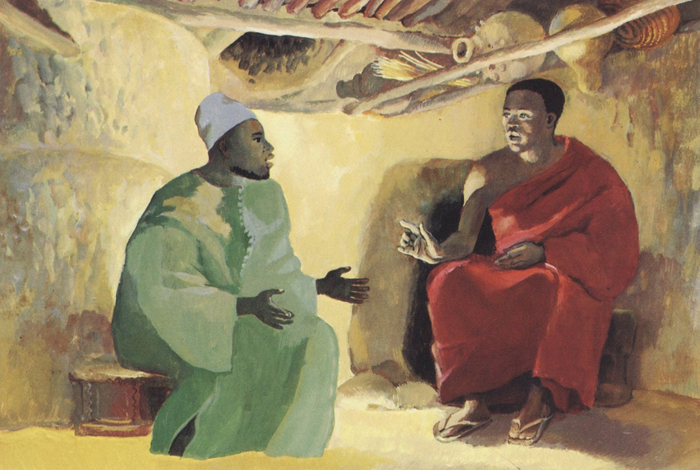
The following 1973 painting “Nicodemus” of the JESUS MAFA project is a response to New Testament readings from the Lectionary by a Christian community in Cameroon, Africa. Each of the readings was selected and adapted to dramatic interpretation by the community members. Photographs of their interpretations were made, and these were then transcribed to paintings:
Here we see Jesus patiently teaching about the kingdom of God to a perplexed Nicodemus, whose hands are in a gesture of questioning. Nicodemus has, like so many before and since, gotten caught up in the literal and limited understanding of the scriptures. Jesus attempted to explain the nature of reality in different terms that thereby he (and we) might be transformed. The boundaries we place on ourselves can be escaped if only we are brave enough to venture beyond them. Shall we remain in the cover of night with Nicodemus or step into the light that Jesus offers?
From Art in the Christian Tradition, a project of the Vanderbilt Divinity Library, Nashville, TN. Image retrieved March 23, 2026. Original source: librairie-emmanuel.fr.
“In Thai society, those who are possessed by evil spirits are usually the weak or mentally unstable. This man is shown as freed from his spiritual and physical chains. Even though he is naked Jesus is not ashamed to be close to him.”
“Jesus is dressed in a different style of clothing than the style of the woman who is shown as a Lanna Thai northerner. It is unusual for him to talk to a person from a different region, especially a woman. The clothes, the roof of the house in the background, and the dipper for water all indicate that this is in northern Thailand.”