Hand colored stencil print on momigami by Sadao Watanabe (1981).
Image taken with permission from the SadaoHanga Catalogue where you can find many more images and information about Sadao Watanabe. For other images of Sadao Watanabe art works in TIPs, see here.
Following is an illustration by Annie Vallotton:
Copyright by Donald and Patricia Griggs of Griggs Educational Service. More images can be viewed at rotation.org . For other images by Annie Vallotton on Translation Insights & Perspectives, see here.
Following is a painting by Ketut Lasia (b. 1945):
Ketut Lasia is one of the last traditional Balinese painters in the Ubud style. As an adult, Lasia converted from Hinduism to Christianity, and he paints primarily biblical scenes. You can find artwork from Ketut Lasia in a variety of formats for sale at Fine Art America .
Hand colored stencil print on momigami by Sadao Watanabe (1965).
Image taken with permission from the SadaoHanga Catalogue where you can find many more images and information about Sadao Watanabe. For other images of Sadao Watanabe art works in TIPs, see here.
Following is a painting by Xu Jihua 徐濟華 (1912-1937) (housed in the Société des Auxiliaires des Missions Collection – Whitworth University):
Image taken from Chinese Christian Posters . For more information on the “Ars Sacra Pekinensis” school of art, see this article , for other artworks of that school in TIPs, see here.
Hand colored stencil print on washi by Sadao Watanabe (1969).
Image taken with permission from the SadaoHanga Catalogue where you can find many more images and information about Sadao Watanabe. For other images of Sadao Watanabe art works in TIPs, see here.
The following is the image “Pentecost” by Sister Marie Claire , SMMI (1937–2018) from Bengaluru, India:
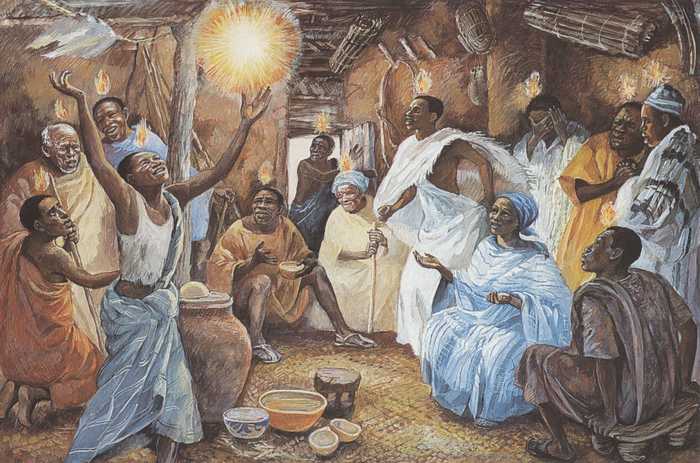
Following is a 1973 painting of the JESUS MAFA project, a response to New Testament readings from the Lectionary by a Christian community in Cameroon, Africa. Each of the readings was selected and adapted to dramatic interpretation by the community members. Photographs of their interpretations were made, and these were then transcribed to paintings:
The exuberant expression of joy in this depiction represents the Acts story, including Mary and the women mentioned in Acts, Chapter 1. Pentecost was originally an ancient Hebrew time of thanksgiving celebration for the first grain harvest, as recorded in Leviticus. The new significance given to this day by the gospel writers and early Christians extends that joyful expression to the new “filling up” by the Holy Spirit.
From Art in the Christian Tradition, a project of the Vanderbilt Divinity Library, Nashville, TN. Image retrieved March 23, 2026. Original source: librairie-emmanuel.fr.
Hand colored stencil print on washi by Sadao Watanabe (1970).
Image taken with permission from the SadaoHanga Catalogue where you can find many more images and information about Sadao Watanabe. For other images of Sadao Watanabe art works in TIPs, see here.
The following artwork is part of a series of 56 paintings on biblical themes by Kazakh artist Nelly Bube (born 1949):
The following is a stained glass window in the Sacred Heart Cathedral in Chiang Mai, Thailand:
Photo by Jost Zetzsche
Stained glass is not just highly decorative, it’s a medium which has been used to express important religious messages for centuries. Literacy was not widespread in the medieval and Renaissance periods and the Church used stained glass and other artworks to teach the central beliefs of Christianity. In Gothic churches, the windows were filled with extensive narrative scenes in stained glass — like huge and colorful picture storybooks — in which worshipers could ‘read’ the stories of Christ and the saints and learn what was required for their religious salvation. (Source: Victoria and Albert Museum )