
Click here to see the image in higher resolution.
Image taken from the Wiedmann Bible. For more information about the images and ways to adopt them, see here .
For other images of Willy Wiedmann paintings in TIPs, see here.

For more information on the Wiedmann Bible and the Wiedmann Bible Foundation, see wiedmannbible.org.

Image taken from the Wiedmann Bible. For more information about the images and ways to adopt them, see here .
For other images of Willy Wiedmann paintings in TIPs, see here.
Following is a hand colored stencil print on momigami by Sadao Watanabe (1980):

Image taken with permission from the SadaoHanga Catalogue where you can find many more images and information about Sadao Watanabe.
For other images of Sadao Watanabe art works in TIPs, see here.

Image taken from the Wiedmann Bible. For more information about the images and ways to adopt them, see here . For other images of Willy Wiedmann paintings in TIPs, see here.
Following is a contemporary tempera / gouache on leather painting by an unknown Ethiopian artist:

Source: Sacred Art Pilgrim website .
Following is a painting (“Annunciation”) by He Qi:
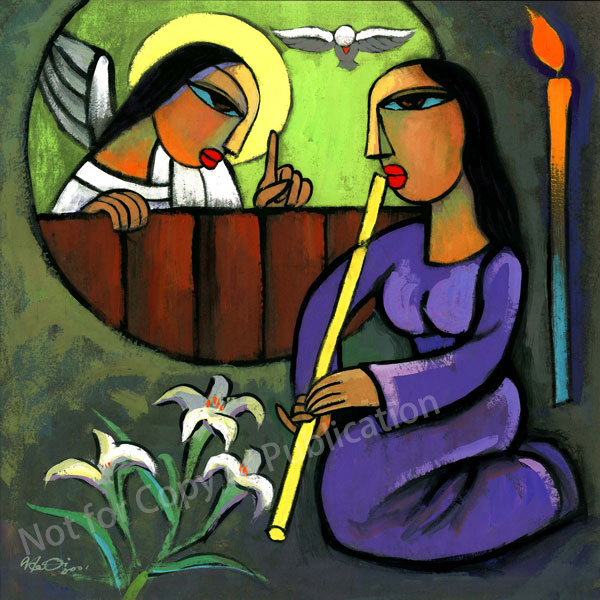
Image taken from He Qi Art . For purchasing prints of this and other artworks by He Qi go to heqiart.com . For other images of He Qi art works in TIPs, see here.
Following is an artwork by Sister Marie Claire , SMMI (1937–2018) from Bengaluru, India:

(Note that supernatural beings are always portrayed with this type of upraised scarf and white circle.)
For more information about images by Sister Marie Claire and ways to purchase them as lithographs, see here . For other images of Sister Marie Claire paintings in TIPs, see here.
The following is a contemporary stained glass window from Our Lady of Pity in Swaffham, United Kingdom:

Source: Art in the Christian Tradition , a project of the Vanderbilt University Divinity Library, Nashville, TN. Original source: Wikimedia
Stained glass is not just highly decorative, it’s a medium which has been used to express important religious messages for centuries. Literacy was not widespread in the medieval and Renaissance periods and the Church used stained glass and other artworks to teach the central beliefs of Christianity. In Gothic churches, the windows were filled with extensive narrative scenes in stained glass — like huge and colorful picture storybooks — in which worshipers could ‘read’ the stories of Christ and the saints and learn what was required for their religious salvation. (Source: Victoria and Albert Museum )

Image taken from the Wiedmann Bible. For more information about the images and ways to adopt them, see here .
For other images of Willy Wiedmann paintings in TIPs, see here.
Following is the 1973 painting “The Possessed” of the JESUS MAFA project, a response to New Testament readings from the Lectionary by a Christian community in Cameroon, Africa. Each of the readings was selected and adapted to dramatic interpretation by the community members. Photographs of their interpretations were made, and these were then transcribed to paintings:
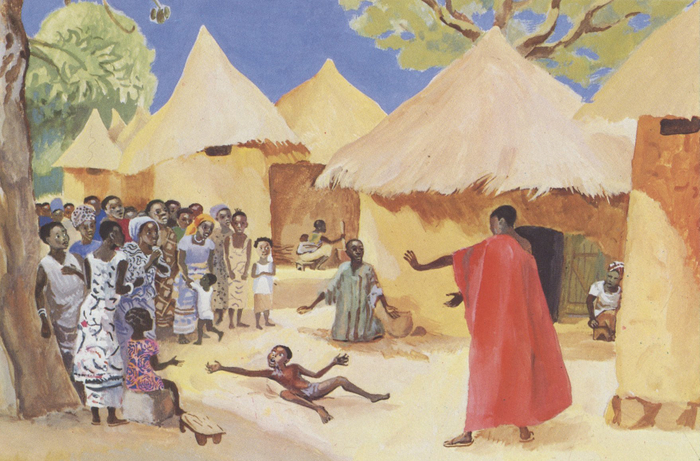
From Art in the Christian Tradition , a project of the Vanderbilt Divinity Library, Nashville, TN. Image retrieved March 23, 2026. Original source: librairie-emmanuel.fr.

Click here to see the image in higher resolution.
Willy Wiedmann, the artist, commented on this picture: “In spite of some difficulty, and unlike Leonardo da Vinci [see here ] I did not set my last supper in a theatrical scene with Jesus in the center behind an elongated table with all the disciples, with two at each end so that that there are 11 seated behind the table. And not like the panel by Juan de Juanes (1623-79) [see here ] in which the six disciples left and right are very dynamic figures. And also not like Martin Schongauer’s Last Supper [see here ] with a slightly shorter table (also incidentally very similar to Juanes in the attitudes of the figures) and two figures seen from the back in the foreground of the panel. Instead I have given the Master the middle place to the foreground, with his back to us to finally leave the controversial Jesus-existential questions unanswered. Slightly symbolically it means that he is leaving his world. The iris color is meant to transfer the rainbow to Jesus, that God once linked to Noah (my kingdom is not of this world). I attempted to present answers that correspond to the characters of each individual.”
Image and text taken from the Wiedmann Bible. For more information about the images and ways to adopt them, see here .
For other images of Willy Wiedmann paintings in TIPs, see here.
Following is a painting by Wang Suda 王肅達 (1910-1963):

Text under painting translated from Literary Chinese into English:
Beginning of the Holy Communion
You have this as food and this is my body.
Image taken from Chinese Christian Posters . For more information on the “Ars Sacra Pekinensis” school of art, see this article , for other artworks of that school in TIPs, see here.
Following is an acrylic on canvas painting by Hanna-Cheriyan Varghese:

Used with permission by the Overseas Ministries Study Center (OMSC) at Princeton Theological Seminary. You can purchase this and many other artworks by artists in residence at the OSMC in high resolution and without a watermark via the OSMC website .
“Hanna-Cheriyan Varghese (1938 – 2009) of Selangor, Malaysia, was the artist in residence at OMSC for the 2006–2007 academic year. She was born to Christian parents, and she remembered her mother taking her to a different worship service every week: ‘My parents encouraged me to attend different churches so that my siblings and I would appreciate the liturgy and traditions of the Christian believers of different denominations. Christians are a minority in Malaysia so we continue to struggle for our identity in a Muslim society. There is no open conflict as such.’
“She always had a passion for painting and drawing. She worked in the mediums of acrylic paint and Batik dye.
“‘All creative work, be it the spoken word, the written word or the sung word, are essentials in praise and worship, meditation, education, inculturation and evangelism. This also includes art and pictures, which is universal seeing.’ Hanna Varghese.” (Source )
See also the last supper (icon) and We All are One in Christ.


