The term that is transliterated as “Mary Magdalene” in English is translated in American Sign Language with a sign signifying 7 demons having gone out, referring to Luke 8:2. (Source: Ruth Anna Spooner, Ron Lawer)
“Mary Magdalene” in American Sign Language, source: Deaf Harbor
The following is a stained glass window in the All Saints’ Church, Highgate, London, of the late 19thy century:
Photo by John Salmon, hosted by Wikimedia Common under the Creative Commons Attribution-Share Alike 2.0 Generic license
Stained glass is not just highly decorative, it’s a medium which has been used to express important religious messages for centuries. Literacy was not widespread in the medieval and Renaissance periods and the Church used stained glass and other artworks to teach the central beliefs of Christianity. In Gothic churches, the windows were filled with extensive narrative scenes in stained glass — like huge and colorful picture storybooks — in which worshipers could ‘read’ the stories of Christ and the saints and learn what was required for their religious salvation. (Source: Victoria and Albert Museum )
The Greek that is translated as “see the tomb” or similar in English is translated in the Pfälzisch translation by Walter Sauer (publ. 2012) colloquially as ans Grab hiegange und wollde nooch em Rechde gugge or “went to the tomb to check whether everything is OK.” (Source: Zetzsche)
Orthodox Icons are not drawings or creations of imagination. They are in fact writings of things not of this world. Icons can represent our Lord Jesus Christ, the Virgin Mary, and the Saints. They can also represent the Holy Trinity, Angels, the Heavenly hosts, and even events. Orthodox icons, unlike Western pictures, change the perspective and form of the image so that it is not naturalistic. This is done so that we can look beyond appearances of the world, and instead look to the spiritual truth of the holy person or event. (Source )
For purchasing artworks by Kateryna Shadrina go to IconArt Gallery .
In Gbaya, the notion of early morning is emphasized with the ideophone sút as in the referenced verses.
Ideophones are a class of sound symbolic words expressing human sensation that are used as literary devices in many African languages. (Source: Philip Noss)
The following is a stained glass window from 1855 by artist H. Beiler over the altar of the Evangelische Stadtkirche Bad Rappenau, Bad Rappenau, Germany:
Photo by Llez, hosted by Wikimedia Commons under a Creative Commons Attribution-Share Alike 3.0 Unported license
Stained glass is not just highly decorative, it’s a medium which has been used to express important religious messages for centuries. Literacy was not widespread in the medieval and Renaissance periods and the Church used stained glass and other artworks to teach the central beliefs of Christianity. In Gothic churches, the windows were filled with extensive narrative scenes in stained glass — like huge and colorful picture storybooks — in which worshipers could ‘read’ the stories of Christ and the saints and learn what was required for their religious salvation. (Source: Victoria and Albert Museum )
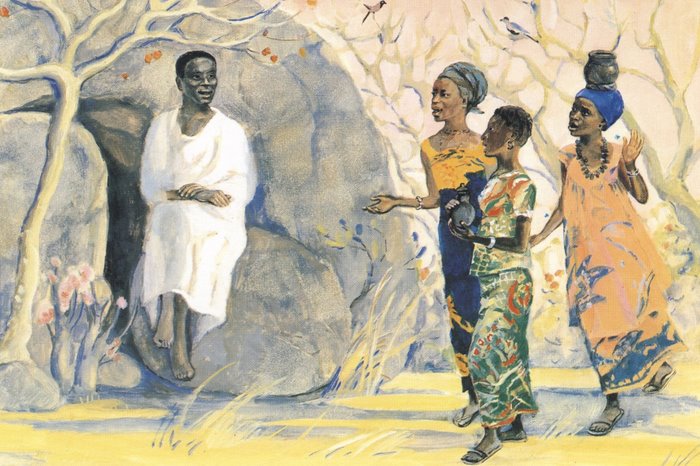
Following is a 1973 painting of the JESUS MAFA project, a response to New Testament readings from the Lectionary by a Christian community in Cameroon, Africa. Each of the readings was selected and adapted to dramatic interpretation by the community members. Photographs of their interpretations were made, and these were then transcribed to paintings:
From Art in the Christian Tradition, a project of the Vanderbilt Divinity Library, Nashville, TN. Image retrieved March 23, 2026. Original source: librairie-emmanuel.fr.
The Hebrew, Ge’ez, and Greek that is translated as “Sabbath” in English is rendered as “day we rest” in Tzotzil, in Mairasi as “Jew’s Rest Day,” in Quiotepec Chinantec as “day when people of Israel rested,” in Shilluk as “day of God,” in Obolo as Usen Mbuban or “Holy Day,” and in Mandarin Chinese as ānxírì (安息日) or “rest day” (literally: “peace – rest – day”). (Sources: Tzotzil: Marion Cowan in Notes on Translation with Drill, p. 169ff; Mairasi: Enggavoter 2004; Quiotepec Chinantec: B. Moore / G. Turner in Notes on Translation 1967, p. 1ff.; Shilluk: Nida 1964, p. 237; Obolo: Enene Enene; Chinese: Jost Zetzsche)
In Matumbi it is translated as Sabato ya Ayahudi or “Sabbath of the Jews,” to distinguish it from the Islamic Sabbath (which is Friday) or the Christian Sabbath (which is Sunday). (Source: Pioneer Bible Translators, project-specific notes in Paratext)
In the old Khmer version as well as in the first new translation this term was rendered as “day of rest” (Thngai Chhup Somrak / ថ្ងៃឈប់សំរាក). Considered inadequate to convey its religious meaning (not only about cessation of work, but also in honor of Yahweh as the Creator), the committee for the Today’s Khmer Version (publ. 2005) decided to keep the Hebrew word and use its transliterated form Thgnai Sabath (ថ្ងៃសប្ប័ទ). “The Buddhist word Thngai Seil ‘day of merits’ used by some Catholics was once under consideration but was rejected because it did not receive unanimous support.” (Source: Joseph Hong in The Bible Translator 1996, p. 233ff. )
In Spanish, the translation is either día de reposo (“day of rest”) or sábado (usually: “Saturday,” derived from the Greek and Hebrew original). Nida (1947, p. 239f.) explains that problem for Spanish and other languages in its sphere of influence: “In translation ‘Sabbath’ into various aboriginal languages of Latin America, a considerable number of translators have used the Spanish sábado, ‘Saturday,’ because it is derived from the Hebrew sabbath and seems to correspond to English usage as well. The difficulty is that sábado means only ‘Saturday’ for most people. There is no religious significance about this word as the is with ‘Sabbath’ in English. Accordingly the [readers] cannot understand the significance of the persecution of Jesus because he worked on ‘Saturday.’ It has been found quite advantageous to use the translation ‘day of rest,’ for this accurately translated the Hebrew meaning of the term and resolves the problem in connection with the prohibitions placed upon some types of activities.”
In the Nueva traducción viviente translation (2010) it día de descanso al mantenerlo santo (“day of rest to keep it holy”). (Source: Lénart de Regt in The Bible Translator 2017, p. 131ff. )
In French Sign Language it is translated with a sign that depicts closing of the blinds of a store:
Following are a number of back-translations of Matthew 28:1:
Uma: “After the worship day was passed, before the sun appeared on Sunday, Maria Magdalena and the other Maria went to look at the grave.” (Source: Uma Back Translation)
Yakan: “When the Saturday was over, the day of-no-work, very early on Sunday, Mariyam, the woman from Magdala, and her namesake went to look at the grave.” (Source: Yakan Back Translation)
Western Bukidnon Manobo: “After the Day of Rest when it was about to dawn on the day Sunday, Mary Magdalene and her companion whose name was Mary also, they went to the burial place because they will see the cave.” (Source: Western Bukidnon Manobo Back Translation)
Kankanaey: “When the day for-resting was finished and it was getting-light on Sunday, Maria Magdalena and her namesake Maria went to go see Jesus’ burial place.” (Source: Kankanaey Back Translation)
Tagbanwa: “When the Day of Rest had passed, when it was very early morning on Sunday, Maria Magdalena went to check on the grave of Jesus, her companion being another Maria.” (Source: Tagbanwa Back Translation)
Tenango Otomi: “The day of rest passed. The day of Sunday dawned, the first day of the week. Mary, the native of Magdala and the other Mary went to see the tomb.” (Source: Tenango Otomi Back Translation)





Leave a Reply
You must be logged in to post a comment.