Housed in the Société des Auxiliaires des Missions Collection – Whitworth University
Image taken from Chinese Christian Posters . For more information on the “Ars Sacra Pekinensis” school of art, see this article , for other artworks of that school in TIPs, see here.
Following is an artwork by Sister Marie Claire , SMMI (1937–2018) from Bengaluru, India:
For more information about images by Sister Marie Claire and ways to purchase them as lithographs, see here . For other images of Sister Marie Claire paintings in TIPs, see here.
The Greek that is typically translated in English as “manger” is translated in Mbe as édzábri, the term used for “old worn-out baskets that isn’t usable anymore, except to feed the animals.”
John Watters (in Wycliffe Bible Translators 2016, p. 19) tells the story how this word was chosen:
“In Nigeria, the Mbe translation team was translating the Gospel of Luke. They came to chapter 2, verse 7, which says, ‘She [Mary] gave birth to her firstborn son. She wrapped him snugly in strips of cloth and laid him in a manger, because there was no lodging available for them.’
“The translators took the time to ponder how to to translate some of the words, but not ‘manger.’ They immediately used the word ókpáng.
“As their translation consultant, I asked them, ‘What’s an ókpáng? Tell me what it looks like.’ One of the translators drew a picture on the whiteboard. It was essentially a cradle hung by ropes so that the newborn could be laid in it and swung.
“I suggested they check the collection of notes and commentaries we were using to help the translators whose first language isn’t English. The Mbе translators saw that ‘manger’ referred to animal feeding trough.
“Even as the Mbe team read the notes, they objected. ‘We have always used the word ókpáng. We have used it for years, and that’s what we should use.’ I pointed out to them that it wasn’t just a matter of tradition. God expects us to find the words that express the original meaning as accurately as possible. Furthermore, this word tells us something profound about God.
“‘When he came to live among us and bring salvation to us, he came in the lowliest way possible. He did not come and sleep in a nice ókpáng like every Mbe mother wants for her newborn. Instead, he showed us his unbelievable humility,’ I told them. ‘So we need to find your best word for an animal-feeding trough.’
“Suddenly the person who had argued most loudly for the traditional term offered, ‘We feed our animals out of an old worn-out basket that isn’t usable anymore, except to feed the animals. We call it édzábri!’
“‘Then try that term,’ I said.
As the Mbe people listened, they were visibly moved. Picturing the newborn baby lying in the animals’ feeding basket, they recognized in a new way that Jesus was willing to do whatever it took to reach them. As an adult, he would humble himself by washing the disciples’ feet and then by dying on the cross. And this humility started right from birth, when he was born to a young peasant woman under questionable social conditions and laid in an animal-feeding trough.”
The name that is transliterated as “Joseph” in English is translated in Finnish Sign Language with the sign signifying “woodworker” (referring to Mark 6:3). (Source: Tarja Sandholm)
There are three different levels of speech in Burmese: common language, religious language (addressing and honoring monks, etc.), and royal language (which is not in active use anymore). Earliest Bible translations used exclusively royal and religious language (in the way Jesus is addressed by others and in the way Jesus is referred to via pronouns), which results in Jesus being divine and not human. Later editions try to make distinctions.
In the Common Language Version (publ. 2005) the human face of Jesus appears in the narrative of the angel’s message to Joseph and what Joseph did in response (Matthew 1:21-25). The angel told Joseph that Mary was going to give birth to a son, not a prince.
Likewise in Luke 2:6-7 the story of Jesus’ birth in Bethlehem is told simply using the Common language. Again in the description of the shepherds’ visit to the baby Jesus (Mark 1:21-25), in the story of Jesus’ circumcision (Luke 2:6-2:7), and in the narrative of the child Jesus’ visit to Jerusalem (Luke 2:46-51), the human face of Jesus comes to the forefront.
On the other hand, the child Jesus is clearly depicted as a royal or a divine child in the story of the wise men (Matthew 2:9-12), the story of the flight to Egypt (Matthew 2:13-14), and the return to Nazareth (Matthew 2:20-21).
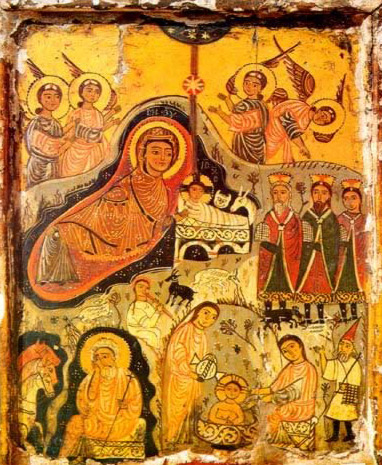
Following is an early specimen of the traditional Orthodox iconography depicting the Nativity. This Greek Orthodox icon is from the 6th century (found in the monastery of St. Catherine in Sinai):
Orthodox Icons are not drawings or creations of imagination. They are in fact writings of things not of this world. Icons can represent our Lord Jesus Christ, the Virgin Mary, and the Saints. They can also represent the Holy Trinity, Angels, the Heavenly hosts, and even events. Orthodox icons, unlike Western pictures, change the perspective and form of the image so that it is not naturalistic. This is done so that we can look beyond appearances of the world, and instead look to the spiritual truth of the holy person or event. (Source )
Tibbs (2025, p. 51ff.) analyzes about the nativity icon Click or tap here to see the analysis:
In Western Christianity (Protestant and Roman Catholic), the Cross is often viewed as the central focus of Christ’s redemptive work. However, the Bible emphasizes that the significance of Christ’s coming predates the Cross and reaches into eternity. Centuries before His birth, the prophets foretold that the Son of God would enter the world as a human, carried in a woman’s womb. (…) The Icon of the Nativity also portrays representatives from different walks of life, each rendering a unique offering to the newborn King.
The ancient Christian tradition holds that Mary and Joseph were sheltered in something like a cave for the night. This is consistent with the earliest examples of the Nativity Icon (such as the sixth¬ century icon from Sinai) in which Mary and the Christ Child are shown in a cave of a mountain. The familiar A-frame shelter of contemporary Christmas cards did not appear in the religious art of the Nativity until around the late twelfth century in the Roman Catholic West. All versions of the Orthodox Icon of the Nativity of Christ, however, are set in a cave on a mountain, following the earliest tradition.
Bethlehem is hilly, at about 2,500 feet above sea level, but it is not as mountainous as suggested by the prominence of the mountain range in the Icon of the Nativity of Christ. The mountains in this icon represent more than natural geology. The mountain is often the place in Scripture where a theophany (an appearance or manifestation of God) occurs. Consider Moses’s or Elijah’s encounters with God on Mount Sinai. Moses encountered the Lord, the “I AM,” in the burning bush at the top of Mount Sinai (Exodus 3:14). God told Elijah to climb Mount Horeb (another name for Mount Sinai), where he heard God’s still small voice (1 Kings 19:11-12). (…)
Mary’s importance cannot be overstated: she has given birth to the Savior of the universe. Mary therefore occupies a central place in this icon. Her size and placement illustrate the iconographic technique of hierarchical perspective, in which importance is indicated by both position and size. She is shown outside the opening of the cave, reclining on a cot. It is likely that travelers would have brought a bed similar to this with them on their journey, which would hang from posts provided by the inn. Mary is looking away from the child she has just borne, appearing calm and meditative. As Luke recounts: “Mary kept all these things and pondered them in her heart” (Luke 2:19).
The Christ Child is shown at the center of the icon and is depicted as the brightest element, receiving focus from the rays extending from the heavenly star. He is shown wrapped in swaddling clothes and lying in a manger, as indicated in Luke 2:7. This manger, typically a feeding trough for animals, forms another notable example of the altered perspective technique in icons. It employs an inverse perspective, where the lines from the manger converge forward toward the viewer, in contrast to the convention used in typical naturalistic art. Furthermore, the baby and crib are often shown as if looking down from above, while everything else is represented from a front-facing viewpoint. The reason for the alteration of perspectives, as in all iconography, is to establish the historical setting of the event while simultaneously removing the temporal and physical boundaries of the event. In a way, the icon adds something like a fourth dimension, which is a glimpse into its cosmic reality. (…) Jesus’s bed in this icon appears nothing like a traditional crib. For that matter, it also looks nothing like a traditional manger! But it is actually a very important clement of this icon that conveys the profound and cosmic realities of Christ’s death, burial, and Resurrection. To explain, let us fast-forward thirty-three years or so in the life of Christ. On the morning of the third day after Christ’s Crucifixion, women arrived at the tomb with myrrh and spices to anoint His body (Mark 16:1). [There is an] intentional similarity between the iconographic depictions of the cloths that wrapped the baby in the manger and the graveclothes left behind in the empty tomb.
Though the manger resembles a tomb, it should not be seen as a somber addition to the otherwise joyful Nativity scene. The significance lies not in the crib’s iconographic similarity to the tomb but rather in the way the swaddling clothes are wrapped around the baby Jesus. The swaddling clothes of the Nativity Icon prefigure the graveclothes left behind (Matthew 27:59; Luke 24:12). (…)
In most icons depicting the Nativity of Jesus Christ, an ox and a donkey are shown near the crib. However, these animals are not mentioned in the narratives of Christmas by either Luke or Matthew. This leads to questions regarding why they are portrayed at all, and why they are positioned so close to the baby Jesus. This curiosity allows us to remember that icons usually do not include elements that are unrelated to the biblical truth, prompting a further exploration of their significance. As it happens, these two animals hold considerable importance in the grand narrative of the arrival of Israel’s Messiah. In a way, the presence of these two humble animals shown together speaks volumes about the true message of Christ’s gospel!
The Prophet Isaiah was granted a vision of the coming of the Messiah and prophetically announced that His coming would be recognized by these two animals: “The ox knows its owner, / And the donkey its master’s crib; / But Israel does not know, / My people do not consider” (Isaiah 1:3). These animals symbolize the prophecy of the Messiah’s coming and the rejection He will suffer as the suffering servant of God.
The imagery of Jesus as the Prince of Peace in the Nativity Icon finds its roots in the placement of the ox and the donkey together. This association would have been scandalous to observant Jews, in direct conflict with a specific Mosaic law that explicitly prohibited the pairing of ox and donkey: “You shall not plow with an ox and a donkey together” (Deuteronomy 22:10). According to the dietary and ritual cleanliness laws outlined in the Old Testament, the ox is considered to be a “clean” animal, while the donkey is classified as “unclean.” Per these laws, clean and unclean were never to be in close proximity to one another. (…) This same emphasis is the intended symbolism in the Nativity Icon: the ox represents Jews, while the donkey represents Gentiles. The presence of both animals together signifies that this baby has the power to bring these two estranged groups together in peace and harmony. Understanding the symbolism of the seemingly inconsequential pairing of two animals reveals a profound significance: the coming together of the clean and unclean (from a Jewish perspective) in worship of the Christ. (…)
Because Israel’s shepherds lived out in the fields, keeping watch over their flocks (Luke 2:8), they could not keep the details of the Jewish ceremonial law such as handwashing and other rules. Even though they were often shunned by many religious Jews of their time, God determined that these simple men of the fields should be the first to receive the message of His Son’s birth. There is also something of a perfect symmetry here, since those who cared for the lambs will become the first to worship the pure “Lamb of God” (John 1:29).
At first, a single angel appeared to convey the “good tidings of great joy” to the shepherds, and then a multitude of angels followed (Luke 2:9-13). The single angel is usually depicted on the right side of the icon, bending down toward the shepherds, while the multitude of the heavenly host is portrayed at the top. In many icons, one choir of angels is portrayed facing downward, delivering good news and attending to the earthly events, while another grouping is depicted facing upward, praising God. Additionally, certain icons include a shepherd playing a flute, through which human art (music) is added to the praises of the angels.
Why does the icon portray Joseph as being so far from Mary and the baby Jesus, and why does he appear so elderly? Let us first remember how Jesus came to be the child of Mary: “The Holy Spirit will come upon you, and the power of the Highest will over¬shadow you; therefore, also, that Holy One who is to be born will be called the Son of God” (Luke 1:35). Very simply, Jesus does not have an earthly biological father. For this reason, we will find nothing like the concept of a Holy Family in the New Testament, nor in the early Apostolic and Patristic writings, nor in the Eastern Orthodox Christian tradition, either then or now.
Although Joseph was certainly an important figure in the Nativity story, he was not Jesus’s biological father. This is the primary reason why Joseph is shown far away from the main activity of the Nativity Icon. His contribution to the birth of God’s Son was as guardian and protector of Mary and Jesus. (…)
The “wise men,” as they are often called, are usually shown in icons opposite the shepherds, and most often on the left side. They are opposite the shepherds in many ways. The shepherds came immediately to the child as soon as they heard the news of His birth. The wise men, however, took a circuitous route through study of the stars and a detour to meet with “Herod the King” (Matthew 2:1). The Greek in Matthew’s Gospel is very specific, however, that these were not actually “wise men” at all, but magi, a particular class of Median and Persian priests who had a reputation in the Greek-speaking world for astrology and interpretation of dreams. (…) This specific group of magi are typically rendered in the icon either as walking or on horses. They are also usually shown as various ages — one older, one younger, one in the middle. More than likely, the visit of the magi from Matthew’s Gospel was a separate event, happening several months, if not a year or two, after Jesus’s birth. (…)
The magi in the Nativity story and in the icon have multiple layers of significance. The magi were outcasts from the Jewish religious system due to their Gentile status and association with astrology and sorcery. Despite this, they undertook a lengthy journey to find the newborn Messiah, an act that contrasts sharply with Herod’s evil intentions. In the end, upon finding the child, they worshiped Him (Matt. 2:11). It is an example of something like divine symmetry, that the magi, who gained insights from the skies, were in a way “taught by a star” to worship the true “Sun of Righteousness.” (…) The narrative surrounding the magi underscores the universal appeal of the Savior’s birth and the profound impact it had on those who were traditionally marginalized or at odds with the existing religious and political power structures. They are prominently included in the Icon of the Nativity as a powerful testament to the inclusive nature of the gospel of Jesus Christ and the transformative power of encountering Him.
[Lastly,] the so-called “washing” or “bathing” scene. In the corner opposite Joseph, two women are depicted. One of them appears older than the other and holds the naked baby Jesus in her lap. She is ready to wash Him in the basin of water in front of her. The younger woman stands next to the basin pouring water into it. The fact that Jesus is shown twice in the same icon is characteristic of the absence of the passing of natural time.
The washing scene began to appear in painted icons as early as the sixth century and perhaps even earlier. Most contemporary icons of the Nativity of Christ will include the washing scene. Nothing like this is mentioned in the New Testament, however. Nevertheless, the reason for including it is scriptural, which is simply to emphasize the Incarnation — Jesus becoming human. The main theological point is that Jesus became like us in every way yet without sin. Jesus condescended to this human custom of washing after birth, just as He condescended to circumcision on the eighth day after His birth, and to baptism by John in the Jordan River, even though He had no sins to be cleansed.
Following are two less traditional depictions. The first is a Macedonian Orthodox icon of the Nativity scene from 1865 (found in Saint George Church in Kočani, North Macedonia).
Following are a number of back-translations of Luke 2:16:
Noongar: “They hurried away and came to Mary and Joseph. They saw the baby. He was lying in the food container.” (Source: Warda-Kwabba Luke-Ang)
Uma: “They went, they indeed did find Maria and Yusuf, with their baby that was sleeping in a manger.” (Source: Uma Back Translation)
Yakan: “So-then they hurried there and they found Mariyam and Yusup, and the child was there laid in the box for feeding animals.” (Source: Yakan Back Translation)
Western Bukidnon Manobo: “And then they left and came in a hurry, and arrived to Joseph and Mary, and they saw also the baby that had been laid down in the feeding-place of the horse.” (Source: Western Bukidnon Manobo Back Translation)
Kankanaey: “Then they hurried to go, and they came-upon Maria and Jose and the baby laid-down in the eating-place of the animals.” (Source: Kankanaey Back Translation)
Tagbanwa: “After they had discussed that, they hurried going there. They found Maria and Jose together with that baby who was lying there in the animal feeder.” (Source: Tagbanwa Back Translation)
In American Sign Language it is translated with a sign for the letter M and the sign for “virgin,” which could also be interpreted as “head covering,” referring to the way that Mary is usually portrayed in art works. (Source: Ruth Anna Spooner, Ron Lawer)
“Mary” in American Sign Language, source: Deaf Harbor
In Hungarian Sign Language the sign is based on historical images, referring to the veil covering her head: the earliest depictions of Mary (dating back to the 2nd century) already portray her wearing a headscarf or a veil. Its sign in sign language refers to the veil because, within Christian culture, this is her most recognizable visual attribute, distinguishing her from other biblical figures. (Source: Jenjelvi Biblia and HSL Bible Translation Group)
In some Semitic languages, the transliteration for “Mary” is identical to the one for the prophetess “Miriam,” testifying to the fact that these names are identical (Arabic and the many translations that are reliant on Arabic: مَرْيَم, Hebrew: מִרְיָם, Ge’ez / Amharic and related languages: ማርያም).





Leave a Reply
You must be logged in to post a comment.