
In Kuy the term the woman uses for what is translated in English as “sir” implies that she was older than Jesus (see verse 4:11), and the term Jesus uses for what is translated in English as “woman” in verse 4:21 reflects this, as he addresses her as “younger aunt.”
worship
The Hebrew, Aramaic, Ge’ez, and Greek terms that are often translated as “worship” (also, “kneel down” or “bow down”) are likewise translated in other languages in certain categories, including those based on physical activity, those which incorporate some element of “speaking” or “declaring,” and those which specify some type of mental activity.
Following is a list of (back-) translations (click or tap for details):
- Javanese: “prostrate oneself before”
- Malay: “kneel and bow the head”
- Kaqchikel: “kneel before”
- Loma (Liberia): “drop oneself beneath God’s foot”
- Tepeuxila Cuicatec: “wag the tail before God” (using a verb which with an animal subject means “to wag the tail,” but with a human subject)
- Tzotzil: “join to”
- Kpelle: “raise up a blessing to God”
- Kekchí: “praise as your God”
- Cashibo-Cacataibo: “say one is important”
- San Blas Kuna: “think of God with the heart”
- Rincón Zapotec: “have one’s heart go out to God”
- Tabasco Chontal: “holy-remember” (source of this and all above: Bratcher / Nida)
- Bariai: “lift up God’s name” (source: Bariai Back Translation)
- Q’anjob’al: “humble oneself before” (source: Newberry and Kittie Cox in The Bible Translator 1950, p. 91ff. )
- Alur: rwo: “complete submission, adoration, consecration” (source: F. G. Lasse in The Bible Translator 1956, p. 22ff. )
- Obolo: itọtọbọ ebum: “express reverence and devotion” (source: Enene Enene)
- Ngäbere: “cut oneself down before” (“This figure of speech comes from the picture of towering mahoganies in the forest which, under the woodman’s ax, quiver, waver, and then in solemn, thunderous crashing bury their lofty heads in the upstretched arms of the surrounding forest. This is the experience of every true worshiper who sees ‘the Lord, high and lifted up.’ Our own unworthiness brings us low. As the Valientes say, ‘we cut ourselves down before’ His presence. Our heads, which have been carried high in self-confidence, sink lower and lower in worship.)
- Tzeltal: “end oneself before God.” (“Only by coming to the end of oneself can one truly worship. The animist worships his deities in the hope of receiving corresponding benefits, and some pagans in Christendom think that church attendance is a guarantee of success in this life and good luck in the future. But God has never set a price on worship except the price that we must pay, namely, ‘coming to the end of ourselves.'”) (Source of this and the one above: Nida 1952, p. 163)
- Folopa: “die under God” (“an idiom that roughly back-translates “dying under God” which means lifting up his name and praising him and to acknowledge by everything one does and thanks that God is superior.”) (Source: Anderson / Moore, p. 202)
- Chokwe: kuivayila — “rub something on” (“When anyone goes into the presence of a king or other superior, according to native law and custom the inferior gets down on the ground, takes a little earth in the fingers of his right hand, rubs it on his own body, and then claps his hands in homage and the greeting of friendship. It is a token of veneration, of homage, of extreme gratitude for some favor received. It is also a recognition of kingship, lordship, and a prostrating of oneself in its presence. Yet it simply is the applicative form of ‘to rub something on oneself’, this form of the verb giving the value of ‘because of.’ Thus in God’s presence as king and Lord we metaphorically rub dirt on ourselves, thus acknowledging Him for what He really is and what He has done for us.”) (Source: D. B. Long in The Bible Translator 1952, p. 87ff. )
- In the German New Testament translation Fridolin Stier (1989) it is consistently translated as “bow (to someone) deeply” (tief verneigen)
In Luang it is translated with different shades of meaning:
- For Mark 15:19 and Matt. 2:8 and 2:11: “uh’idma-rrama llia’ara” — “to kiss the fingernail and lick the heel”
- For Acts 16:14: ra’uli-rawedi — “to praise-talk about”
- For Acts 14:15, 15:20, 17:16, 17:25: hoi-tani — “serve right hand – serve left”
- For Acts 13:16 and 13:26: una-umta’ata — “respect-fear”
- For 2 Thess. 2:4: kola tieru awur nehla — “hold waist – hug neck”
Source: Kathy Taber in Notes on Translation 1/1999, p. 9-16.
Jerusalem
The name that is transliterated as “Jerusalem” in English is signed in French Sign Language with a sign that depicts worshiping at the Western Wall in Jerusalem:
“Jerusalem” in French Sign Language (source: La Bible en langue des signes française )
While a similar sign is also used in British Sign Language, another, more neutral sign that combines the sign “J” and the signs for “place” is used as well. (Source: Anna Smith)
“Jerusalem” in British Sign Language (source: Christian BSL, used with permission)
Learn more on Bible Odyssey: Jerusalem .
He deliberately took time to draw near to social outcasts (image)

“Jesus is dressed in a different style of clothing than the style of the woman who is shown as a Lanna Thai northerner. It is unusual for him to talk to a person from a different region, especially a woman. The clothes, the roof of the house in the background, and the dipper for water all indicate that this is in northern Thailand.”
Drawing by Sawai Chinnawong who employs northern and central Thailand’s popular distinctive artistic style originally used to depict Buddhist moral principles and other religious themes; explanation by Paul DeNeui. From That Man Who Came to Save Us by Sawai Chinnawong and Paul H. DeNeui, William Carey Library, 2010. . For more images by Sawai Chinnawong in TIPs see here.
See also The woman at the well (image).
Learn more on Bible Odyssey: Woman at the Well .
The woman at the well
Following is a painting in the Hamzanama style:

The woman at the well, 2017-2018, Paul Abraham with Manish Soni, Opaque watercolour and natural pigments on hand-made paper, © Sarmaya Arts Foundation. (2018.33.5)
Following is a painting by Ketut Lasia (b. 1945):

Ketut Lasia is one of the last traditional Balinese painters in the Ubud style. As an adult, Lasia converted from Hinduism to Christianity, and he paints primarily biblical scenes. You can find artwork from Ketut Lasia in a variety of formats for sale at Fine Art America .
See also He deliberately took time to draw near to social outcasts (image).
The following artwork is part of a series of 56 paintings on biblical themes by Kazakh artist Nelly Bube (born 1949):
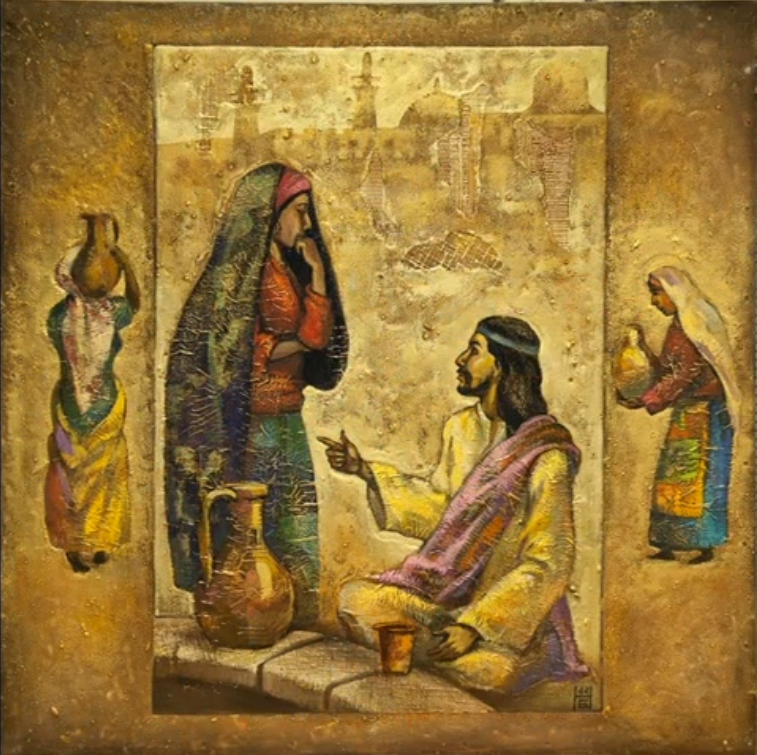
Copyright by Norwegian Bible Society , used with permission.
For other images of Nelly Bube in TIPs, see here.
complete verse (John 4:21)
Following are a number of back-translations of John 4:21:
- Uma: “Yesus said: ‘Believe these my words: The time will come, it will no longer be just in Yerusalem people worship God, also not at this mountain only.” (Source: Uma Back Translation)
- Yakan: “Isa said to her, ‘Woman, believe what I say. There will be a time in the future when people will worship our (incl.) God not here on this mountain or there in Awrusalam.” (Source: Yakan Back Translation)
- Western Bukidnon Manobo: “And Jesus said, ‘It is true, Woman, what I say to you that the time is coming that no longer again here only in this mountain or even there in Jerusalem will our (incl.) Father God be worshipped.” (Source: Western Bukidnon Manobo Back Translation)
- Kankanaey: “Whereupon Jesus said, ‘Mother (vocative for any older woman), you from-Samaria, you definitely don’t know God whom you are worshipping, but we (excl.) Jews by-contrast, we (excl.) know-(him), because the one who will save all people, he was born a Jew. Believe (sing.) (strong command particle) what I say now. In the time that will arrive, it will not be on this mountain and neither also in Jerusalem where-people -will-worship God the Father.” (Source: Kankanaey Back Translation)
- Tagbanwa: “Jesus answered her, saying, ‘Hopefully, Daughter, you will believe this which I will say. The time is now arriving when you (pl.) will worship Father God not only here on this hill or there in Jerusalem.” (Source: Tagbanwa Back Translation)
- Tenango Otomi: “Jesus said, ‘Believe me, woman. The time will come when you will worship the Father, but it will not be necessary that you come to this hill here nor to go there to Jerusalem.” (Source: Tenango Otomi Back Translation)
Father (address for God)
The Greek that is translated with the capitalized “Father” in English when referring to God is translated in Highland Totonac with the regular word for (biological) father to which a suffix is added to indicate respect. The same also is used for “Lord” when referring to Jesus. (Source: Hermann Aschmann in The Bible Translator 1950, p. 171ff. )
Like a number of other East Asian languages, Japanese uses a complex system of honorifics, i.e. a system where a number of different levels of politeness are expressed in language via words, word forms or grammatical constructs. These can range from addressing someone or referring to someone with contempt (very informal) to expressing the highest level of reference (as used in addressing or referring to God) or any number of levels in-between. In the widely-used Japanese Shinkaiyaku (新改訳) Bible of 2017, God the Father is addressed with mi-chichi (御父). This form has the “divine” honorific prefix mi– preceding the archaic honorific form chichi for “father.”
If, however, Jesus addresses his Father, he is using chichi-o (父を) which is also highly respectful but does not have the “divine” honorific. (Source: S. E. Doi, see also S. E. Doi in Journal of Translation, 18/2022, p. 37ff. )
See also Lord and my / our Father.
1st person pronoun referring to God (Japanese)
Click or tap here to see the rest of this insight.
Like a number of other East Asian languages, Japanese uses a complex system of honorifics, i.e. a system where a number of different levels of politeness are expressed in language via words, word forms or grammatical constructs. These can range from addressing someone or referring to someone with contempt (very informal) to expressing the highest level of reference (as used in addressing or referring to God) or any number of levels in-between.
One way Japanese shows different degree of politeness is through the choice of a first person singular and plural pronoun (“I” and “we” and its various forms) as shown here in the widely-used Japanese Shinkaiyaku (新改訳) Bible of 2017. The most commonly used watashi/watakushi (私) is typically used when the speaker is humble and asking for help. In these verses, where God / Jesus is referring to himself, watashi is also used but instead of the kanji writing system (私) the syllabary hiragana (わたし) is used to distinguish God from others.
(Source: S. E. Doi, see also S. E. Doi in Journal of Translation, 18/2022, p. 37ff. )
See also pronoun for “God”.
Leave a Reply
You must be logged in to post a comment.