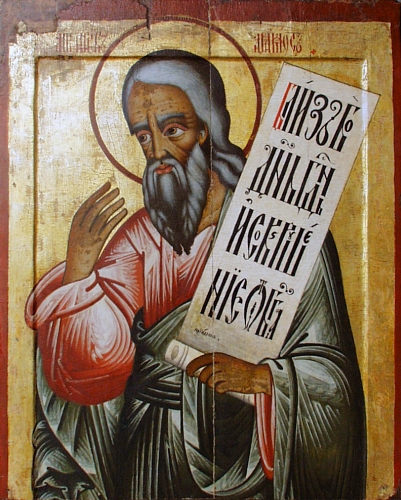
The Hebrew, Latin, and Greek that is transliterated as “Joel” in English means “LORD of God,” “the LORD is God,” “the LORD is might.” (Source: Cornwall / Smith 1997 )
In Spanish Sign Language it is translated in two different ways. The first is with a sign depicting “Pentecost flame,” referring to Peter’s speech on Pentecost in which he quotes Joel in Acts 2:16 and following. (Source: Steve Parkhurst)
First translation of “Joel” in Spanish Sign Language, source: Sociedad Bíblica de España
The second is with a sign for “grasshopper,” referring to Joel 1:4 and Joel 2:25.
Second translation of “Joel” in Spanish Sign Language, source: Sociedad Bíblica de España
See also locust (different kinds in Joel 1:4 and 2:25).
In Swiss-German Sign Language it is translated with a sign that depicts to tear ones’ heart, referring to Joel 2:13.
“Joel” in Swiss-German Sign Language, source: DSGS-Lexikon biblischer Begriffe , © CGG Schweiz
In Hungarian Sign Language it is translated with a sign that refers to the fact that God’s message, through the prophet, was perceived and proclaimed in the widest possible scope (see Joel 2:28). (Source: Jenjelvi Biblia and HSL Bible Translation Group)
“Joel” in Hungarian Sign Language — note that only the first part refers to “Joel,” the second and third parts refer to “prophet” and “book” (source )
For more information on translations of proper names with sign language see Sign Language Bible Translations Have Something to Say to Hearing Christians .
More information on Joel (prophet) .