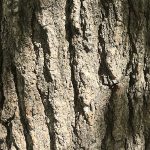
broom tree

A number of scholars identify rothem as the White Broom Retama raetam, a tough desert shrub found in the Holy Land and Arabia. Earlier, Moldenke (Plants of the Bible. Chronica Botanica. Ronald Press, 1952) contended that rothem refers to a parasitic plant called dog’s club. In the story of Elijah’s flight from Jezebel, the mention of the broom tree in 1 Kings 19:4 provides detail to the image of desolation brought to mind by the word “wilderness” earlier in the verse. The references to rothem in Psalm 120:4 (“. . . with glowing coals of the broom tree”) and Job 30:4 (“. . . and to warm themselves the roots of the broom”) have led scholars to conclude that it is indeed the broom shrub, since it makes a very hot fire, due to the oil in the stems and leaves. The place name Rithmah (“place of rothem”) referred to in Numbers 33:18f. may also refer to the broom. The white broom is found on hills, rocky places, ravines and sandy places throughout the Holy Land, especially near the Dead Sea, in Gilead, on Mount Carmel, in the Syrian desert, and on the Phoenician coast.

The white broom, which is more of a large bush than a shrub, can reach a height of 2 meters (7 feet). It has many small branches, few leaves, and clusters of white flowers that make the shrub a beautiful sight on a hillside.

In 1 Kings 19:4 the New Jerusalem Bible renders rothem as “furze bush,” also known as “gorse,” in an attempt to use a name known to English gardeners, but neither “gorse” nor “furze” are familiar to botanically ignorant city-dwellers of the twenty-first century. Hence, some modern versions use a generic term in 1 Kings, such as “large bush” (Contemporary English Version), “tree” (Good News Bible, and “bush” (New Century Version). In areas where plants are still known by species names, translators can select a shrub that grows in dry, barren areas (assuming it is big enough to offer shade), or transliterate from the Hebrew (rothem) or a major language (for example, retem in Arabic). Otherwise, they can use “small tree” or “shrub.”

In Psalm 120:4 a local kind of wood that produces a very hot fire could be used, since the text is rhetorical, and needs an image of something very hot.

The reference to broom in Job 30:4 poses major textual and exegetical problems, which explains the variety of renderings in modern Bibles. New Revised Standard Version, updated edition reads “they pick mallow and the leaves of bushes, and to warm themselves the roots of the broom.” Good News Bible and the New International Version have these poor folk eating the roots of the broom tree. However, reliable sources tell us that the root of the broom tree is poisonous. That is why Moldenke suggested that it must be another plant, namely the parasite Dog’s Club Cynomorium coccineum, which grows up out of the roots of the broom tree. However, there is good evidence that the writer intended to say the roots were “burned” (as in New Revised Standard Version, updated edition), not “eaten” (as in Good News Bible and New International Version).
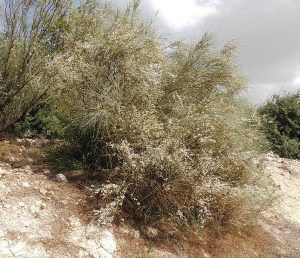
Broom bush, Wikimedia Commons

Source: Each According to its Kind: Plants and Trees in the Bible (UBS Helps for Translators)

In the Contemporary Chichewa translation (2002/2016) it is translated as “mopane tree .” These trees grow in Southern African countries. They can grow up to 18 meters high and their leaves have a butterfly shape. They’re good for firewood and timber as they are in the category of hardwood trees because they can live for up to 100 years. (Source: Mawu a Mulungu mu Chichewa Chalero Back Translation)

cattail (reed-mace𖺗 bulrush)

The Hebrew word suf probably designates more than one species of the cattail, also called “reed-mace” and “bulrush.” There are two in Israel: Typha domingensis and Typha latifolia. Both species like to stand in the slow-moving water on the edge of rivers and streams. The reference to suf (“weeds”) in Jonah 2:5 supports Zohary’s conjecture (Plants of the Bible. Cambridge University Press, 1982) that suf may be a collective name for many water plants. Suf is paired with qaneh (“reeds”) in Isaiah 19:6, so it is almost certainly the cattail since both are found in marshes and slow streams.

The cattail reaches 3 meters (10 feet) in height and is notable for its soft, fuzzy brown seed head that eventually disintegrates into fluffy material that blows away in the wind and floats on the water. The plant also spreads through its thick roots, which creep along the bottom of shallow lakes and streams. Its leaves are long, erect, and sharply pointed.

In Bible times, as now, the leaves of cattails were used for baskets and mats. The thick roots are edible, as are the pollen and the young green stalks. The cattails of Exodus are famous as the plants among which the mother of Moses hid her son in his little floating basket.

Most kinds of cattail are found in Europe and North America, where the leaves are used for mats and chair seats. Some typha species in India (Typha elephantina) are used for making paper and ornaments. Translators who live near rivers may have other reed-like plants that can be used, keeping in mind that there are four reed-like plants mentioned in the Bible (see “Papyrus,” “Reed,” and “Rush”). In Exodus 2:3 and 2:5 a number of English versions, including the New Revised Standard Version, updated edition use the generic word “reeds.” In communities that are unfamiliar with waterside vegetation, generic expressions such as “tall grass” or “tall stalks of grass” may be effective. The basic options for rendering suf in Exodus and Isaiah are:
1. a local grass that grows in streams and rivers;
2. a generic word such as “grass”;
3. a descriptive phrase such as “tall grass.”

The word suf has a different sense in Jonah 2:5. In this passage the plants are living in the water without roots or are perhaps rooted in the bottom of a shallow sea. So translations typically use “seaweed,” a plant with long, grass-like leaves that is often not attached to the soil under the sea.

The Hebrew expression yam suf (literally “sea of reeds”) has been translated somewhat inaccurately by the Septuagint translators and many others as “Red Sea.” A Handbook on Exodus recommends following the Hebrew, which is literally “Sea of Reeds,” or the modern equivalent “Gulf of Suez” as in the Good News Bible, unless there is a strong tradition in the receptor culture for “Red Sea.” If “Red Sea” is used, then a footnote should be added, giving “Sea of Reeds” as the literal meaning of the Hebrew text.

Cattail, Wikimedia Commons

Source: Each According to its Kind: Plants and Trees in the Bible (UBS Helps for Translators)

In Jonah 2:5, it is translated as “ocean grass” in Newari (source: Newari Back Translation).

saffron crocus

Our experts agree on the identification of the Hebrew word karkom with the saffron crocus Crocus sativus, but there are others who identify it as the Indian plant Turmeric Curcuma longa on the basis of its Arabic name kurkum or kurkam. However, according to Moldenke (Plants of the Bible. Ronald Press. 1952), Arabic kurkum refers to the plant, and the product from it is called saferan, from which we get the English word “saffron” (compare Arabic asfar, meaning “yellow”). Saffron is now widely known as a food additive and dye, but in Bible times it was also considered a perfume and medicine. It comes from the reddish-purple flowers of the crocus, which grew throughout Asia Minor in Bible times. Since then it has been widely cultivated in Europe, England, and America. The English word “crocus” comes from Hebrew karkom via Greek krokos.

Archeological records indicate that saffron was cultivated in the seventh century B.C. in Assyria and later in Crete (Bronze Age). Saffron-based paint has been found in fifty thousand year old pictures in what is today Iraq. The Sumerians used saffron for medicine and magical potions and traded it with other kingdoms. International trade reached a peak with the Minoans in the second millennium B.C. Use of saffron spread into Asia via the Persians and/or the Mongol invaders, and today Buddhist monks in India wear saffron-colored robes. Merchants in the Middle East sell dried safflower (Carthamus tinctorius) as saferan, but real saffron comes only from crocus flowers. The fake saffron is appropriately called alazor bastardo in Spanish and safran batard in French.

Crocus plants have long, tapered grasslike leaves growing from an onion-like bulb under the ground. They grow to less than 13 centimeters (5 inches) in height and have beautiful reddish or purple flowers.

In Bible times saffron was used as perfume and as medicine, but today it is mostly known as a coloring agent for cloth and food. One reason why it was costly is that it takes about six hundred flowers to produce a few drops of oil.

Since Bible times the saffron crocus has been grown mostly in the Mediterranean basin, but it also thrives in India, Oceana, and North Africa, so in those places local words will likely be found. Elsewhere, transliteration from a major language is recommended.

Crocus sativus, Wikimedia Commons

Source: Each According to its Kind: Plants and Trees in the Bible (UBS Helps for Translators)

See also crocus.

opobalsamum (balsam; balm)

The Hebrew word bosem, which is often rendered “balm” (derived from “balsam”), can refer to any type of aromatic healing substance, but it also designates the product of a particular tree, the balsam or opobalsamum Commiphora gileadensis. Arabs call it balasam or balasham. In the Talmud it is called afarsimon. Excavations near En Gedi have uncovered an ancient processing plant for balsam oil.

The opobalsamum tree likes a desert or semi-desert climate. It grows to 2‑3 meters (7‑10 feet) tall and has small, wrinkled, three-part leaves, white flowers, and pea-sized red berries that have a fragrant yellow seed inside. The bark of younger branches is gray, turning brown with age. The resin appears by itself in green droplets from the stems and branches, but collectors also make cuts in the branches to speed the process. The droplets turn from green to brown, clump together, and fall to the ground, where they are collected.

In Bible times, balsam oil was used in holy anointing oil, as medicine, and as an ingredient of perfume.

A generic word or phrase for sweet-smelling substances is appropriate to render bosem, although where a specific name for the balsam tree is available, as in southwestern Arabia and Somalia, this could also be used. At least one hundred species of the genus Commiphora are spread throughout dry areas of the world. Translators in some areas will know the plants; others may know only the dried resin of Commiphora sold in spice markets.

Balsam tree, Photo by Nigel Hepper

Source: Each According to its Kind: Plants and Trees in the Bible (UBS Helps for Translators)

liquidambar (Oriental sweetgum𖺗 storax)

The Hebrew word tsori (“balm”) may be the basis for the word “storax,” which Zohary (Plants of the Bible. Cambridge University Press, 1982) takes to be a name for the dried resin of the liquidambar Liquidambar orientalis, a tree that is also called kataf or nataf in Hebrew.

The Hebrew word nataf does not occur outside of Exodus 30:34 in the Bible. The Septuagint renders it staktē, which New Revised Standard Version, updated edition transliterates as “stacte.” According to Zohary, nataf is a synonym of tsori (= storax), which is found six times in the Bible. The liquidambar (or storax) is a tree that used to grow widely in the Middle East and Turkey.

The liquidambar tree grows to 10 meters (33 feet) tall, and has deeply incised leaves with five points and round yellow flowers on a 4 centimeter (2 inch) stalk. The fruits are prickly. The sticky gray-brown gum is produced by making cuts in the trunk of the tree.

The Jeremiah and Ezekiel references indicate that tsori was medicinal. We conclude from Exodus 30:34 that it was aromatic. Genesis 37:25 shows that it was highly valued in trade with Egypt.

The genus Liquidambar was widespread many thousands of years ago, according to fossil evidence, but it disappeared from Europe when the glaciers came. The surviving species, apart from orientalis in the Middle East, are formosana in South China and Taiwan and styraciflua in the eastern United States and Central America.

The references to tsori in Genesis and Ezekiel are non-rhetorical, as is nataf in Exodus. If Zohary is correct, and the translator wants to be specific, then a transliteration of “storax” may be used in these passages. Alternatively, in Exodus 30:34 translators can use a generic expression such as “resin” or “gum resin”; that is, they can use their local word for the globs of hardened sap that come from trees that produce it.

If a word for “sweet-smelling healing ointment” exists, it can be used for tsori in Genesis. Tsori is the second of three spices the Ishmaelite traders carried in Genesis 37:25, the other two being neko’th (“gum”) and lot (“myrrh” or “resin”). Translators can cover all three words with a phrase such as “different kinds of sweet-smelling medicine and incense.” Transliteration is also possible, from Hebrew tsori or Arabic nakaa/nakati. “Balm” in English is not a good basis for transliteration.

Liquidambar trunk, Wikimedia Commons

Source: Each According to its Kind: Plants and Trees in the Bible (UBS Helps for Translators)

aloe

The New Testament aloe must be distinguished from that mentioned in some versions of the Old Testament. In Numbers 24:6, Psalm 45:8; and some other places aloe refers to chips of fragrant wood from the agarwood tree found in northern India. However, the New Testament reference to aloe is to the true aloe Aloe vera. This aloe originated in southern Africa, Arabia, and Madagascar. The gel-like substance in the leaves of the aloe has been used as medicine for centuries, especially to treat burns and abrasions of the skin. It is also used as a laxative, and in modern times as an ingredient in all kinds of skin creams, soaps, shampoo, and even as a drink (in Asia), or as an additive to tea.

The leaves of aloe plants are stiff, fleshy spines that come out like fat knife blades from the center of the plant. They have spiny margins and are mostly solid green in color, but some are spotted or blotched. Most aloes have no visible stem, but some do have stems, and can reach a height of more than a meter (3 feet). The plants produce clusters of small red or yellow tube-like flowers that are borne on a stalk.

Aloes are native to southern Africa, Madagascar and Arabia, but are now found in tropical countries throughout the world. Translators in those areas will have local names for the plant. Since the one reference to aloe is a non-rhetorical passage, a transliteration from a major language is advised, but it will depend on what is done with myrrh, the other word in the pair.

Aloe vera, photo by Rob Koops

Source: Each According to its Kind: Plants and Trees in the Bible (UBS Helps for Translators)

spikenard / nard

The name “spikenard” seems to be gaining ground over “nard” in global English. The Hebrew and Greek words for spikenard could have referred to a variety of substances from a variety of plants. Zohary (Plants of the Bible. Cambridge University Press, 1982) takes the New Testament spikenard to be the same as the Old Testament one, namely Nardostachys jatamansi from India. Hepper (Baker Encyclopedia of Bible Plants: Flowers and Trees, Fruits and Vegetables, Ecology. Baker Book House, 1992) doubts the Indian origin of most biblical spices and suggests that the references in Song of Songs may be to the Camel Grass Cymbopogon schoenanthus, which grows in the deserts of Arabia and North Africa. Assyrians called it lardu. However, if the writing of Song of Songs is late, the Indian origin of spikenard mentioned there is quite possible. The Greek expression nardos pistikos in Mark 14:3 and John 12:3 is rendered “pure nard” by New Revised Standard Version, updated edition, but the meaning of pistikos is debatable. It may in fact come from the Sanskrit picita, the local name of the spikenard plant. In Arabic spikenard is called sunbul Hindi (“Indian spike”).

The spikenard plant is a leafy bush less than a meter (3 feet) high, with fragrant-smelling, short stems and a tuft of three narrow leaflets at the tip of each stem. The pink flowers are umbrella-shaped. The rhizomes (tubers) are pounded to extract pungent, pale orange or yellow oil.

The two references to spikenard in Song of Songs 4:13 and 4:14 are metaphorical, the bride being referred to as a luxurious garden or park filled with all kinds of lovely spice plants and trees. The spikenard there is mentioned first in the plural in Hebrew, paired with a plural form of henna, as though they are plants or trees, or perhaps the fruit of trees. Then its singular form is paired with saffron, followed by calamus and cinnamon. Spikenard was a luxury item in ancient Egypt, the Near East, and Rome. A Chinese medical text written around 1100 A.D. notes the calming effect of spikenard incense. It is still used in incense sticks (senko) in China and as a medicine. It is also used in Japan as an ingredient of the incense used in the Plum Blossom Festival. In John 12:3 spikenard is cited as the “costly perfume” used by Mary, the sister of Lazarus, to anoint Jesus.

For the metaphorical references in Song of Songs a cultural equivalent of spikenard is appropriate. The references in Mark and John are of course non-rhetorical and should be translated with a local name for spikenard where possible or transliterated where translators feel it is important to be concordant throughout. A transliteration such as “naridi” is recommended.

Spikenard Wikimedia Commons

Source: Each According to its Kind: Plants and Trees in the Bible (UBS Helps for Translators)

henna

Henna Lawsonia inermis grew wild in the oases by the Dead Sea in Old Testament times. It is also known as “Egyptian privet” and is common in the hot, drier parts of Africa, southern Asia, and northern Australia. Although henna was, and is, primarily used because of its coloring properties derived from the dried leaves, in Song of Songs 1:14 the writer mentions its flowers, which are indeed pretty and fragrant. They are in a “cluster” (’eshkol in Hebrew), which could be taken as a woven object parallel to the little bag of myrrh in verse 13 or as a garland, or simply as a clump of flowers in the cultivated terraces above En-Gedi. The reference to henna in Song of Songs 4:13 is strange since it is in the plural form in Hebrew (kefarim), parallel to the yet stranger Hebrew word neradim (from nerd; see spikenard). Neither of these plants has significant fruit, so the verse can be taken as a glorious concoction of romantic images of spices and flowers.

Henna is a shrub that reaches 2‑3 meters (7‑10 feet) in height. It has opposite leaves and many fragrant white flowers. The leaves yield a red juice that people in many countries use for coloring the skin and hair.

The context is clearly metaphorical in both references to henna, so there is the possibility of substituting locally known equivalents. In places where henna is known only as an agent for coloring the hair, skin or fingernails, it may be important to substitute, or to create a note stating that the smell and beauty of the flowers are in focus. In Song of Songs 4:13 most translations ignore the plural, perhaps assuming that it is influenced by the word “fruits” earlier. Alternatively, a transliteration can be used based on a major language. The recent resurgence in skin decoration (“mehndi”) using henna may make it easier to find a known word.

Red henna flower, Wikimedia Commons

Source: Each According to its Kind: Plants and Trees in the Bible (UBS Helps for Translators)