
swallow / swift

Swallows, martins, and swifts are birds that look and behave in very similar fashion, and in many places where they are found, all are popularly known by one name only. This is true in English too, since all three types of bird are usually referred to as “swallows” by people who are not expert bird-watchers. Scientifically, swallows and martins are related, but the swifts are birds of a completely different family.

The fact that most English versions translate all three Hebrew words as “swallow” reflects the usage of the average person. However, it is likely that deror is strictly speaking the swallow and the martin, while sus and sis (differently pronounced forms of the same word) indicate the swift. In modern Hebrew sis is the name for the swift, and deror is the name for the sparrow, not the swallow.

The Greek word chelidōn refers to either swallows or swifts.

Four species of swift, three species of martin, and two species of swallow are common in Israel. The Common Swift Apus apus, the Pallid Swift Apus pallidus, the Alpine Swift Apus melba, and the Little Swift Apus affinis are all migrant birds that spend the whole summer in Israel. This is also true of one type of swallow, the Red-rumped Swallow Hirundo daurica, and the House Martin Delichon urbica. Another species of martin, the Pale Crag Martin Hirundo obsolete is permanently resident there. The remaining species of martin and swallow are passing migrants that stay only a few days, although a few individual birds may stay all summer in Israel while the majority passes on.

Swallows, martins, and swifts are all small birds with long slender wings and short legs. They fly at great speed for long periods on end, twisting and turning, usually in fairly large groups. They catch insects in the air as they fly. The Hebrew name deror is derived from a word meaning “free,” probably a reference to this wonderful ability to fly freely at speed, swooping, diving, and turning, with no need to stop for a rest. The name sus or sis refers to the swishing sound the fast-flying swifts make in the air as they pass.

The common swift makes a noise described in many bird books as a “high-pitched scream”, especially in the breeding season, but it also keeps up a noisy twittering almost constantly, especially near the places where it roosts. This is also a common feature of some other types of swift and many types of martin.

The common swift, house martin, European swallow, red-rumped swallow, and pale crag martin all make their nests under overhangs on rock faces, in caves, or in human structures, such as buildings and the underside of bridges. (Psalms 84:4 speaks of the deror making its nest in the Temple.) The swifts make their nests out of grass and leaves cemented together with their saliva (it is the nest of a swift that is collected by Chinese people for the famous bird’s nest soup). The swallows and martins make their nests out of small pellets of mud mixed with grass. Both types of nest are bonded to a rock or wall, usually close to an overhanging projection such as a roof.
Swallows and swifts are amazing migrants. Some species migrate from central Africa to the Far East and to parts of southwestern China, others move from northern Russia and Scandinavia to South Africa. One group of swallows is known to have covered more than 12 ,000 kilometers (7,500 miles) in thirty-five days. When gathering for migration, or when stopping briefly on their way, they can often be seen in the hundreds of thousands. In Bangkok in one night, university students counted nearly two million migrating swallows roosting on the telephone and power lines in the city. They were gone the following day.

These birds were noted for a) their regular migration, b) their unending flight, c) the fact that they build nests in human dwellings, and, in the case of the swift, d) their unending, and perhaps sad-sounding noise.

Swifts, swallows, and martins are found worldwide. If the local language makes a difference between swifts and swallows, then deror should be translated as “swallow” and sus and sis as “swift”. In most languages, however, both families of bird are called by the same name, so that only one word will be used to translate the three Hebrew words.
Proverbs 26:2 makes reference to the fact that swallows can fly the whole day without stopping once.

Source: All Creatures Great and Small: Living things in the Bible (UBS Helps for Translators)
sparrow

While the Greek word strouthion is certainly the name for the sparrow, the Hebrew tsippor is actually an inclusive word that refers to sparrow-sized birds in general. These small birds, especially sparrows, were caught in nets and traps and were an important part of the diet of poor people.

There are three types of sparrow that are common in Israel, the House Sparrow Passer domesticus, the Spanish Sparrow Passer hispaniolensis, and the Dead Sea Sparrow Passer moabiticus. All three are small speckled brown birds. Additional small birds that abound around towns and settlements are members of the bunting, finch, and tit families. Sparrows in particular are usually found in fairly large numbers roosting and nesting together. All are seed eaters and live mainly on grass seeds and grain.

Sparrows were considered clean birds and were associated with the poor.

Sparrows or sparrow-like small birds are found all over the world. Finding a local word is not usually difficult. The reference to “a lonely bird on the housetop” in Psalms 102:7 takes on additional meaning if the sparrow was intended, since it is a bird that is seldom seen alone. It would then indicate the psalmist’s sense of loneliness at being separated from those with whom he belongs.

Source: All Creatures Great and Small: Living things in the Bible (UBS Helps for Translators)

seagull

All modern English translations, except New English Bible and Revised English Bible (which have “long-eared owl”), render shachaf as “seagull” or “gull”, and this reflects the overwhelming consensus among scholars. This is also the meaning in modern Hebrew, while the tern (a relative of the gull) is called shechafit (“little gull”).

It is likely that in biblical times this word referred to all seabirds with long narrow wings, including gulls, terns, skuas, coursers, shearwaters, and others. There are at least twelve common species of this family of birds found in Israel, along the coastal areas and on Lake Galilee. The most common are the Black-headed Gull Larus ridibundus, the Herring Gull Larus argentatus, the Common Tern Sterna hirundo, and the Little Tern Sterna albifrons.

Seagulls, as their name suggests, are seabirds, living on the coasts of seas and lakes. Some of their relatives, the terns and skimmers, are also found on the great rivers of the world, such as the Amazon, Nile, Zambezi, Ganges, Brahmaputra, Mekong, Murray, and Mississippi. Some are even found on smaller rivers and ponds. Gulls are bigger than terns and have heavier beaks, with some species having a noticeable hook at the tip.
Most of the birds in this family are white with gray or black backs and upper wing surfaces. They have long flexible wings. They feed on fish or plankton, usually settling on the water to feed. Some dive into the water for their food, and many are also shoreline scavengers, eating dead fish, crabs, and shellfish. They typically follow fishing boats to eat scraps or discarded fish.

They are listed among the unclean birds.

Since gulls and terns are found worldwide near the sea or any other significant body of water, a local name will not be difficult to find in such areas. Both of the terns mentioned above occur worldwide, migrating from one hemisphere to the other. The black-headed gull is found in Europe and Africa. In drier or mountainous inland parts of the world where neither gulls or terns are known, a phrase such as “seabird” can be used.

Source: All Creatures Great and Small: Living things in the Bible (UBS Helps for Translators)
partridge

Partridges have been hunted and trapped for millennia. In the land of Israel there are three common types of partridge which are still found today: the Rock Partridge Alectoris graeca (also known in the Middle East as the Chukar Alectoris chukar), the Black Francolin Francolinus francolinus, and the Sand Partridge Ammoperdix heyi. In modern Hebrew the sand partridge is still called qore’, but in biblical times all three types of partridge were probably referred to by this name. The name means “the caller”, a reference to the ringing crowing of the males, typically while standing on top of a rock.

Partridges were hunted with stones, slings, and throwing sticks, and were also caught in snares. In 1 Samuel 26:20 David likens himself to a partridge being hunted. This is a very apt simile, since he had been moving from one refuge to another, just as a partridge flies short distances from cover to cover when being chased. He had also been hiding in the same rocky hills that partridges inhabit near En Gedi.

In Sirach 11:30 there is reference to “a decoy partridge in a cage”. This refers to a practice still common in many parts of the world. A male partridge is captured and the caged bird is left in an area where it is known there are partridges, or it is taken from the cage and tethered to a bush by its leg. Grain is scattered around and slip noose snares are set. Toward sundown the captive partridge begins to call, and this attracts other partridges, which begin to feed on the grain and are snared. [See also decoy partridge.]

Partridge eggs were also an important part of the ancient diet, and many Bedouin tribes still collect these eggs regularly. Up until the twentieth century partridges of all three types were abundant throughout Palestine. Today they still exist but in much smaller numbers.

The three partridges mentioned above live in slightly different habitats. The rock partridge, as its name suggests, frequents rocky hill terrain. It is found all over Israel, where it makes good use of the broken terrain to remain hidden. The black francolin prefers denser vegetation in wadis or river valleys. The presence of both these partridges is usually known from their calls rather than from actual sightings of the birds. The sand partridge frequents the Judean Desert and can still be seen coming to drink at pools in wadis along the Dead Sea.

All three types of partridge, in spite of their different markings and the fact that the sand partridge is smaller than the other two, are typical of the partridge family. They live in small flocks called coveys, lay a great many eggs, and prefer to run when in danger, flying only when necessary. Even when they take flight they fly for only a short distance before dropping back to the ground. They also have the ability to squat absolutely still, almost in a trance. With their natural camouflage this ability usually means that the birds will not be seen even by someone passing very near them.

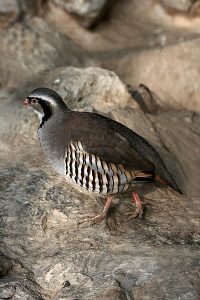
The rock partridge is about 35 centimeters (14 inches) in length and has striking white cheeks with a black band running from its brow, through its eyes, down its neck, and curving around its breast. It also has striking black and chestnut stripes on its flanks. Its back and wings are gray. The beak and legs are red. Both sexes look alike.
The black francolin is about the same size but has a slightly shorter tail. The male has a black breast and flanks. The female is a speckled brown.
The sand partridge is the color of the local sand and is about half the size of the other two types.

Partridges or their close relatives the button quails and pheasants are found all over the world, and finding a local equivalent should not prove difficult. In Asia the Bamboo Partridge Alectoris orientalis is found from Pakistan to China and down through Southeast Asia. In Australia the Brown Quail Coturnix australis and the Stubble Quail Coturnix pectoralis are probably the closest equivalents, rather than the mallee fowl or the scrub fowl, which are mound builders, a very specialized type of bird.
In Africa any of the francolins are a good equivalent. They are found all over Africa.

Rock partridge, Wikimedia Commons

Source: All Creatures Great and Small: Living things in the Bible (UBS Helps for Translators)
In Newari it is translated as “pheasant” (source: Newari Back Translation).

tinshemeth / barn owl

Owls are found worldwide except in the Antarctic and on some islands. They are active at night and are characterized by flat faces and short hooked beaks that they can open very wide. They swallow their prey whole and later regurgitate the undigested parts as small balls. They also have the ability to turn their heads more than 180 degrees.

There are two basic owl families, both of which are found in the land of Israel. One family is the Tytonidae, which are the Barn and Grass Owls. They have heart-shaped whitish faces, usually outlined by a dark line, and small dark eyes. The other family is the Strigidae, the typical owls. This family contains a large variety of species, all of which have large eyes that may vary in color from light brown through orange to yellow. This family includes the eared or horned owls, the fairly rare fishing owls, and owls that vary in size from the midget scops owl (less than 20 centimeters [8 inches]) through to the giant eagle owl (over 70 centimeters [28 inches]).

Eight species of owl are fairly common in the land of Israel. Most are very seldom seen by humans, but they are quite well known by their different and distinct calls. In biblical times the nights would have been much quieter than in most modern places, and the strange night sounds probably would have interested people, causing some speculation about what was making the sound. The different owls would thus probably have had different names even if people had never seen them. In fact it is unlikely that they would have been able to associate most of the calls with the owls that were seen.

The terms “barn owl,” “screech owl,” and “white owl” are alternative names for the same owl. There is a long tradition among both Jewish and Christian scholars of translating tinshemeth as “barn owl”. New English Bible and Revised English Bible follow Driver’s suggestion “little owl”, but this does not have as wide support among scholars as “barn owl,” which is also the modern Hebrew meaning of tinshemeth. The New Revised Standard Version, updated edition rendering of “water hen” can be disregarded since it’s too vague a term to be useful.

The word tinshemeth actually occurs three times in the Bible. Twice the word probably refers to the barn owl, but the third occurrence is a reference to a type of lizard or chameleon.

The Barn Owl Tyto alba is one of the most widely distributed owls in the world, being common virtually everywhere but the Arctic and Antarctic regions and remote islands. It is a very pale color, light fawn or gray on the wings and back, and almost white on the chest and under the wings. It has small eyes, a large head for its size, and a very striking heart-shaped white facial disk outlined in brown. This facial disk consists of short bristle-like feathers that help the owl to sense very small sounds. Barn owls often roost in barns, deserted houses, caves, and tombs. They utter a variety of strange sounds, varying from the well-known drawn-out trembling screech, to various hissing, chirruping, and snoring sounds. The females are larger and more vocal than the males. These owls live mainly on rats, mice, and other small nocturnal creatures.

It is listed as an unclean bird and was associated with tombs and death.

This is one owl for which finding a local equivalent should not present any major problem. Failing all else, the phrase “white-faced owl” can be used, although strictly speaking, there is another smaller owl, not closely related to the barn owl, that has this English name.

Barn owl, Wikimedia Commons

Source: All Creatures Great and Small: Living things in the Bible (UBS Helps for Translators)

lilith / scops owl

Owls are found worldwide except in the Antarctic and on some islands. They are active at night and are characterized by flat faces and short hooked beaks that they can open very wide. They swallow their prey whole and later regurgitate the undigested parts as small balls. They also have the ability to turn their heads more than 180 degrees.

There are two basic owl families, both of which are found in the land of Israel. One family is the Tytonidae, which are the Barn and Grass Owls. They have heart-shaped whitish faces, usually outlined by a dark line, and small dark eyes. The other family is the Strigidae, the typical owls. This family contains a large variety of species, all of which have large eyes that may vary in color from light brown through orange to yellow. This family includes the eared or horned owls, the fairly rare fishing owls, and owls that vary in size from the midget scops owl (less than 20 centimeters [8 inches]) through to the giant eagle owl (over 70 centimeters [28 inches]).

Eight species of owl are fairly common in the land of Israel. Most are very seldom seen by humans, but they are quite well known by their different and distinct calls. In biblical times the nights would have been much quieter than in most modern places, and the strange night sounds probably would have interested people, causing some speculation about what was making the sound. The different owls would thus probably have had different names even if people had never seen them. In fact it is unlikely that they would have been able to associate most of the calls with the owls that were seen.

Some commentators associate the word lilith with a female demon referred to in Babylonian legends. However, even if this is accepted, it is likely that this demon was also associated with some type of night bird. In many Middle Eastern cultures, demons and monsters have been identified with owls, probably as the result of their strange sounds at night.

In modern Hebrew lilith is the name of the tawny owl. Some Bedouin say that the trilled call of another owl, the Scops Owl Otus scops (one of the most common owls in Israel), is the hooting of a female demon quietly rejoicing that she has found prey. The root of this name is similar to the Hebrew word for “night” but is actually a Babylonian word. It is also similar to the way some modern Palestinians describe the sound of hooting.

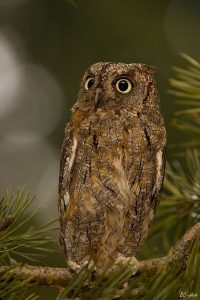
The scops owl is a tiny eared owl that is a mottled gray in color. By day it perches close to the trunk of a tree, where its mottled coloring blends in with the tree bark, making the owl look like the stump of a broken branch. It has a soft, trilled call.

It is associated with doom, destruction, and demons.

An expression, such as “owl demon” or “owl witch”, is probably the best solution. In sub-Saharan Africa, where the scops owl is well known, the local name plus a word for demon or witch can be used.

Scops owl, Wikimedia Commons

Source: All Creatures Great and Small: Living things in the Bible (UBS Helps for Translators)

kos / little owl

Owls are found worldwide except in the Antarctic and on some islands. They are active at night and are characterized by flat faces and short hooked beaks that they can open very wide. They swallow their prey whole and later regurgitate the undigested parts as small balls. They also have the ability to turn their heads more than 180 degrees.

There are two basic owl families, both of which are found in the land of Israel. One family is the Tytonidae, which are the Barn and Grass Owls. They have heart-shaped whitish faces, usually outlined by a dark line, and small dark eyes. The other family is the Strigidae, the typical owls. This family contains a large variety of species, all of which have large eyes that may vary in color from light brown through orange to yellow. This family includes the eared or horned owls, the fairly rare fishing owls, and owls that vary in size from the midget scops owl (less than 20 centimeters [8 inches]) through to the giant eagle owl (over 70 centimeters [28 inches]).

Eight species of owl are fairly common in the land of Israel. Most are very seldom seen by humans, but they are quite well known by their different and distinct calls. In biblical times the nights would have been much quieter than in most modern places, and the strange night sounds probably would have interested people, causing some speculation about what was making the sound. The different owls would thus probably have had different names even if people had never seen them. In fact it is unlikely that they would have been able to associate most of the calls with the owls that were seen.

Traditionally kos has been translated as “little owl”, and this is the meaning in modern Hebrew. The case for this translation is probably the strongest, even though not conclusive. If we accept this identification, the lists of unclean birds has a rather neat structure with this the smallest of the owls being paired with nets, the smallest of the birds of prey.

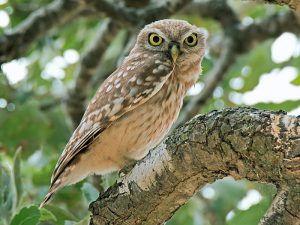
The Little Owl Athene noctua is, as its name suggests, a small owl, which feeds at night mainly on insects and nestlings. It is about 25 centimeters (10 inches) in length and has a short tail. It does not have ear tufts. It nests in holes in banks or termite hills. It is often seen in the daytime, usually being chased by a group of small birds.

It is listed as an unclean bird.

The little owl is found in southeastern Europe, the Middle East, and northeast Africa. Elsewhere one may use the name of a small species of owl or the phrase “little owl”.

Little owl, Wikimedia Commons

Source: All Creatures Great and Small: Living things in the Bible (UBS Helps for Translators)

yanshuf / tawny owl

Owls are found worldwide except in the Antarctic and on some islands. They are active at night and are characterized by flat faces and short hooked beaks that they can open very wide. They swallow their prey whole and later regurgitate the undigested parts as small balls. They also have the ability to turn their heads more than 180 degrees.

There are two basic owl families, both of which are found in the land of Israel. One family is the Tytonidae, which are the Barn and Grass Owls. They have heart-shaped whitish faces, usually outlined by a dark line, and small dark eyes. The other family is the Strigidae, the typical owls. This family contains a large variety of species, all of which have large eyes that may vary in color from light brown through orange to yellow. This family includes the eared or horned owls, the fairly rare fishing owls, and owls that vary in size from the midget scops owl (less than 20 centimeters [8 inches]) through to the giant eagle owl (over 70 centimeters [28 inches]).

Eight species of owl are fairly common in the land of Israel. Most are very seldom seen by humans, but they are quite well known by their different and distinct calls. In biblical times the nights would have been much quieter than in most modern places, and the strange night sounds probably would have interested people, causing some speculation about what was making the sound. The different owls would thus probably have had different names even if people had never seen them. In fact it is unlikely that they would have been able to associate most of the calls with the owls that were seen.

As with most of the owls, there is no complete agreement among the versions. It would appear at first that “screech owl” has strong support as the translation of yanshuf. However, this is misleading. The next Hebrew name on the list of unclean birds in Leviticus 11:18 and Deuteronomy 13:16 is tinshemeth, which New International Version renders “white owl” and New American Bible “barn owl”. In fact both white owl and barn owl are simply alternate names for the screech owl, which these two versions have included earlier in the list. They have thus actually listed the same owl twice. Among Jewish scholars the translation of tinshemet as barn owl has a long history, and in modern Hebrew this is the name of the barn owl. Thus it seems best to translate yanshuf in some other way.

There are two likely candidates. For translators who have translated the word tachmas earlier in the list as “eared owl”, yanshuf can be translated as “tawny owl”. For those who decided to follow modern Hebrew usage and translate tachmas as “nightjar”, it would be good to translate yanshuf as “eared owl”, which also follows modern Hebrew usage.

The Tawny Owl Strix aluco is a fairly rare bird in Israel, but where it is present, its call is unmistakable. The male calls with a series of hoots “HOO-hoo-hoo, hoo-HOO-hoo”, and the female replies with a higher pitched single hoot “HOO”. Its eyes are outlined with pale circles, so that it looks as though it is wearing spectacles. As its name indicates, it is a mottled gray-brown color. It prefers wooded areas or orchards and roosts close to the trunk of a tree.

It is listed as an unclean bird.

Owls very similar to the tawny owl, which belongs to the same family as Wood Owls Strigidae, are found in many places in the world. In sub-Saharan Africa the Wood Owl Strix woodfordii is very similar to the tawny owl, while in Australasia the Boobook Owl Ninox novaseelandiae is a good equivalent. Elsewhere the word for a medium-sized wood owl, or a phrase meaning “tawny-colored owl” can be used.

Tawny owl, Wikimedia Commons

Source: All Creatures Great and Small: Living things in the Bible (UBS Helps for Translators)