locust / grasshopper / cricket

The locust is the most important insect in the Bible, being mentioned many more times than any other insect. Although there are nine Hebrew words in the Bible which refer to locusts, the most common one is ’arbeh. The equivalent in Greek is akris, and in Latin it is locusta. These words certainly refer to the locust rather than to the grasshopper. All locusts and grasshoppers belong to the family Acrididae, which is a family within the order Orthoptera, or “straight-winged” insects. Many species are found in the land of Israel and Egypt, but the most important are the Migratory Locust Locusta migratoria, the Desert Locust Schistocerca gregaria, and the Moroccan Locust Dociostaurus moroccanus. All three species are an important local food and are probably all called ’arbeh in the Bible.

Grasshoppers and locusts are both six-legged, winged insects that are characterized by the fact that their third pair of legs is elongated and adapted to hopping. The lower portion of these legs has a row of spikes that are used both for making sounds and as a means of defense. The front wings are narrow, straight, and stiff. When not being used to fly, they function as a cover for thin, membrane-like hind wings, which are much larger and colored, and which are folded together like a Chinese fan. When the locust or grasshopper flies, it hops into the air spreading out its wings as it does so. It flies with a slight clattering sound, made by the stiff front wings striking each other.

Locusts differ from grasshoppers mainly in that they form swarms at certain periods and migrate to new areas, which they colonize. At other times they live either solitary or in small groups. Their reproduction rate varies with the climatic conditions. Eggs are laid in the soil in small packets, and hatching is related to the degree of humidity. In dry periods only a few hatch, but in periods of good rainfall they suddenly hatch out in exceptionally large numbers.

Unlike most other insects, locusts do not go through stages in which they exist as larvae or caterpillars. They emerge from the eggs as nymphs, which are simply tiny wingless locusts with undeveloped hopper legs. The nymphs, which can only crawl around, feed on green vegetation, consuming many times their own body weight each day. As they grow bigger and develop, they shed their skins. Their hopping legs develop before their wings, so that they pass through a stage when they can hop but not fly. At this stage, when they are referred to as “hoppers”, they exist in less dense masses than as nymphs, having spread out a little, but since they are now eating even more than before, they can still cause considerable damage to crops. Once they develop into adults they can both hop and fly. If the climatic conditions are right and exceptionally large numbers have developed to this stage, they completely devastate the vegetation where they have been developing. When this happens they begin to congregate in preparation for swarming. In other words they come together and migrate as a group to greener pastures, flying together in large swarms. At this congregating stage, during the migration and immediately after it, they present a major threat to crops and other vegetation, on which they feed unceasingly.

A locust swarm may consist of billions of locusts. A report of a single swarm in 1889 estimated for that swarm to cover 5,500 square kilometers (about 2,000 square miles). Certainly even in recent times swarms have been known large enough to blot out the sun like a large black cloud. The clattering of wings as the locusts approach is a sound hard to forget. Where the swarm lands, even temporarily, every green bush or clump of grass in sight is attacked by the locusts, and the sound of them munching on the leaves is clearly audible, sometimes for hours. Afterwards, hardly a single green leaf or blade of grass can be seen, and many bushes even have the bark eaten off, leaving them bare.

Against such enormous numbers ancient peoples felt absolutely helpless. There was no way they could stop the destruction. The lighting of grass fires helped only in a very small way. Ironically it is when locusts swarm like this that they can be easily caught in large numbers for eating. They are often caught in blankets, fishing nets, and baskets. The lower part of the hopping legs is snapped off, and they are cooked by toasting, grilling, frying, or broiling. In some places they are also eaten raw. When toasted and salted they taste a little like salted peanuts.

Some commentators have pointed out that the plague of locusts in Egypt probably provided the Israelites with food in the Arabian and Sinai deserts, since this is the usual migration route of locusts in that part of the world.

Following is a summary of the development cycle of the major locust species: Nymphs, which can only crawl, develop to a hopping stage; the hoppers develop wings and become adult locusts; if climatic conditions are right, these adults gather into swarms and migrate to new locations; the females lay eggs, and the whole cycle is repeated. There are thus four discernible phases: nymphs, hoppers, resident adults, and swarming or migrating adults. It is possible that chasil refers to the crawling nymph, yeleq to the juvenile hopper, ’arbeh to the resident adult, and gazam to the swarming adult. However, this is far from proven, as the words seem to be used almost interchangeably when referring to locust plagues.

Crickets and katydids: Crickets are a nocturnal relative of the locusts and grasshoppers. Some types have wings, others do not. They are usually black or brown, with shorter rounder bodies, and they shelter during the day under rocks or logs, or, in the case of the so-called mole crickets, in holes that they dig. At night they make characteristic high-pitched chirping sounds, which carry a surprisingly long way. Each species makes a slightly different sound. Like locusts and grasshoppers they feed on vegetation, usually leaves.

Katydids are similar to crickets but are usually green and have wings. They are active at night, when they make cricket-like chirping sounds, but settle during the day underneath leaves in trees. Their wings are leaf-shaped, and with their green color they have excellent camouflage. Some katydids eat other insects.

Both crickets and katydids have extremely long feelers.

Given their large numbers and swarming characteristics, it is small wonder that locusts were a symbol of a vast attacking army against which there was no defense. They were also a symbol of divine punishment.

The Migratory Locust Locusta migratoria is found in many parts of the world, except North America. In these areas it should be easy to find a local word. However, in some countries with high rainfall this and other species of locust do not swarm in the same way that they do in the Middle East and the drier parts of Africa. In these countries it may be necessary in some contexts to use a phrase such as “swarms of locusts” rather than simply “locusts”. In areas where locusts are not known, a phrase like “large/giant grasshopper” can usually be substituted.

The Hebrew words gev, gov and govay are related to a verb meaning “to swarm” or “to gather together”, and thus the reference is almost certainly to the locust.

The word tselatsal (Deuteronomy 28:42; Isaiah 18:1) represents the sound of insects’ wings, and the reference is most likely to the sound made by a swarm of locusts. The English versions that have “whirring” or “buzzing” make some attempt at reflecting this, but “buzzing” is inadequate as a description of the sound such a swarm makes. “Clattering”, “chirping”, “whirring”, or “fluttering” comes closest in English to representing the sound represented by the Hebrew word.

In many Bantu languages in Africa, and in other languages where ideophones occur which express the sound of thousands of whirring wings, such ideophones are a good equivalent. Elsewhere a noun phrase, modified by an adverbial expression similar to the English, can be used.

In most contexts the word chagav seems to mean “grasshopper”, the exception being 2 Chronicles 7:13, where the reference is to locusts. In the two passages where the grasshopper symbolizes something small and insignificant (Numbers 13:33 and Isaiah 40:22), it may not be possible to capture the right inference by translating literally. In such cases the translator is free to use some other insect that is symbolic of small size and insignificance in the local culture, such as “ant”, “louse”, “flea”, and others. In cases where no insect name carries this symbolism, the name of an animal with the correct connotations can be used; for example, “mouse” or “squirrel”.

Source: All Creatures Great and Small: Living things in the Bible (UBS Helps for Translators)

See also locust, locust (different kinds in Joel 1:4 and 2:25), and as thick as locusts.
hornet / wasp

There is little doubt among scholars that the Hebrew and Greek words refer to both hornets and wasps.

Hornets and wasps are closely related species, with the hornets being larger than the wasps. Like bees they both belong to the zoological order Hymenoptera, which means that they have stiff, transparent, membrane-like wings. The hornets are usually black or brown; some species have yellow bands. Wasps are often greenish and may also have yellow or light green bands. The larger hornets can be 30-40 millimeters (1-1.5 inches) long.
Both hornets and wasps are characterized by having a long narrow waist between the thorax (chest) and the abdomen (stomach). All have a sting that, because of their large size, can be very painful, even dangerous. Unlike bees, hornets and wasps do not have a detachable sting and can sting repeatedly. They feed on insects, caterpillars, and spiders, and many types sting their prey and then deposit the paralyzed but still living insect or spider near the hornet’s eggs, as a readily available source of food for the larvae when they hatch from the eggs. Some species actually lay their eggs on the paralyzed victim.

One of the most dangerous varieties is the Oriental Black Ground Hornet Vespa orientalis, which establishes large underground nests. They are large shiny black hornets, and when their nest is disturbed they emerge in numbers and attack any animal or person nearby. They are very sensitive to vibration, and a single animal or person walking nearby is enough to arouse them. Once they begin to sting, the smell of the sting arouses them even further, and they may remain in this angry state for hours, with each fresh sting stimulating their ferocity afresh. Some of their victims may end up paralyzed or may even die.

Black ground hornets are found across tropical Africa, through the Middle East, and across Asia to eastern China. In many of these countries known black ground hornet nest sites are marked in some way, such as with a sharpened stick pointing to the nest, as a warning to passersby.

It is little wonder that hornets are a symbol in the Bible for a dangerous enemy or an attacking army.

Although hornets or wasps are found in most warm countries, some large dangerous-looking hornets are relatively harmless. For instance, the black house hornet found all over Africa does not live in swarms but on its own. It makes mud nests on walls or under a roof. It is large and has a sting, but it is not aggressive and very seldom stings any person or animal. Thus care should be taken by translators to choose the name of a hornet that both lives in swarms and is dangerous. In cases where all local hornets or wasps are relatively harmless, a descriptive phrase meaning “warrior hornet”, “war hornet”, “army hornet”, “death hornet” or something similar can be used.

Source: All Creatures Great and Small: Living things in the Bible (UBS Helps for Translators)

onycha

The Hebrew word refers to something that was used in the mixture of aromatic spices that made frankincense. This ingredient is believed to have been the nail-like covering on the foot of a mollusk (that is, a boneless sea creature) of the strombus type. However, a few scholars suggest that it is a type of flower.

The strombus mollusks are a type of sea creature something like snails, which live inside a single shell, usually spiral in structure. They have eyes set on the end of each of two stalks. Part of the mollusk extends from the shell and attaches itself to a rock or other flat surface. This is called the foot and is the means by which the mollusk moves. The foot has a nail or scale-like covering called the operculum, and when the mollusk withdraws into its shell this operculum acts as a lid, sealing the opening of the shell. It is this operculum that is thought to have been referred to by the Hebrew word shechelet.

The only languages that will have a good equivalent of this Hebrew word are those spoken by people who have an intimate knowledge of sea creatures. Elsewhere it is probably best to opt for the solution followed by the translators of New English Bible and use an expression such as “aromatic seashell” or “fragrant seashell”. Another alternative would be to use a transliteration of the Hebrew shechelet or the Greek onycha, with an entry in a word list indicating what the word refers to.

Source: All Creatures Great and Small: Living things in the Bible (UBS Helps for Translators)

frog

There is little doubt that the Hebrew and Greek words mean “frog”. The plague of frogs mentioned in Exodus comes after the plague of polluted water. The frogs seem to have left the water and come into the villages. Since frogs eat flies and thus control fly populations, it seems likely that the death of the frogs was one of the causes of the next two plagues to trouble Egypt, namely gnats and flies.

The two most common frogs in the Middle East and Egypt are the Edible Frog Rana esculenta and the Spotted Frog Rana punctata. They are both about 70 millimeters (3 inches) long and are brown or olive-green in color. They live in the water almost all of the time and eat gnats, flies, and other waterside insects. They lay eggs, which hatch as tadpoles and gradually grow legs. The hind legs are much bigger and better developed than the front legs, since the hind legs are used for jumping.

Frogs were considered unclean by the Jews and also by the Egyptians and Persians, who associated them with demons.

Frogs are found all over the world, and there should be no problem in finding a local equivalent.

Source: All Creatures Great and Small: Living things in the Bible (UBS Helps for Translators)

lizard

There is a reasonably strong consensus among scholars that leta’ah refers to the lacertid and agama lizards, both of which are common and fairly obvious in Israel. The lacertids are soft-skinned lizards that live in close proximity to roads and houses. One of the more colorful is the Syrian Green Lizard Lacerta trilineata, which lives in orchards and woods. The most common of the agamas is the Rainbow Agama Agama stellio, which is very common around houses and on walls and rocks.

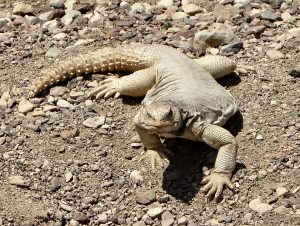
Most scholars agree that tsav is the name for the dab or thorn-tailed lizards of which there are many species in Israel. Two of the most common are the Egyptian Thorn-tailed Lizard Uromastyx aegyptius and the Colored Thorn-tailed Lizard Uromastyx ornatus. The name “dab” is an English version of their Arabic name dhabb (ضب), which is reflected in the Hebrew tsav.

Lacertid lizards (leta’ah) are fairly small, about 15-20 centimeters (6-8 inches) long, and they have a shiny smooth skin. Syrian green lizards have dark green spots on a lighter green background, with a yellow-green belly. They feed on flies, gnats, mosquitoes, and ants.

The rainbow agama is much larger, reaching 50-60 centimeters (20-24 inches) in length. In the breeding season the male develops bright colors, with a blue tail, green body, and bright orange or bright green head, dependent on the subspecies. The females and non-breeding males are a dull gray color. All agamas are characterized by the fact that they bob their heads vigorously by doing “push-ups” with their front legs. They have long, fairly stiff tails, which they raise when they run. They feed on a wide variety of insects and also prey on smaller lizards. In most of the Arab-speaking world they are known as hardoun lizards. Some agamas have the ability to change color to match their surroundings in the same way that chameleons do.

The thorn-tailed lizards (tsav) are relatively large desert lizards with a length of about 65 centimeters (26 inches). They have a fairly thick, squat appearance and have a thick short tail covered with sharp spikes, which are actually cone-shaped scales. They use this tail for defense. They often crawl into holes or cracks in rocks and then block the entrance with their thorny tail. They are vegetarian, eating various succulent desert plants. Even though they are on the list of unclean foods, they are commonly eaten by Arabs and Bedouin, who keep them in cages and fatten them.

They are listed as unclean.

Agamas are found throughout Africa and in tropical Asia. Lacertids are found all over Europe. Elsewhere a general word for lizard can be used.

For tsav a phrase, such as “big thorny lizard” or “big lizard with a thorny tail”, is usually the best option. Where languages differentiate between smaller lizards and monitor lizards, “thorny monitor” or “monitor with a thorny tail” will better convey the idea of large size.

Egyptian thorn-tailed lizard, Wikimedia Commons

Source: All Creatures Great and Small: Living things in the Bible (UBS Helps for Translators)

gecko

Translations generally agree that ’anaqah indicates the gecko. There are many different species of gecko in the land of Israel, ranging from the fairly large Rock Gecko Ptyodactylus hasselquistii to the small Turkish Gecko or Mediterranean Gecko Hemidactylus turcicus, which is only about 10 centimeters (4 inches) long. ’Anaqah is probably a general word for all kinds of gecko. The word is related to a verb meaning “to cry out”, and it is this that gives the clue to the identification of the name.

Geckos are the only lizards that call. The name “gecko” is borrowed from the Malay word getjok, which mimics the call of one type of gecko. In many languages the names for the different kinds of gecko also mimic their two syllable calls. For instance, in Thai the giant gecko is called tuk-gae (ตุ๊กแก) and the house gecko ching-chok (จิ้งจก).

Besides their distinctive calls, all geckos are characterized by the knobs on the end of their toes. These pads are covered in microscopic hairs that catch on any slight roughness of the surface and enable the geckos to walk upside down on ceilings and overhangs.

Geckos feed on ants, moths, beetles, flies, mosquitoes, and other insects. The males often fight, and one may end up with the detached tail of the other in its mouth. This too may be eaten. Some of the larger geckos also eat small lizards and small snakes.

Geckos are listed as unclean. In the context of Proverbs 30:28 the gecko is a symbol of an insignificant creature that associates freely with royalty.

Geckos are found throughout Africa, the Middle East, southeastern Europe, Asia, and the tropical parts of Australia. In these areas it will not be hard to find a local word. In areas where they are not found, a word borrowed from Hebrew or the dominant language of the area can usually be combined with the word for lizard; for example, “anaka lizard” or “gecko lizard”.

While King James Version has “spider” for semamith at Proverbs 30:28, other translations and commentators are unanimous in interpreting this word as “lizard”. It probably is a reference to the house gecko, which is the most common lizard found inside houses. Most modern commentators take the verb to be a passive in this verse, that is, “the lizard, which can be held [or, caught] in the hand.”

Rock gecko, Wikimedia Commons

Source: All Creatures Great and Small: Living things in the Bible (UBS Helps for Translators)

cobra

There is general agreement among modern scholars that the word pethen refers to the cobra, since the word is closely associated with snake charming, which requires a snake that can raise the front part of its body vertically, something a viper cannot do. The words tsif‘oni and tsefa‘ are also probably references to a type of cobra. This can be well supported by the contexts in which the word occurs, in which reference is made to the fact that it lives in holes and lays eggs. These contexts would rule out any of the vipers.

There is some evidence that pethen was the earlier name for the cobra, and tsefa‘ and tsif‘oni were later names. Something similar is the case with English, where “cobra” has been in use only for the last one hundred years, and previously “asp” was used.

“Adder” is used as the name for some of the subspecies of viper and is probably not the best word to translate these three Hebrew words.

Cobras are characterized by their ability to spread the ribs in their neck area, so as to form a broad flat profile called the hood. This makes the snake look much thicker than it really is. Cobras also have short fixed fangs in the front of their mouths. The cobra that is found in the land of Israel is the Desert Cobra or Walter Innes’s snake (Walterinnesia aegyptia), while the cobra found in Egypt is the Egyptian Cobra Naja haje. The cobra is a large snake, reaching 2 meters (6 feet) in length, and about 50 millimeters (2 inches) in diameter. It is dark brown with a yellowish underside. In some areas where it is found it has broad yellowish bands, which give it its alternative English name, banded cobra. When it rears up and spreads its hood, the hood has a yellowish background, but displays a broad dark brown horizontal stripe.

Its bite is very poisonous, and it takes quick effect, acting on the nervous system. The cobra feeds on mice, gerbils, birds, bird’s eggs, lizards, frogs, and other snakes. It hunts by following scent trails, which it senses with its tongue. When within range of its prey, it raises its head slowly vertically, and suddenly strikes at the unsuspecting victim. It lives mainly in grassland and where the vegetation is fairly thick. It takes cover in rat holes, holes in eroded banks, hollow trees, under logs, and among exposed roots. It may lay its eggs in any of these sheltered places. In cold weather it coils itself up to preserve its body heat.

The cobra, besides being a symbol of lurking danger, was also closely associated with Egypt. In some poetic passages, therefore, it is a metaphor for the enemies of Israel, Egypt in particular.

The Egyptian cobra is found all over Africa, and a local word should not be difficult to find. In South and Southeast Asia a word for the King Cobra Naja hannah or one of the other cobras would be a good equivalent. In areas where these cobras are symbols of good luck and the presence of a deity, the Hebrew symbolism might need to be explained in a footnote. In other parts of the world, if cobras are unknown, the name of a local long poisonous snake of a type different from vipers and adders is a possible choice.

In passages where snakes are referred to as “stinging”, it is not necessary to use a verb meaning literally “to sting”. This is just the Hebrew way of referring to the bite of a snake. In many languages the verb used for a snake’s bite is different from the one used to refer to the bite of something else, such as a dog.

Desert cobra, Wikimedia Commons
Egyptian cobra, Wikimedia Commons

Source: All Creatures Great and Small: Living things in the Bible (UBS Helps for Translators)

See also flying fiery serpent, adder / serpent / asp / viper, and serpent.

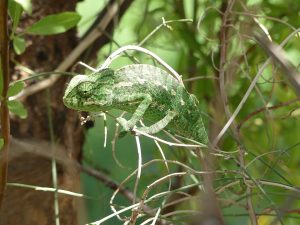
chameleon

This word appears in the list of unclean birds as well as in the list of lizards, and it seems quite clear that an owl and a reptile had the same name. Giving quite different creatures the same name is a common phenomenon in many languages. For instance, in English the word “cob” is used for a male swan as well as for a type of riding horse, and “sable” is the name of a small carnivorous animal as well the name of a large antelope; in Dutch “duiker” is the name of both the cormorant (a bird) and a type of antelope.

The Hebrew name tinshemeth is derived from a verb that means “to pant or to breathe loudly”. This makes it very likely that the reference is to the chameleon. When annoyed, hurt, or in danger, the chameleon turns black, inflates its large lungs, making itself look bigger, and then opens its mouth, puffing and hissing like a snake. See also tinshemeth / barn owl.

The Chameleon Chamaeleo chamaeleon is a very interesting lizard. It lives in vegetation. It is basically green but can change color to match its environment. It can become brown, pale yellow, or gray, and can vary the shade at different points of its body so as to become mottled or to have patches of dark and light color. This gives it good camouflage in vegetation. It is slow moving, often moving only one limb at a time in a series of wavering movements, mimicking the movement of twigs in the breeze. It has opposed claws on each foot, enabling it to hold very tight and to walk along thin twigs.

It has small scales and many small wart-like lumps on its tough skin. It has a row of pointed scales down its spine. Some species of chameleon have horn-like protrusions on their heads and faces.

The chameleon’s eyes are unique. It has an eyelid that completely covers the eye except for a small hole for the chameleon to see through. The chameleon can move this aperture around with each eyelid working independently of the other, and this enables it to look in two directions at once. It feeds on insects by catching them with its long, sticky, elastic tongue, which it flicks at the prey. The chameleon is also able to use its tail to wrap around twigs and other things to support itself when the wind blows or when climbing at a steep angle. It can hang by this tail from a twig or small branch and often uses this technique to move from a higher branch to a lower one.

It is listed as an unclean animal.

Chameleons are found all over Africa except in desert areas, and in some parts of tropical Asia. Where chameleons are not known, it may be necessary to borrow a word from the dominant language of the area, or from Hebrew, as Jerusalem Bible has done. A phrase such as “slow lizard” or “puffer lizard” is another option.

Chamaeleo chamaeleon, Wikimedia Commonsb

Source: All Creatures Great and Small: Living things in the Bible (UBS Helps for Translators)