
ebony

Ezekiel 27:15 reports traders who brought hovnim to Tyre. Coupled with ivory, the Hebrew word hovnim could have referred to either Asian or African products. In 1982 Zohary (Plants of the Bible. Cambridge University Press, 1982) stated that the identity of the hovnim in Ezekiel is unclear. He said that at best we can say that both Asian and African merchandise were shipped to Dedan, a Phoenician commercial center on the Arabian coast. Since then, however, Hepper (Baker Encyclopedia of Bible Plants, Baker Book House, 1992), who believes that trading with the Far East was less than many other scholars have alleged, has said that this tree is not the Asian Ebony Diospyros ebenum we know today but a leguminous tree Dalbergia melanoxylon, which grows all across Africa along the southern edge of the Sahara Desert. Evidence for this, he says, is that the Old Egyptian cognate hbny found in hieroglyphs refers to Dalbergia melanoxylon.

If hovnim are from Africa, they could be Dalbergia melanoxylon, as Hepper asserts, or one of the many species of the genus Diospyros found throughout the continent, such as Diospyros mespiliformis. The latter is a huge, widespread forest tree up to 35 meters (115 feet) tall. Dalbergia melanoxylon is a smaller, spiny tree reaching a height of 6‑7 meters (20‑23 feet). It inhabits the dry savanna areas from Ethiopia across to Senegal and as far south as southern Africa, where it is called “zebrawood.” The leaves are compound, with the leaflets nearly opposite one another on the spine. It has white flowers that hang in loose clusters, and around October they give way to flat, papery seedpods about 6 centimeters (2.5 inches) long and 1 centimeter (1/2 inch) wide. The Asian ebony, if that is what hovnim refers to, is found in India and Sri Lanka, grows to 10 meters (33 feet) tall, and has evergreen leaves. The inner part of the trunk is black, which makes it an attractive wood for carvers, who inlay the wood with ivory.

There are hundreds of species of ebony in tropical areas of the world (eighty in the Americas, ninety-four in Africa, and two hundred in Asia). In Africa the tree that produces most of the true ebony is Diospyros mespiliformis, which is found all the way from Senegal to the Red Sea and Arabia and southward to Southwest Africa and the Transvaal. In Nigeria it is called kanran or kanyan (Adamawa Fulfulde nelɓe). Surprisingly, both the Yoruba and Igbo Bibles in Nigeria have used eboni, perhaps reflecting the urbanization and Anglicization of those societies (or at least of the translators!). The Hausa word kanya correctly refers to the ebony tree. Diospyrus ebenum, found in India and Sri Lanka, might possibly have been on the world market in Bible times. A local word for this tree could be used in translations. If Hepper is correct, then the Dalbergia melanoxylon, locally known in Africa as “ebony” and also used for carving, should be used. Other transliteration possibilities are ebene (French) and ebenuz (Spanish).

Dalbergia species are also found in Central and South America under the names of palisander, kingwood, or tulipwood. A species in India is called blackwood or rosewood. In all these places the wood is used for radio cabinets, musical instruments, buttons, knife handles, chess pieces, and decorative carvings for tourists.

Dalbergia melanoxylon, photo by Nigel Hepper

Source: Each According to its Kind: Plants and Trees in the Bible (UBS Helps for Translators)

cypress

The Hebrew word berosh probably covered cypress, fir, and juniper; we are including here only those instances of berosh that possibly refer specifically to the cypress. The Cypress Cupressus sempervirens, native to Israel, was once common in the mountains of Judea. It also grew abundantly in Lebanon along with cedars, firs, and Grecian junipers. Cypresses also grew in Judea, Gilead and Edom, and do so up to the present day.

A comparison of English versions reflects the disagreement among scholars on the identification of the coniferous trees. For example, the Hebrew word berosh in 1 Kings 5:8 is translated as “cypress,” “pine,” “juniper,” or “fir.”

The disagreement here arises from the fact that berosh is probably a generic term, and it should probably be translated generically, if possible, or differently according to the context. We take the word berosh in 1-2 Kings and 2 Chronicles, where it is usually paired with ’erez (“cedar”) and/or Lebanon, to refer to the Cilician fir or to the Grecian juniper rather than to the cypress (see fir and Grecian juniper). In the few other places where it occurs, it may refer to any one of the three conifers. The logic here is that since cypresses grew in Judea, King Solomon would not need to import them from Lebanon. However, it could also be argued that Lebanon may have produced better specimens than King Solomon could find in Israel and he might have imported some of them. In either case, this does not argue against berosh as a generic term.

Closely related to the pines, firs and cedars, the cypress may reach 9-15 meters (30-50 feet) high. It has small scale-like leaves and round cones. The tall, narrow specimens that are common today in Israel and other countries are a modern variety (pyramidalis) that has been specially developed.

Cypress, photo by Ray Pritz
Cypress branch with seed cones, photo by Nigel Hepper

Source: Each According to its Kind: Plants and Trees in the Bible (UBS Helps for Translators)

cedar

Long ago the majestic cedars of Lebanon (Cedrus libani) completely covered the upper slopes of the Lebanon Mountains on the western and northern sides. Now only a few pockets of these mighty cedars remain. At that time they were mixed, as they are today, with other trees such as Cilician fir, Grecian juniper, cypress, and Calabrian pine.

We know from 1 Kings that Solomon used cedar wood in his palace and in the Temple. Cedar was used for beams, boards, pillars, and ceilings. Historians tell us that the Assyrians also hauled cedars to their land for use in buildings. Nebuchadnezzar of Babylon also imported cedars from Lebanon. In some versions of Isaiah we read that people made idols of cedar and oak (44:14-20). Finally, when the Temple was rebuilt by the returning exiles (Ezra 3:7), they again cut down cedar trees to grace the house of God.

In 2 Samuel, 1-2 Kings, 1-2 Chronicles and Ezra, when Lebanon is specifically mentioned, there can be no doubt that ’erez is Cedrus libani, the “cedar of Lebanon,” although it is possible that sometimes the word was used loosely to include various evergreen trees.

In the description of the purification rituals (Leviticus 14:4 at al.), the word ’erez probably refers to the Phoenician juniper tree, since that was the only cedar-like tree in the Sinai Desert.

Description  Cedar trees can reach 30 meters (100 feet) high with a trunk more than 2 meters (7 feet) in diameter. The leaves of true cedars are not flat like those of most trees, but consist of tufts of dark green, shiny spines. (The cedars in North America have a flatter type of spine than the biblical cedar.) The wood is fragrant and resistant to insects. Cedars bear cones and can live to be two or three thousand years old.

The cedar of Lebanon is famous for its large size (see Isaiah 2:13 et al.), and for the fragrance of its wood. Psalm 92:12 links the cedar to righteousness, that is, presumably, to its straightness and height above other trees. The cedar is the national emblem of Lebanon.

Cedrus species are found in the mountains of North Africa, in the Himalayas, in India, and in North America. Translators in these places, should, of course, use the local name in nonfigurative references. In sub Saharan Africa, translators can transliterate from Hebrew (’erez), Greek (kedar), English (sedar), or another major language, or they can take a generic solution such as “large, beautiful tree.” In poetic passages (wisdom literature and prophecy), some translators may wish to use a cultural equivalent with these traits. In Africa, according to Burkhill (The Useful Plants of West Tropical Africa, volume 4. Kew: Royal Botanic Gardens, 1985), the Pink Mahogany Guarea cedrata is also called the pink African cedar because of the cedar-like scent of its timber. Likewise, some people in India and Australia use “cedar” to refer to the toon because of its reddish wood. I do not recommend such substitutes in historical passages, since the ’erez is not related to these trees. In some figurative passages, however, the substitution could be effective, since all are large trees with reddish wood. However, each passage has to be evaluated to determine the intended effect of the image.

Cedar of Lebanon, Wikimedia Commons

Source: Each According to its Kind: Plants and Trees in the Bible (UBS Helps for Translators)

boxthorn

In the fable of the trees in Judges 9:14, all the trees come to ‘atad (in English Bible translations: thornbush or bramble) and ask it to become their king. Most scholars have generally agreed that this is probably a reference to the Boxthorn Lycium europaeum. Zohary (Plants of the Bible, Cambridge University Press, 1982) holds that it is more likely the Christ Thorn Ziziphus spina-christi. Both are thorny trees that are plentiful in the Near East, especially near Samaria in northern Israel, where Jotham, the teller of the fable, lived. The name “Christ thorn” (French couronne-du-Christ) reflects the tradition that this tree must also have been the source of the thorns that are referred to in the account of Christ’s crucifixion. The topic is widely debated, and there is little to confirm whether the “crown of thorns” came from this tree, or from one of many other prickly plants such as the thorny burnet, which is more common in the Jerusalem area. We advocate the majority opinion here, which is boxthorn (French lycie d’Europe).

The boxthorn tree grows to 5 meters (17 feet) tall, has small leaves forming an oval crown, and has very sharp thorns. The yellowish green flowers give way to edible fruits about the size of grapes or cherries.

The word associations in Jotham’s fable are by no means clear, but he appears to use the ’atad as a tree that is neither attractive nor very useful. Indeed, its fruit is barely edible, and it does not produce usable wood, or even effective shade, since the leaves are fairly small and sparse. The ’atad is thorny, but whether that is significant in the fable is not clear. If the tree represents Abimelech (see Abimelech’s downfall), most readers would probably agree that he was a thorny character.

Jotham’s fable, being an allegory, allows the option for translators to substitute rhetorically equivalent species for the olive, fig, grapevine, and boxthorn. However, there may be no single word for “boxthorn” in the receptor language, so translators will end up using a generic phrase like “thorn tree” or substituting a thorny local tree or shrub, probably the most common one in their area. A common problem is that languages often do not have names for plants that are not useful. If transliterations are needed, ‘atad can be used from Hebrew, or translators can use a transliteration from a major language for a related type of tree.

Boxthorn, photo by Ray Pritz
Boxthorn branch, photo by Ray Pritz

Source: Each According to its Kind: Plants and Trees in the Bible (UBS Helps for Translators)
acacia

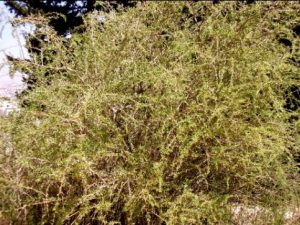
The plural form of shittah (shittim) is used sometimes as a place name (see Shittim), which is evidence of the wide distribution of this tree in Sinai and southern Palestine. The acacia referred to in the Bible was of two kinds, the Umbrella Thorn Acacia Acacia tortilis and the Common Acacia Acacia raddiana.

The Acacia tortilis is found in the hot Arabah Valley, whereas the Acacia raddiana tends to be found in cooler conditions throughout Sinai. A third variety (Acacia albida) is found in lowland Israel, the Sharon Plain, and lower Galilee. The common acacia was the only tree available to the Israelites for construction of the Tabernacle.

Both types of acacia are short, reaching 3-5 meters (10-17 feet) tall, but having a wide crown. As members of the Mimosa family, they have sharp spines, finely divided leaves, and tiny pale yellow flowers arranged in drooping bunches. The bean pod they produce is twisted and looped when dry.

Since the acacia is widespread in dry areas of Africa, Arabia, India and Australia, translators in those areas should be able to use a local word. In such languages a local species should be used, especially one that is used for building. Elsewhere, if none of these is available, the translator can transliterate from Hebrew (shittah) or from a major language, for example, sunt or talh (Arabic), akasiya (English/French/Spanish via Latin). West African translators need to beware of confusing “acacia” and “cassia,” a common tree with yellow flowers.

Acacia raddiana, photo by Ray Pritz
Acacia flowers, photo by Gloria Suesss

Source: Each According to its Kind: Plants and Trees in the Bible (UBS Helps for Translators)

all kinds of scented wood

The Thyine tree Tetraclinis articulata is also called “thuja” or “thuya,” and, confusingly, “citron” or “citrus” in different parts of the world. Similar to the well-known arborvitae, the thyine is found mainly in the Mediterranean area and across North Africa (Morocco, Algeria). It is a coniferous tree related to cypresses, pines, and cedars. Its identification in the book of Revelation is based on the Greek spelling, thuinos. In some places it is called the sandarac tree on the basis of the clear varnish (sandarac) that is made from the resin. The Romans, who used the wood for cabinet work, called it “citrus” for some strange reason, though apart from the yellow fruit, it bears no resemblance to true citrus trees.

The thyine can reach a height of 9 meters (30 feet). It has scaly leaves like cedars and cypresses, reddish brown bark, and sweet-smelling wood that is resistant to insects.

Tetraclinis articulata, Wikimedia Commons

Source: Each According to its Kind: Plants and Trees in the Bible (UBS Helps for Translators)

four-footed creatures and reptiles

The Greek that is translated as “four-footed creatures and reptiles” or similar in English is translated in Matumbi as “four-footed creatures and snakes,” since lizard-like creatures are already included in four-footed. (Source: Pioneer Bible Translators, project-specific notes in Paratext)

See also reptiles / creeping things.